S-1: General form for registration of securities under the Securities Act of 1933
Published on
As filed with the Securities and Exchange Commission on April 13, 2026.
Registration No. 333-
UNITED STATES
SECURITIES AND EXCHANGE COMMISSION
Washington, D.C. 20549
___________________________
FORM S-1
REGISTRATION STATEMENT
UNDER
THE SECURITIES ACT OF 1933
___________________________
Rare Earths Americas, Inc.
(Exact name of registrant as specified in its charter)
___________________________
Texas |
|
1000 |
|
39-4918133 |
|
(State or other jurisdiction of incorporation or organization) |
|
(Primary Standard Industrial Classification Code Number) |
|
(I.R.S. Employer Identification Number) |
|
101 W. Main Street
Manchester, GA 31816
(706) 846-5063
(Address, including zip code, and telephone number, including area code, of Registrant’s principal executive offices)
___________________________
Donald Swartz
Chief Executive Officer and President
Rare Earths Americas, Inc.
101 W. Main Street
Manchester, GA 31816
(706) 846-5063
(Name, address, including zip code, and telephone number, including area code, of agent for service)
___________________________
Copies to:
Era Anagnosti Andrew Ledbetter DLA Piper LLP (US) 500 Eighth Street, NW Washington, D.C. 20004 (202) 799-4000 |
|
|
|
James Guttman Dorsey & Whitney LLP TD Bank Tower 66 Wellington Street W, Suite 3400 Toronto, ON M5K 1E6 (416) 367-7370 |
___________________________
Approximate date of commencement of proposed sale to the public: As soon as practicable after the effective date of this Registration Statement.
If any of the securities being registered on this Form are to be offered on a delayed or continuous basis pursuant to Rule 415 under the Securities Act of 1933, check the following box. ☐
If this form is filed to register additional securities for an offering pursuant to Rule 462(b) under the Securities Act, please check the following box and list the Securities Act registration statement number of the earlier effective registration statement for the same offering. ☐
If this form is a post-effective amendment filed pursuant to Rule 462(c) under the Securities Act, check the following box and list the Securities Act registration statement number of the earlier effective registration statement for the same offering. ☐
If this form is a post-effective amendment filed pursuant to Rule 462(d) under the Securities Act, check the following box and list the Securities Act registration statement number of the earlier effective registration statement for the same offering. ☐
Indicate by check mark whether the registrant is a large accelerated filer, an accelerated filer, a non-accelerated filer, a smaller reporting company, or an emerging growth company. See the definitions of “large accelerated filer,” “accelerated filer,” “smaller reporting company,” and “emerging growth company” in Rule 12b-2 of the Exchange Act.
Large accelerated filer |
|
☐ |
|
Accelerated filer |
|
☐ |
Non-accelerated filer |
|
☐ |
|
Smaller reporting company |
|
☒ |
|
|
|
|
Emerging growth company |
|
☒ |
If an emerging growth company, indicate by check mark if the registrant has elected not to use the extended transition period for complying with any new or revised financial accounting standards provided pursuant to Section 7(a)(2)(B) of the Securities Act. ☐
The Registrant hereby amends this registration statement on such date or dates as may be necessary to delay its effective date until the Registrant shall file a further amendment which specifically states that this registration statement shall thereafter become effective in accordance with Section 8(a) of the Securities Act of 1933, as amended, or until the registration statement shall become effective on such date as the Securities and Exchange Commission, acting pursuant to said Section 8(a), may determine.
The information in this prospectus is not complete and may be changed. We may not sell these securities until the registration statement filed with the Securities and Exchange Commission is effective. This prospectus is not an offer to sell these securities and it is not soliciting an offer to buy these securities in any jurisdiction where the offer or sale is not permitted.
PRELIMINARY PROSPECTUS |
|
SUBJECT TO COMPLETION, DATED , 2026 |
Shares
Common Stock

RARE EARTHS AMERICAS, INC.
This is the initial public offering of shares of common stock of Rare Earths Americas, Inc. All of the shares of common stock are being sold by us.
Prior to this offering, there has been no public market for our common stock. It is currently estimated that the initial public offering price per share will be between $ and $ . We intend to apply to list our common stock on the NYSE American LLC (“NYSE American”) under the trading symbol “REA”.
We are an “emerging growth company” and a “smaller reporting company” as defined under the federal securities laws and, as such, have elected to comply with certain reduced public company reporting requirements for this prospectus and may elect to do so in future filings.
Investing in our common stock involves a high degree of risk. See the section titled “Risk Factors” beginning on page 11 to read about factors you should consider before buying shares of our common stock.
|
|
Per share |
|
Total |
|
||
Initial public offering price |
|
$ |
|
|
$ |
|
|
Underwriting discounts(1) |
|
$ |
|
|
$ |
|
|
Proceeds to us before expenses(2) |
|
$ |
|
|
$ |
|
|
____________
To the extent that the underwriters sell more than shares of common stock, the underwriters have the option to purchase up to an additional shares of common stock from us at the initial public offering price less the underwriting discount.
The underwriters expect to deliver the shares against payment in New York, New York on , 2026.
Neither the Securities and Exchange Commission nor any state securities commission has approved or disapproved of these securities or passed upon the accuracy or adequacy of this prospectus. Any representation to the contrary is a criminal offense.
Cantor Stifel
B. Riley Securities Canaccord Genuity
Prospectus dated , 2026
TABLE OF CONTENTS
|
|
|
Page |
|
|
1 |
|
|
|
6 |
|
|
|
8 |
|
|
|
9 |
|
|
|
11 |
|
|
|
42 |
|
|
|
44 |
|
|
|
46 |
|
|
|
47 |
|
|
|
48 |
|
|
|
50 |
|
Management’s Discussion and Analysis of Financial Condition and Results of Operations |
|
|
52 |
|
|
64 |
|
|
|
95 |
|
|
|
127 |
|
|
|
134 |
|
|
|
144 |
|
|
|
146 |
|
|
|
148 |
|
|
|
153 |
|
Material U.S. Federal Income Tax Consequences to Non-U.S. Holders |
|
|
155 |
|
|
159 |
|
|
|
170 |
|
|
|
170 |
|
|
|
170 |
|
|
|
F-1 |
“REA,” “Rare Earths Americas,” the “Rare Earths Americas” logo, and other trademarks, trade names, or service marks of Rare Earths Americas, Inc. appearing in this prospectus are the property of Rare Earths Americas, Inc. All other trademarks, trade names, and service marks appearing in this prospectus are the property of their respective owners. Solely for convenience, the trademarks and trade names in this prospectus may be referred to without the ® and ™ symbols, but such references should not be construed as any indicator that their respective owners will not assert their rights thereto.
Neither we nor the underwriters have authorized anyone to provide you with any information or to make any representations other than those contained in this prospectus or in any free writing prospectuses prepared by or on behalf of us or to which we have referred you. We and the underwriters take no responsibility for, and can provide no assurance as to the reliability of, any other information that others may give you. This prospectus is an offer to sell only the shares offered hereby, but only under circumstances and in jurisdictions where it is lawful to do so. The information contained in this prospectus or in any applicable free writing prospectus is current only as of its date, regardless of its time of delivery or any sale of shares of our common stock. Our business, financial condition, and results of operations may have changed since that date.
For investors outside the United States: Neither we nor the underwriters have done anything that would permit this offering or possession or distribution of this prospectus or any free writing prospectus we may provide to you in connection with this offering in any jurisdiction where action for that purpose is required, other than in the United States. You are required to inform yourselves about and to observe any restrictions relating to this offering and the distribution of this prospectus and any such free writing prospectus outside the United States.
i
PROSPECTUS SUMMARY
This summary highlights selected information contained in greater detail elsewhere in this prospectus. This summary is not complete and does not contain all of the information you should consider in making your investment decision. Before investing in our common stock, you should carefully read this entire prospectus, including the sections titled “Risk Factors,” “Special Note Regarding Forward-Looking Statements,” and “Management’s Discussion and Analysis of Financial Condition and Results of Operations” and our financial statements and the related notes included elsewhere in this prospectus. As used in this prospectus, unless the context otherwise requires, references to “we,” “us,” “our,” “the Company,” “REA,” “Rare Earths Americas” and similar references refer to Rare Earths Americas, Inc. together with its consolidated subsidiaries.
Overview
We are an exploration stage company advancing a portfolio of critical minerals projects focused on high-grade heavy rare earth mineral assets. Our work is aimed toward defining mineralization for our projects and increasing our understanding of its characteristics and economics. Our portfolio includes three material projects, which we believe positions REA as a future potential cornerstone of non-Chinese rare earth supply, aligning with Western industrial and national security priorities:
We also hold rights to several additional, currently not material, early-stage exploration projects, most notably our Homer Project located in Goiás, Brazil, and Liberty Peak located in Georgia, United States. The Homer Project hosts multiple large carbonatite clusters with potential for rare earth minerals and niobium considering the region contains
1
some of the world’s preeminent niobium mines. During the first quarter of 2026, we started an active drilling campaign at Homer, based on field work, sampling and prospecting work performed in 2024 and 2025. We control 1,233 km² of tenements in Brazil. Liberty Peak is a new discovery zone within the Shiloh Project area, with recent prospecting confirming monazite-sands at the surface. We recently completed an airborne geophysical and magnetic survey over approximately 500 km2 of Liberty Peak and plan to accelerate exploration at Liberty Peak throughout 2026, including land acquisition, future drilling, and opening of a satellite facility.
Our primary focus is on heavy rare earth elements, which are critical to high-performance permanent magnets used in robotics, defense applications, electric vehicles, wind power systems, renewable energy systems, and consumer electronics. We are currently in the exploration stage, with no revenue generated to date. Our objective is to systematically advance our portfolio—comprising the Shiloh Project, the Alpha Project, and the Constellation Project—from early exploration toward resource definition and, eventually, development.
Our projects are strategically positioned, with dual-jurisdiction exposure in the United States and Brazil, which aligns with growing initiatives in the U.S. and its cooperating nations to ensure diversified, secure rare earth elements supply chains.
Our Business Strategy
We intend to grow the value of our assets by:
We believe the long-term prospects for rare earth elements, more specifically heavy rare earth elements, continue to be strong, as described in more detail in the section titled “Business.” In part, this reflects the acknowledgment of the U.S. Government that critical minerals, including rare earth elements, are essential for national security and economic resilience and its policies to facilitate domestic mineral production, including by offering expedited permitting, reconsidering regulatory bottlenecks, and providing capital and technical assistance. We have assembled a team with extensive mining sector-related experience, including exploration, development, permitting, operations and capital markets, to execute our strategy and pursue the market opportunity available to us.
Corporate Information
We were incorporated in February 2025 under the laws of the Cayman Islands as “Rare Earths Americas Ltd.” We completed a redomestication transaction through the filing of a certificate of conversion, becoming a Texas corporation on October 15, 2025 (the “Redomestication”). Following the Redomestication, our name changed to “Rare Earths Americas, Inc.”
In July 2025, in two transactions, each contingent upon the completion of the other, we acquired our predecessor, Alpha Minerals Brazil Participações Ltda., a company organized under the laws of Brazil (“AMBPL” or “Predecessor”), and Foothills Rare Earths Limited, an Australian public unlisted corporation (“FRE Australia”). Consideration paid to the shareholders of AMBPL and FRE Australia consisted of shares of our common stock and warrants exercisable for shares of our common stock. REA and AMBPL were entities under common control at the acquisition date.
2
We operate and control our business and affairs through our wholly owned subsidiaries: AMBPL, FRE Australia, Foothills Rare Earths LLC (“FRE US”), and T.E. Liberty Holdings, LLC (“T.E. Liberty”).
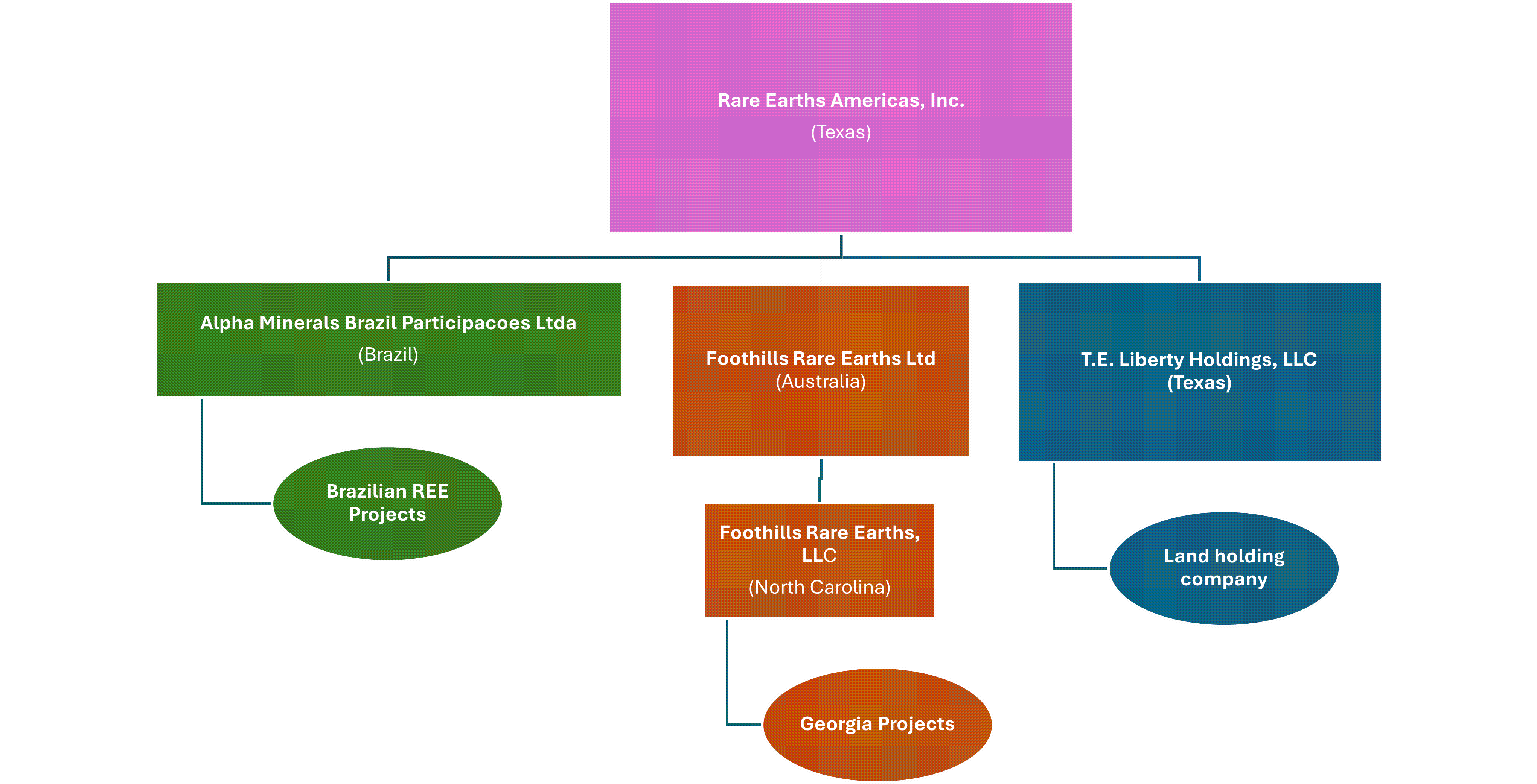
Our principal executive offices are located at 101 W. Main Street, Manchester, Georgia 31816. In support of our exploration activities, we also maintain field offices in the state of Georgia and in Brazil. Our corporate website is rareearthsamericas.com. Information contained on, or accessible through, our website shall not be deemed incorporated by reference and is not a part of this prospectus or the registration statement of which it forms a part. We have included our website in this prospectus solely as an inactive textual reference and do not intend it to be an active link to our website.
Risk Factors
Our business is subject to a number of risks of which you should be aware before making a decision to invest in our common stock. These risks are more fully described in the section titled “Risk Factors” immediately following this prospectus summary. These risks include, among others, the following:
3
Implications of Being an Emerging Growth Company and a Smaller Reporting Company
We qualify as an “emerging growth company” as defined in the Jumpstart Our Business Startups Act of 2012 (the “JOBS Act”). An emerging growth company may take advantage of relief from certain reporting requirements and other burdens that are otherwise applicable generally to public companies. These provisions include:
4
In addition, under the JOBS Act, emerging growth companies can delay adopting new or revised accounting standards until such time as those standards apply to private companies. We intend to avail ourselves of this exemption from new or revised accounting standards, and accordingly, we will not be subject to the same new or revised accounting standards as other public companies that are not emerging growth companies or that have opted out of using such extended transition period, which may make comparison of our financial statements with those of other public companies more difficult. We may take advantage of these reporting exemptions until we no longer qualify as an emerging growth company or, with respect to adoption of certain new or revised accounting standards, until we irrevocably elect to opt out of using the extended transition period.
We will remain an emerging growth company until the earliest of (i) the last day of the fiscal year in which we have total annual gross revenue of $1.235 billion or more; (ii) the last day of our fiscal year following the fifth anniversary of the date of the closing of this offering; (iii) the date on which we have issued more than $1 billion in nonconvertible debt during the previous three years; and (iv) the date on which we are deemed to be a large accelerated filer under the rules of the SEC. We may choose to take advantage of some but not all of these reduced reporting burdens.
We are also a “smaller reporting company,” meaning that the market value of our stock held by non-affiliates plus the proposed aggregate amount of gross proceeds to us as a result of this offering is less than $700.0 million and our annual revenue is less than $100.0 million during the most recently completed fiscal year. We may continue to be a smaller reporting company after this offering if either (i) the market value of our stock held by non-affiliates is less than $250.0 million or (ii) our annual revenue is less than $100.0 million during the most recently completed fiscal year and the market value of our stock held by non-affiliates is less than $700.0 million. If we are a smaller reporting company at the time we cease to be an emerging growth company, we may continue to rely on exemptions from certain disclosure requirements that are available to smaller reporting companies. Specifically, as a smaller reporting company we may choose to present only the two most recent fiscal years of audited financial statements in our Annual Report on Form 10-K and, similar to emerging growth companies, smaller reporting companies have reduced disclosure obligations regarding executive compensation.
5
THE OFFERING
Common stock offered by us |
|
shares |
Underwriters’ option to purchase additional shares of common stock |
|
We have granted the underwriters a 30-day option to purchase up to additional shares of common stock at the initial public offering price less the underwriting discounts. |
Common stock to be outstanding immediately after this offering |
|
shares ( shares if the underwriters exercise their over-allotment option in full). |
Use of proceeds |
|
We estimate that the net proceeds from this offering will be approximately $ million (or approximately $ million if the underwriters exercise in full their option to purchase up to additional shares of common stock), after deducting the underwriting discounts and estimated offering expenses payable by us. We intend to use the net proceeds from this offering as follows: • approximately $ million to fund land acquisition and option payments, drilling, metallurgical test work, permitting and S-K 1300 technical report summary preparation at our Shiloh Project. We plan to prioritize advancement of our Shiloh Project; • approximately $ million to fund exploration, evaluation, land consolidation, metallurgy, engineering and permitting studies at our Alpha Project; and • approximately $ million to fund exploration, evaluation, land option payments, metallurgy, engineering and permitting studies at our Constellation Project. We intend to use any remaining net proceeds for evaluating our non-material exploration projects, including Homer and Liberty Peak, as well as for working capital and other general corporate purposes. See the section titled “Use of Proceeds” for additional information. We may find it necessary or advisable to use the net proceeds for other purposes, and our management will have broad discretion in the application of the net proceeds, and investors will be relying on our judgment regarding the application of the net proceeds from this offering. |
Lock-up |
|
We have agreed, subject to certain exceptions and without the approval of Cantor, not to offer, issue, sell, contract to sell, encumber, grant any option for the sale of, or otherwise dispose of any of our securities for a period of 180 days following the closing of this offering. Our directors, executive officers, and a significant portion of all other holders of our common stock prior to this offering have agreed with the underwriters not to offer for sale, issue, sell, contract to sell, pledge or otherwise dispose of any of our common stock or securities convertible into common stock for a period of 180 days following the closing of this offering, subject to certain exceptions. See the section titled “Underwriting” for additional information. |
Risk factors |
|
See “Risk Factors” on page 11 and other information included in this prospectus for a discussion of factors to consider carefully before deciding to invest in our securities. |
Proposed NYSE American symbol |
|
REA |
The number of shares of our common stock to be outstanding after this offering is based on shares of common stock outstanding as of , 2026 and excludes:
6
Our 2026 Plan provides for annual automatic increases in the number of shares reserved thereunder. See the section titled “Executive Compensation—Equity Incentive Plans” for additional information.
Unless otherwise indicated, all information contained in this prospectus, including the number of shares of common stock that will be outstanding after this offering, assumes or gives effect to:
7
SUMMARY FINANCIAL DATA
The following tables set forth a summary of our historical financial data. The selected consolidated statements of operations data for the years ended December 31, 2025 and 2024, and the selected consolidated statements of cash flows data for the years ended December 31, 2025 and 2024 have been derived from our consolidated financial statements included elsewhere in this prospectus. Our historical results are not necessarily indicative of the results that may be expected in the future.
You should read the following summary financial data in conjunction with “Management’s Discussion and Analysis of Financial Condition and Results of Operations” and our financial statements and related notes included elsewhere in this prospectus. The summary financial data in this section are not intended to replace, and are qualified in their entirety by, the financial statements and related notes. Dollars presented in thousands, except per share data.
|
|
For the Year Ended December 31, |
|
|||||
|
|
2025 |
|
|
2024 |
|
||
|
|
|
|
|
|
|
||
Operating expenses: |
|
|
|
|
|
|
||
Exploration and evaluation expenses |
|
$ |
3,717 |
|
|
$ |
2,890 |
|
General and administrative expenses |
|
|
5,466 |
|
|
|
1,094 |
|
Depreciation expense |
|
|
25 |
|
|
|
6 |
|
Transaction costs |
|
|
247 |
|
|
|
— |
|
Total operating expenses |
|
|
9,455 |
|
|
|
3,990 |
|
Operating loss |
|
|
(9,455 |
) |
|
|
(3,990 |
) |
Other income (expenses): |
|
|
|
|
|
|
||
Interest income |
|
|
138 |
|
|
|
15 |
|
Interest expense |
|
|
(206 |
) |
|
|
— |
|
Foreign exchange gain |
|
|
31 |
|
|
|
— |
|
Loss on extinguishment of debt |
|
|
(577 |
) |
|
|
— |
|
Change in fair value of warrants |
|
|
139 |
|
|
|
— |
|
Total other (expenses) income |
|
|
(475 |
) |
|
|
15 |
|
Loss before income taxes |
|
|
(9,930 |
) |
|
|
(3,975 |
) |
Provision for income taxes |
|
|
— |
|
|
|
— |
|
Net loss |
|
|
(9,930 |
) |
|
|
(3,975 |
) |
Less: Net loss attributable to noncontrolling interest |
|
|
— |
|
|
|
— |
|
Net loss attributable to Rare Earths Americas, Inc. |
|
$ |
(9,930 |
) |
|
$ |
(3,975 |
) |
Net loss per common share, basic and diluted |
|
$ |
(0.85 |
) |
|
$ |
(0.46 |
) |
Weighted average common shares outstanding, basic and diluted |
|
|
11,744,438 |
|
|
|
8,674,507 |
|
|
|
Year Ended December 31, |
|
|||||
|
|
2025 |
|
|
2024 |
|
||
Other Financial Data (in thousands): |
|
|
|
|
|
|
||
Net cash used in operating activities |
|
$ |
(4,855 |
) |
|
$ |
(3,793 |
) |
Net cash provided by investing activities |
|
|
1,063 |
|
|
|
65 |
|
Net cash provided by financing activities |
|
|
26,547 |
|
|
|
3,311 |
|
8
GLOSSARY OF MINING AND OTHER TERMS
“Cut-off Grade” means a term used in S-K 1300 to describe the grade that determines the destination of the material during mining. For purposes of establishing “prospects of economic extraction,” the cut-off grade is the grade that distinguishes material deemed to have no economic value (it will not be mined in underground mining or if mined in surface mining, its destination will be the waste dump) from material deemed to have economic value (its ultimate destination during mining will be a processing facility).
“Deposit” means an accumulation of minerals.
“Development Stage” means a term used in S-K 1300 to describe a property that has mineral reserves disclosed but no material extraction.
“Exploration Stage” means a term used in S-K 1300 to describe a property that has no mineral reserves disclosed.
“Feasibility Study” means a term used in S-K 1300 to describe a comprehensive technical and economic study of the selected development option for a mineral project, which includes detailed assessments of all applicable modifying factors, as defined by S-K 1300, together with any other relevant operational factors, and detailed financial analysis that are necessary to demonstrate, at the time of reporting, that extraction is economically viable. The results of the study may serve as the basis for a final decision by a proponent or financial institution to proceed with, or finance, the development of the project.
“Indicated Mineral Resource” means a term used in S-K 1300 to describe that part of a mineral resource for which quantity and grade or quality are estimated on the basis of adequate geological evidence and sampling. The level of geological certainty associated with an indicated mineral resource is sufficient to allow a qualified person to apply modifying factors in sufficient detail to support mine planning and evaluation of the economic viability of the deposit. Because an indicated mineral resource has a lower level of confidence than the level of confidence of a measured mineral resource, an indicated mineral resource may only be converted to a probable mineral reserve.
“Inferred Mineral Resource” means a term used in S-K 1300 to describe that part of a mineral resource for which quantity and grade or quality are estimated on the basis of limited geological evidence and sampling. The level of geological uncertainty associated with an inferred mineral resource is too high to apply relevant technical and economic factors likely to influence the prospects of economic extraction in a manner useful for evaluation of economic viability. Because an inferred mineral resource has the lowest level of geological confidence of all mineral resources, which prevents the application of the modifying factors in a manner useful for evaluation of economic viability, an inferred mineral resource may not be considered when assessing the economic viability of a mining project, and may not be converted to a mineral reserve.
“Measured Mineral Resource” means a term used in S-K 1300 to describe that part of a mineral resource for which quantity and grade or quality are estimated on the basis of conclusive geological evidence and sampling. The level of geological certainty associated with a measured mineral resource is sufficient to allow a qualified person to apply modifying factors, as defined in S-K 1300, in sufficient detail to support detailed mine planning and final evaluation of the economic viability of the deposit. Because a measured mineral resource has a higher level of confidence than the level of confidence of either an indicated mineral resource or an inferred mineral resource, a measured mineral resource may be converted to a proven mineral reserve or to a probable mineral reserve.
“Mineralization” means the concentration of metals within a body of rock or the process by which such concentration occurs.
“Mineral Reserve” means a term used in S-K 1300 to describe an estimate of tonnage and grade or quality of indicated and measured mineral resources that, in the opinion of a qualified person, can be the basis of an economically viable project. More specifically, it is the economically mineable part of a measured or indicated mineral resource, which includes diluting materials and allowances for losses that may occur when the material is mined or extracted.
9
“Mineral Resource” means a term used in S-K 1300 to describe a concentration or occurrence of material of economic interest in or on the Earth’s crust in such form, grade or quality, and quantity that there are reasonable prospects for economic extraction. A mineral resource is a reasonable estimate of mineralization, taking into account relevant factors such as cut-off grade, likely mining dimensions, location or continuity, that, with the assumed and justifiable technical and economic conditions, is likely to, in whole or in part, become economically extractable. It is not merely an inventory of all mineralization drilled or sampled.
“Mining” means the extraction of valuable geological materials from the Earth.
“Probable Mineral Reserves” means a term used in S-K 1300 to describe the economically mineable part of an indicated and, in some cases, a measured mineral resource.
“Qualified Person” or “QP” means a term used in S-K 1300 to describe an individual who (1) is a mineral industry professional with at least five years of relevant experience in the type of mineralization and type of deposit under consideration and in the specific type of activity that person is undertaking on behalf of us; and (2) is an eligible member or licensee in good standing of a recognized professional organization that meets certain criteria specified under S-K 1300.
“Recovery” means that portion (usually expressed as a percentage) of the metal contained in mineralized material that is successfully extracted by processing.
“Sampling” means selecting a fractional part of a mineral deposit for analysis.
“Sediment” means solid fragmental material that originates from weathering of rocks and is transported or deposited by air, water, or ice, or that accumulates by other natural agents, such as chemical precipitation from solution or secretion by organisms, and that forms in layers on the earth’s surface at ordinary temperatures in a loose, unconsolidated form.
“S-K 1300” means subpart 1300 of Regulation S-K, promulgated by the U.S. Securities and Exchange Commission, which sets forth the rules and regulations for disclosure by registrants engaged in the mining industry.
“Technical Report Summaries” means, collectively, the technical report summaries for each of the Shiloh Project, Alpha Project and Constellation Project, in accordance with S-K 1300, filed as Exhibits 96.1, 96.3 and 96.2, respectively, to this registration statement, of which this prospectus forms a part.
“TREO” means total rare earth oxides.
10
RISK FACTORS
In addition to the other information contained in this prospectus, including the matters addressed under the heading “Special Note Regarding Forward-Looking Statements” and “Market and Industry Data,” you should carefully consider the following risk factors, together with all of the other information included in this prospectus, including the financial statements and notes to the financial statements included herein, before deciding whether to invest in our common stock. The risk factors described below disclose the material risks, but are not intended to be exhaustive, and do not describe all of the risks we are facing or may face in the future. The occurrence of one or more of the events or circumstances described in these risk factors, alone or in combination with other events or circumstances, may have a material adverse effect on our business, financial condition, results of operations and prospects of, in which event the market price of our common stock could decline, and you could lose part or all of your investment. Additional risks not currently known to us or that we currently deem to be immaterial, or that are not identified because they are generally common to businesses, also may have a material adverse effect on our business, financial condition, results of operations or prospects. Because of the factors described in this section and elsewhere in this prospectus, as well as other factors affecting our businesses, financial condition, operating results, and prospects, past financial performance should not be considered a reliable indicator of future performance, and investors should not rely on historical trends to anticipate trends or results in the future.
Risks Related to Our Business
We are an exploration stage mining company with no operating history other than conducting limited exploratory activities, and there are no assurances that we will build successful business operations or ever produce minerals from any of our properties.
We are an exploration stage mining company, which means that we have no material property with mineral reserves disclosed. We do not currently operate any mines, and we do not have any direct or indirect interest in any active mining operations. Each of our three material mineral projects, the Shiloh Project, Alpha Project, and Constellation Project, is in an exploration stage and has never been mined for rare earth elements by us or by any prior owner. Additionally, we have several additional, currently not material, early-stage exploration projects, including our Homer Project and Liberty Peak. As a result, we have never produced revenue, and we have no operating history upon which to base estimates of future operating costs, capital expenditure needs, site remediation costs or other necessary investments. While our management team and board of directors have extensive combined mining sector-related experience, the Company has no experience in developing or operating a mine.
We may never be able to develop and produce minerals from a commercially viable mineral property. Although we continue systematic exploration of our properties, such as the Shiloh Project, results of these exploratory works are not yet available and there is no certainty that such results will be consistent with the earlier results disclosed herein.
Advancing our mineral properties to the development stage (which the SEC defines as the preparation of mineral reserves for extraction) will require significant capital and time, and successful commercial production from any mines will be subject to the additional risks associated with developing and establishing new mining operations and business enterprises including:
11
Our mining rights are subject to mineral rights purchase option agreements, and we may be unable to exercise such options.
Our wholly owned subsidiaries are party to various mineral rights purchase option agreements, pursuant to which we have been granted options to purchase and/or lease certain mining rights subject to, among other things, our payment of the applicable premiums and exercise prices, which are substantial. Therefore, our acquisition of certain mining rights depends on our ability to obtain adequate financial resources to pay the applicable exercise prices. In some instances, the payment of the exercise price shall be via the issuance of our shares, which issuance would dilute the ownership percentage of existing stockholders. We may not be able to successfully complete our planned exploration activities, establish mining operations or profitably produce rare earth elements at any of our current or future properties if we are unable to exercise such options. Please see the section titled “Business – Mining Rights” for a description of our mineral rights purchase option agreements. In addition, any impairment in the value of these mineral interests could negatively impact our business and cause the price of our common stock to decline.
We have no history of producing rare earth elements.
We have no history of producing rare earth elements. Our properties are all exploration stage properties in various stages of exploration and evaluation. Our Shiloh Project and our non-material exploration projects, including Homer and Liberty Peak, are all early-stage exploration projects and are not yet at the resource stage. Advancing properties from exploration into the development stage requires significant capital and time, and successful commercial production from a property, if any, will be subject to completing various studies through definitive feasibility, permitting and construction of the mines, processing plants, roads, and other related works and infrastructure. As a result, we are subject to all the risks associated with developing and establishing new mining operations and business enterprises including:
12
The costs, timing and complexities of exploration, development and construction activities may be increased by the location of our properties and demand by other rare earth elements exploration and mining companies. It is common in exploration programs to experience unexpected problems and delays during drill programs and, if warranted, development, construction and mine start-up. Accordingly, our activities may not result in profitable mining operations and we may not succeed in establishing mining operations or profitably producing rare earth minerals.
Mineral exploration is highly speculative and subject to an exceptionally high probability of failure.
The mineral exploration industry is characterized by significant risk and uncertainty. It is widely understood that many exploration programs are unsuccessful for a multitude of reasons including political environment, capital markets, lack of funding and government regulation.
The purpose of exploration is to demonstrate the dimensions, position and mineral characteristics of mineral deposits, estimate mineral resources, assess amenability of the deposit to mining and processing scenarios and estimate potential deposit value. Once mineralization is discovered, it may take several years from the initial exploration phases before production is possible, during which time the project may cease to be feasible. Substantial expenditures are required to establish proven and probable mineral reserves, to determine processes to extract the metals and, if required, to construct mining and processing facilities and obtain the rights to the land and resources required to develop the mining activities.
Development projects have no operating history upon which to base estimates of proven and probable mineral reserves and estimates of future operating costs. Estimates are, to a large extent, based upon the interpretation of geological data and modeling obtained from drill holes and other sampling techniques, feasibility studies that derive estimates of operating costs based upon anticipated tonnage and grades of material to be mined and processed, the configuration of the deposit, expected recovery rates, facility and equipment capital and operating costs, anticipated climatic conditions and other factors. As a result, actual operating costs and economic returns based upon development of proven and probable mineral reserves may differ significantly from those originally estimated. Moreover, significant decreases in actual or expected commodity prices may mean rare earth elements, once found, will be uneconomical to mine.
We have not yet established mineral reserves and hold exploration options that may not mature into viable operations. There is no guarantee that the properties contain economically extractable rare earth elements, or that we will be able to bring such properties to economic production.
Estimates that guide our development plans and anticipated financing needs with respect to our mineral projects may prove inaccurate or incomplete, which could adversely affect our ability to continue our exploration plans and to profitably produce rare earth elements at any of our properties.
Estimates that guide our development and financing plans are based on the interpretation of geological data, feasibility studies, anticipated climatic conditions and other factors. Any of the following events, among the other events and uncertainties described in this prospectus, could affect the accuracy of such estimates:
13
Inaccuracies in such estimates could adversely affect our ability to continue our exploration plans and to profitably produce rare earth elements at any of our current or future properties.
Any material changes in mineralization estimates and grades of mineralization will affect the economic viability of placing any projects into production.
Because we have not completed various studies and have not commenced actual production, mineralization estimates for our projects may require adjustments or downward revisions. Rare earth elements recovered in small scale tests may not be duplicated in large scale tests under on-site conditions or in production scale. Moreover, while we continue systematic exploration of our properties, such as the Shiloh Project, results of these exploratory works are not yet available, and may be significantly delayed due to the limited availability of laboratories to process and analyze assay results and there is no certainty that such results will be consistent with results disclosed in this prospectus.
The estimates contained in this prospectus have been determined and valued based on assumed future prices, cut-off grades and operating costs that may prove to be inaccurate. Extended declines in market prices for rare earth elements may render portions of our mineralization estimates uneconomic and result in reduced reported mineralization or adversely affect the commercial viability determinations we reach. Any material reductions in estimates of mineralization, or of our ability to extract this mineralization, could have a material adverse effect on our share price and the value of our properties.
We may be adversely affected by fluctuations in demand for, and prices of, magnet rare earth elements.
Because our potential revenue is, and will for the foreseeable future be, derived from the production and sale of rare earth elements, changes in demand for, and the market price of, and taxes and other tariffs and fees imposed upon magnet rare earth elements and their inputs could significantly affect our profitability. Our financial results may be significantly adversely affected by declines in the prices of magnet rare earth elements. Magnet rare earth elements prices may fluctuate and are affected by numerous factors beyond our control, such as interest rates, exchange rates, taxes, tariffs, inflation or deflation, fluctuation in the relative value of the U.S. dollar against foreign currencies on the world market, shipping and other transportation and logistics costs, global and regional supply and demand for magnet rare earth elements, potential industry trends, such as competitor consolidation or other integration methodologies, and the political and economic conditions of countries that produce and procure magnet rare earth elements. Furthermore, supply side factors have a significant influence on price volatility for critical and rare earth elements prices. Supply of rare earth elements is currently dominated by Chinese producers. The Chinese Central Government regulates production via quotas and environmental standards and has in the past and may continue to change in the future such production quotas and environmental standards. Periods of over supply or speculative trading of rare earth elements can lead to significant fluctuations in the market price of rare earth elements.
In contrast, extended periods of high commodity prices may create economic dislocations that may be destabilizing to rare earth elements supply and demand and ultimately to the broader markets. While some periods of high rare earth elements market prices generally are beneficial to our financial performance if we are producing rare earth elements, if ever, or if magnet rare earth elements prices rise in concert with such higher rare earth elements prices, strong rare earth elements prices, however, also create economic pressure to identify or create alternate technologies that ultimately could depress future long-term demand for magnet rare earth elements, and at the same time may incentivize development of competing mining properties.
The success of our business will depend, in part, on the growth of existing and emerging uses for magnet rare earth elements.
14
Our strategy is to produce and sell magnet rare earth elements, which are used in existing and emerging technologies, such as robotics, electric and hybrid vehicles, advanced air mobility, clean energy, consumer electronics and other high-growth, advanced motion technologies. The success of our business accordingly depends on the continued growth of these end markets and successfully commercializing magnet rare earth elements in such markets. If the market for these existing and emerging technologies does not grow as we expect, grows more slowly than we expect, or if the demand for our products in these markets decreases, then our business, prospects, financial condition and operating results could be harmed. In addition, the market for these technologies, particularly in the automotive and wind turbine industry, tends to be cyclical, which exposes us to increased volatility, and it is uncertain as to how such macroeconomic factors will impact our business.
A prolonged or significant economic contraction in the United States or worldwide could put downward pressure on market prices of magnet rare earth elements. Protracted periods of low prices for magnet rare earth elements could significantly reduce revenues and the availability of required development funds in the future. This could cause substantial reductions to, or a suspension of, magnet production operations, impair asset values and reduce our results of operations and financial condition.
Demand for our products may be impacted by demand for downstream products incorporating magnet rare earth elements, including robotics, hybrid and electric vehicles, wind turbines, medical equipment, military equipment and other high-growth, advanced motion technologies, as well as demand in the general automotive and electronic industries. Lack of growth or changes in these markets may adversely affect the demand for our products. Any unexpected costs or delays in the commercialization of magnet rare earth elements or any of our other expected products, or less than expected demand for the critical existing and emerging technologies that use magnet rare earth elements, could have a material adverse effect on our financial condition or results of operations.
An increase in the global supply of magnet rare earth elements or, dumping, predatory pricing and other tactics by our competitors or state actors may adversely affect our profitability.
The pricing and demand for magnet rare earth elements is affected by several factors beyond our control, including growth of economic development and the global supply and demand for magnet rare earth elements. China is projected to continue to account for a substantial portion of global magnet rare earth elements production in the near future. China dominates the manufacture of metals and magnet rare earth elements, capabilities that are not currently materially present in the United States, and the Chinese Central Government regulates production via quotas and environmental standards. Over the past few years, there has been significant restructuring of the Chinese markets in line with China Central Government policy. Assuming that we reach production of magnet rare earth elements and other planned downstream products and subsequently become fully operational and integrated, increased competition may lead our competitors to engage in predatory pricing or other behaviors designed to inhibit our further downstream integration. Any increase in the amount of magnet rare earth elements or related products available in the market, including those exported from other nations, would result in increased competition and may result in price reductions, reduced margins or loss of potential market share, any of which could materially adversely affect our profitability. As a result of these factors, we may not be able to compete effectively against current and future competitors.
A shortage of equipment, supplies and qualified personnel could adversely affect our ability to operate our business.
We are dependent on various supplies and equipment to carry out our mining exploration and, if warranted, development operations. The shortage of such supplies, equipment and parts could have a material adverse effect on our ability to carry out our operations and therefore limit or increase the cost of production.
Suitable infrastructure may not be available or damage to existing infrastructure may occur.
Exploration activities depend on adequate infrastructure. Reliable roads, bridges, port and/or rail transportation, power sources, water supply and access to key consumables are important determinants for capital and operating costs. The lack of availability on acceptable terms or the delay in the availability of any one or more of these items could prevent or delay exploration, development or exploitation of our projects. If adequate infrastructure is not available in a timely and cost-effective manner, the exploitation or development of our projects might not be commenced or completed on a timely basis, or at all, the resulting operations might not achieve the anticipated production volume and the construction costs and operating costs associated with the exploitation and/or development of our projects might be higher than anticipated. In addition, extreme weather phenomena, sabotage, vandalism, government, non-governmental organization and community or other interference in the maintenance or provision of such infrastructure could adversely affect our business, results of operations, financial condition or prospects.
15
Diminished access to water may adversely affect our operations.
Exploration and eventual processing of rare earth elements requires significant amounts of water. Any disruption in the process or loss of access to adequate water sources could prompt the need for significant access to fresh water. Additionally, once we complete the pending projects, we will require an even greater amount of water for our separation and extraction operations, including additional fresh water. In addition, water usage, including extraction, containment, and recycling, requires appropriate permits, which are granted by respective regulatory authorities in Brazil and the United States. The available water supply may be adversely affected by shortages or changes in governmental regulations. We cannot assure stockholders that water will be available in sufficient quantities to meet our future production needs or will prove sufficient to meet our water supply needs. In addition, we cannot assure stockholders that we will maintain our existing licenses related to water rights, particularly if political changes lead to additional regulatory requirements or review of existing licenses. A reduction in our water supply could materially adversely affect our business, results of operations and financial position. In addition, if we are unable to obtain the necessary licenses with respect to water use, we may be prevented from pursuing some of our planned expansion projects.
We depend on key personnel for the success of our business. We may be unable to attract and retain qualified mining and technical personnel, which could materially and adversely affect our business and the execution of our strategic plans.
We highly value and depend on the contributions of our senior management and key personnel, particularly our experts with respect to rare earth elements production. Our success continues to depend largely upon the performance of key officers, employees and consultants who have advanced us to our current stage and contributed to our potential for future growth. The mining industry in the United States faces a significant and growing shortage of skilled personnel, including qualified mining engineers, geologists, metallurgists, and experienced technical staff. The U.S. mining workforce has a high average age, and a substantial number of experienced professionals are expected to retire in the coming years. At the same time, enrollment in university and college mining engineering and geology programs has been in a long-term decline, leading to a limited pipeline of new talent.
Our ability to execute our exploration, development, and operational plans depends on our capacity to attract, hire, and retain individuals with the necessary technical skills and experience. As a result of this industry-wide shortage, we face increased competition for talent, which may require us to offer higher compensation packages or face delays in hiring. We may also be required to seek talent from foreign jurisdictions, which could be subject to visa and other immigration-related restrictions. We may not be able to replace our senior management or key personnel (including personnel that are key to rare earth elements production) with persons of equivalent expertise and experience within a reasonable period of time or at all if one or more of our senior management and key personnel are not retained, and we may incur additional expenses to recruit, train and retain additional personnel. Any prolonged inability to retain key individuals, or to attract and retain new talent as we grow, could have a material adverse effect upon our growth potential and prospects. Additionally, we have not purchased any “key-man” insurance for our directors, officers or key employees.
The loss of key personnel or our inability to find suitable replacements in a timely manner could:
If we are unable to successfully attract and retain a sufficient number of qualified employees, it could have a material adverse effect on our business, financial condition, and results of operations.
We may enter into contracts with government entities, which may expose us to greater risks than contracts with non-government entities.
16
We may enter into contracts with government entities. The terms of such contracts are often non-negotiable and may expose us to greater commercial, political and operational risks than we would assume in other contracts, such as, for example, exposure to materially greater environmental liability, personal injury and other claims for damages (including consequential damages), or the risk that the contract may be terminated by the government entity without cause on short-term notice, contractually or by governmental action, under certain conditions that may not provide us with an early termination payment. Should we enter into such contracts, we can provide no assurance that the increased risk exposure will not have an adverse impact on our future operations.
Risks Related to Our Financial Position and Capital Needs
As a newly public company with no revenue and operations, we will incur substantial operating losses for the foreseeable future and may never achieve or sustain profitability.
We may never achieve or sustain profitability. None of our mineral projects have commenced commercial production, and commercial production at our mineral projects will require significant capital and expenditures. To become and remain profitable, we must generate significant revenues at one or more of our mineral projects, which will require us to be successful in a range of challenging activities that are subject to numerous risks, including those set forth in this “Risk Factors” section. In addition, we may encounter unforeseen expenses, difficulties, complications, delays and other unknown factors that may adversely affect our revenues, expenses and profitability. Our failure to achieve or sustain profitability would depress our market value, could impair our ability to execute our business plan, raise capital or continue our operations and could cause you to lose all or part of your investment.
Our ability to fund mineral exploration and development depends on our ability to obtain additional financing, and we may be unable to do so on favorable terms, if at all.
Mineral exploration and development are capital-intensive activities. Specifically, the exploration and exploitation of reserves, mining and processing costs, the maintenance of machinery and equipment and compliance with applicable laws and regulations require substantial capital expenditures. We will be required to make substantial expenditures for the continued exploration and, if warranted, development of our mineral properties. Mining industry development projects typically require a number of years and significant expenditures before production can begin.
Our current financial resources are limited and will be insufficient to fund all planned exploration, development, and general administrative expenses. To continue operations, we will need to raise substantial additional capital through equity or debt financings in the future. The ability to secure this capital is subject to numerous factors, including the success of our exploration efforts, the general state of the capital markets, and investor sentiment toward the rare earth elements industry. There is no assurance that future financing will be available when needed or that it will be on terms that are not highly dilutive to existing shareholders. Mineral projects could experience unexpected problems and delays during development, construction and start-up. We may not be successful in obtaining the required financing or, if we can obtain such financing, such financing may not be on terms that are favorable to us. Any failure to obtain sufficient equity or debt financing for our operations on favorable terms could have a material adverse effect on our financial condition, results of operations, and prospects.
We may experience time delays, unforeseen expenses, increased capital costs, and other complications while developing our projects, these could delay the start of revenue-generating activities and increase development costs. If we establish the existence of mineral reserves in our ongoing projects in a commercially exploitable quantity, we will require additional capital in order to develop the properties into producing mines. If we cannot raise this additional capital, we will not be able to exploit any reserves, and our business could fail.
The production of rare earth elements and mineral exploration and mining by their nature involve significant risks and hazards, including potential for adverse environmental impacts, as well as industrial and mining accidents. These include, for example, occupational hazards, leaks, ruptures, explosions, chemical spills, seismic events, fires, cave-ins and blockages, flooding, discharges of gasses and toxic substances, contamination of water, air or soil resources, unusual and unexpected rock formation affecting mineralization or wall rock characteristics, ground or slope failures, rock bursts, wildfires, radioactivity and other accidents, incidents, or conditions resulting from mining or manufacturing activities, including, among others, blasting and the transport, storage and handling of hazardous materials. These operations can be dangerous and safety incidents in these operations may cause damage to and loss of equipment, injury or death, monetary losses and potential legal liabilities. Any such incidents could have a material
17
adverse effect on our business, operating results and financial condition. Furthermore, there is the risk that relevant regulators may impose fines and work stoppages for non-compliant production or mining operating procedures and activities, which could reduce or halt production or mining until lifted. The occurrence of any of these events could delay or halt production, increase production costs and result in financial and regulatory liability for us, which could have a material adverse effect on our business, results of operations and financial condition. In addition, the relevant environmental authorities have issued and may issue administrative directives and compliance notices in the future, to enforce applicable statutes or regulations which may require us to implement, maintain, or complete specific environmental assessment, protection or remediation measures. The authorities may also order the suspension of part, or all, of our operations if there is non-compliance with applicable laws or regulations. Contravention of some of these statutes or rules may also constitute a criminal offense and an offender may be liable for a fine or imprisonment, or both, in addition to administrative penalties. As a result, the occurrence of any of these events may have a material adverse effect on our business, results of operations and financial condition.
We have no operating history on which to evaluate our business and performance, and accordingly, our prospects must be considered in light of the risks that any new company encounters.
We were re-incorporated under the laws of the State of Texas, effective as of October 15, 2025. We have never generated any revenue from operations, our mineral properties are in the exploration stage, and we have never produced minerals in commercial quantities from any of our mineral properties. We face many risks common to early-stage enterprises, including under-capitalization, cash shortages and limitations with respect to personnel and other resources. The likelihood that in the future we will generate a level of revenue to achieve and sustain profitable operations must be considered in light of the early stage of our operations.
There is no assurance that any of our mineral properties will ultimately produce minerals in commercially viable quantities or otherwise generate operating earnings. Advancing our mineral properties into the development stage will require significant capital and time, and successful commercial production from any mines on such properties will require us to complete feasibility studies to estimate the anticipated economic returns of a project, obtain adequate financing, obtain various permits, construct processing plants and infrastructure, and complete other activities. We may not succeed in establishing mining operations or profitably producing metals at any of our current or future properties.
A non-U.S. holder may be treated as having income that is “effectively connected” with a United States trade or business upon the sale or other taxable disposition of our common stock unless (i) our common stock is regularly traded on an established securities market and (ii) such non-U.S. holder did not meet certain ownership thresholds during the applicable testing period.
A Non-U.S. Holder (as defined below) of our common stock generally will incur U.S. federal income tax on any gain realized upon a sale or other disposition of our common stock to the extent our common stock constitutes a “United States real property interest” (“USRPI”) under the Foreign Investment in Real Property Tax Act of 1980 (“FIRPTA”). A USRPI includes stock in a “United States real property holding corporation” within the meaning of Section 897(c)(2) of the Code (a “USRPHC”). To our knowledge, we believe we currently are not a USRPHC. However, since the determination of whether we are or may become a USRPHC depends on the fair market value of our USRPIs relative to the fair market value of our non-U.S. real property interests and our other business assets, there can be no assurance we will not become one in the future.
Under the FIRPTA regime, a Non-U.S. Holder is taxed on any gain realized upon a sale or other disposition of a USRPI as if such gain were “effectively connected” with a United States trade or business of the Non-U.S. Holder. A Non-U.S. Holder thus will be taxed on such a gain at the same graduated rates generally applicable to U.S. persons. In addition, a Non-U.S. Holder will have to file a U.S. federal income tax return reporting that gain.
However, if our common stock is regularly traded on an established securities market (the “Regularly Traded Exception”), then gains realized upon a sale or other disposition of the common stock will not be treated as gains from the sale of a USRPI, as long as the Non-U.S. Holder owned, actually and constructively, 5% or less of our common stock throughout the shorter of the five-year period ending on the date of the sale or other taxable disposition or the Non-U.S. Holder’s holding period. It is uncertain whether a trading market for our securities may develop and whether our common stock will be regularly traded for purposes of the Regularly Traded Exception (see also our “There has
18
been no public market for our common shares prior to this offering, and an active market in which investors can resell their shares may not develop“ risk factor on page 28 of this prospectus). Accordingly, we can provide no assurances that the common stock will meet the Regularly Traded Exception at the time a Non-U.S. Holder purchases such security or sells, exchanges, or otherwise disposes of such security. The foregoing summary is qualified in its entirety by the discussion contained herein under the heading “Material U.S. Federal Income Tax Consequences to Non-U.S. Holders”.
Non-U.S. Holders should consult their own tax advisors regarding the potential application of the FIRPTA regime to their investment in our common stock.
We may experience increased costs at our mineral properties which could have a material adverse effect on our business, financial condition, results of operation and prospects.
The costs of exploring and developing our mineral properties will be subject to variation from time to time due to a variety of factors including
Costs are also affected by the price of commodities necessary for our operations such as fuel, steel, water, and electricity. Such commodities may be subject to volatile price movements, including increases that could make production at certain operations less profitable. A material increase in costs at any of our four material mineral projects could have a material negative impact on our business, financial condition, results of operation and prospects.
Risks Related to the Rare Earth Elements Mining Industry
The mining industry is highly competitive.
The mining industry is highly competitive. Much of our competition will come from larger and more established mining companies that have greater resources than us, including more executive management and administrative personnel, more qualified employees, newer and more efficient equipment, lower cost structures, greater liquidity and access to credit and other financial resources, more effective risk management policies and procedures, and greater financial resources allowing for a greater ability to explore and develop mining properties and withstand potential losses. As a result of such advantages, some of our competitors may be able to (i) respond more quickly to new laws, regulations or emerging technologies, (ii) devote greater resources to the operation, expansion or efficiency of their operations, and (iii) expend greater amounts of resources, including capital, in acquiring new and prospective mining properties. In addition, current and potential competitors may make strategic acquisitions or establish cooperative relationships among themselves or with third parties; and the resulting competitors or alliances may gain significant market share to our detriment. We may not be able to compete successfully against current and future competitors, and any such failure to compete successfully could have a material adverse effect on our business, financial condition or results of operations.
China has historically been the largest producer of rare earth elements, controlling a significant portion of the global output, and as a significant player, China possesses great leverage in dealing with competitors in the industry, by among other things, manipulating pricing, processing speed and other factors.
19
China controls a substantial majority of the world’s rare earth elements production. China’s rare earth elements industry benefits from extensive government support, allowing Chinese companies to offer rare earth elements at subsidized prices, often undercutting other producers. Moreover, Chinese companies have invested heavily in improving their processing capabilities, giving them a technological and cost advantage in the global market. Since December 2023, China has banned the export of such technologies and capabilities. While geopolitical friction and U.S. tariff measures have tightened the pressure on China’s rare earth supply-chain leading position, weakening or displacing China’s preeminence in the sector will demand sustained, coordinated action and significant investment over an extended horizon.
Mining and mineral exploration is inherently dangerous and subject to conditions or events beyond our control, which could have a material adverse effect on our business and plans.
Mining and mineral exploration involves various types of risks and hazards, including:
These risks could result in damage to, or destruction of, our projects, production facilities or other properties, personal injury, environmental damage, delays in mining, increased production costs, monetary losses and possible legal liability. We may not be able to obtain insurance to cover these risks at economically feasible premiums. Insurance against certain environmental risks, including potential liability for pollution or other hazards as a result of the disposal of waste products occurring from production, may be prohibitively expensive. We may suffer a material adverse effect on our business if we incur losses related to any significant events that are not covered by our insurance policies.
Permitting, licensing and approval processes are required for our operations and obtaining and maintaining required permits and licenses is subject to conditions which we may be unable to achieve.
Both mineral exploration and extraction at our projects require permits from various federal, state, provincial and local governmental authorities and are governed by laws and regulations, including those with respect to prospecting, mine development, mineral production, transport, export, taxation, labor standards, occupational health, waste disposal, toxic substances, land use, environmental protection, mine safety and other matters. Please see the sections titled “Properties – Shiloh Project,” “Properties – Alpha Project,” and “Properties – Constellation Project” for a description of the permits known to be required. Such licenses and permits are subject to changes in regulations and changes in various operating circumstances. Companies such as ours that engage in exploration activities often experience increased costs and delays in production and other schedules because of the need to comply with applicable laws, regulations and permits. Issuance of permits for our activities is subject to the discretion of government authorities,
20
and we may be unable to obtain or maintain such permits. Permits required for future exploration or development may not be obtainable on reasonable terms or on a timely basis. There can be no assurance that we will be able to obtain or maintain any of the permits required for the continued exploration or development of our projects (or any other mineral properties that we may subsequently acquire) or for the construction and operation of a mine on our properties that we may subsequently acquire at economically viable costs. If we cannot accomplish these objectives, our business could face difficulty and/or fail.
There may be defects in our rights under the mining claims that comprise our properties, and such defects could impair our ability to explore for mineralized material and to otherwise develop such properties.
The mining claims we rely on at our mineral properties may be challenged, and we may not have, or may not be able to obtain, the surface rights needed to explore for or develop any resources present at the property related to such claims. Unknown defects with respect to any of such claims could adversely affect our ability to explore and develop the property or process the minerals that we may ultimately mine at the applicable property. Title insurance for mineral properties is generally not available at a reasonable cost, and we may have limited ability to ensure that we have obtained valid rights to individual mineral properties. We rely on public records in Brazil with respect to our mining claims. However, any challenge to our rights in a concession could result in litigation, insurance claims and potential losses, hinder our access to capital, delay the exploration and development of the property and ultimately result in the loss of some or all of our interest in the related mineral project.
Mineral operations are subject to market forces outside of our control which could negatively impact our operations.
The marketability of minerals is affected by numerous factors beyond our control including market fluctuations, government regulations relating to prices, taxes, royalties, allowable production, imports, exports and supply and demand. One or more of these risk elements could have an impact on the costs of our operations and if significant enough, reduce the profitability of our operations.
Volatility in commodity markets may impair our financial results and access to capital.
Prices for minerals constantly fluctuate, and if the prices of rare earth elements (the primary minerals for which we are exploring) experience sudden or protracted declines, our exploration activities for those minerals may become unattractive and we may discontinue those activities. Prices of minerals are determined by a variety of factors, including market volatility in commodities prices; the exchange rate between the Brazilian Real and the U.S. Dollar; global and regional supply and demand; and changes or volatility in political and economic conditions and production costs in major mineral producing regions of the world.
Changes in government policies or funding priorities for rare earth elements and critical minerals could reduce or eliminate incentives, grants, or programs we rely on, adversely affecting development of our mineral projects and demand for our products.
Government policies regarding rare earth elements and critical minerals are subject to frequent changes based on national security priorities, supply chain assessments, and political considerations. Changes to critical minerals lists, or government funding priorities related to commercial facilities for the mining or manufacturing of rare earth elements or critical minerals, could affect our eligibility for government incentives, grants, or preferential treatment in government procurement. The modification of programs such as the Defense Production Act, the Infrastructure Investment and Jobs Act, or the Inflation Reduction Act could impact available funding, tax incentives, or regulatory streamlining that we currently benefit from or expect to benefit from in the future. Additionally, changes in government priorities or budget constraints could further result in the elimination or reduction of programs that support domestic rare earth elements and critical mineral production and processing. Further, cooperating nations’ governments may decrease support for rare earth elements and critical minerals, which could also adversely impact demand for our products and/or may pose permitting, financing and other risks for developing our projects.
Risks Related to Our Operations in Brazil
Changes in U.S. trade policy, including the imposition of tariffs on goods from Brazil, could materially and adversely affect our business and financial results.
21
Our operations in Brazil, including export of rare earth elements, are or could become subject to changes in U.S. trade policy. In 2025, the U.S. presidential administration imposed new tariffs on a wide range of imports from Brazil, citing various national security, economic, and foreign policy concerns. For example, on July 30, 2025, President Trump signed an executive order imposing an additional 40% tariff on certain Brazilian goods, bringing the cumulative duty to as high as 50% for many products.
In February 2026, the U.S. Supreme Court issued a ruling striking down certain tariffs previously imposed under the International Emergency Economic Powers Act (“IEEPA”), including the 40% additional tariff on most imports from Brazil. Following the Supreme Court’s decision, the U.S. presidential administration announced its intention to invoke other laws to collect tariffs and announced new tariffs on imports from all countries, in addition to any existing non-IEEPA tariffs. There remains substantial uncertainty regarding the duration of existing and newly announced tariffs, potential changes or pauses to such tariffs, tariff levels, and whether further additional tariffs or other retaliatory actions may be imposed, modified, or suspended, and the impacts of such actions on our business.
The imposition of new or increased tariffs on these products could:
Any of these factors could have a material adverse effect on our business, financial condition, and results of operations.
Our ability to respond to market fluctuations may be limited by labor regulations and union agreements in Brazil, which could materially adversely affect our financial performance.
We will likely have a significant number of employees in Brazil upon reaching construction and production who could be members of labor unions and covered by collective bargaining agreements. Labor relations in Brazil are governed by a complex framework of laws and regulations, in addition to the terms of these agreements. As a result, our ability to implement cost-cutting measures, such as reducing our workforce or adjusting compensation, during periods of weak demand may be limited by labor regulations or existing collective bargaining agreements. Conversely, during periods of high demand, our ability to rapidly increase production capacity may be constrained by these same regulations and agreements. We may also be subject to labor disputes, strikes, work stoppages, or other industrial actions that could disrupt our operations, result in a loss of production, and negatively impact our financial results. Any such events could have a material adverse effect on our business, financial condition, and results of operations.
Our reliance on a shared services arrangement with third-party individuals in Brazil, rather than directly managing our own employees, may expose us to operational, compliance, and legal risks.
We have entered into a shared services agreement with certain individuals in Brazil to provide services to our Brazilian entities. Unlike our own employees, over whom we exercise direct management and supervision, we have limited direct control over these individuals. Our ability to ensure their compliance with our policies, procedures, and legal obligations, including those related to anti-corruption, anti-bribery, and data privacy, relies on the terms of our contractual arrangement and their adherence to our instructions. The individuals providing these services are not our employees, and we have a more limited ability to train, monitor, and enforce compliance than we would with a traditional employment relationship.
Any failure by these third-party individuals to perform their services adequately, to adhere to our standards, or to comply with applicable laws could result in operational disruption, financial loss, and damage to our reputation. In
22
particular, we could be held liable for any improper acts committed by these individuals, which could subject us to significant fines, penalties, and other sanctions under a range of legal frameworks, including the U.S. Foreign Corrupt Practices Act and Brazil’s “Clean Company Act.” While we have contractual provisions intended to mitigate these risks, there can be no assurance that they will be sufficient or that we will be able to enforce them effectively. A failure to properly manage this shared services arrangement could have a material adverse effect on our business, results of operations, and financial condition.
Health, Safety, Environmental and Social Risks
Our business presents environmental, health, and safety risks and hazards.
The viability of our business is connected to our ability to protect the well-being of the environment, workers, and communities in which we operate. Inherent in our operations are various physical, chemical, biological, ergonomic, and accident hazards and risks, such as those associated with mobile equipment, vehicles or machinery, and the use or proximity to other industrial equipment. These risks include exposure to hazardous materials, accidents involving heavy machinery, vehicle collisions, falls, fires, explosions, and other incidents that may result in serious injury or death. Such events can occur due to deficiencies in risk identification and assessment or in the implementation of controls associated with risk management. The occurrence of any of the foregoing could result in property damage, loss of production or production delays, harm to employees, contractors, or community members, financial losses, reputational harm, and potential legal or regulatory liability. Additionally, our employees and contractors may also be exposed to infectious diseases or other health hazards that can affect their health and safety.
While we have established corporate standards, policies, controls, and monitoring procedures to mitigate such risks, our operations remain subject to incidents that could adversely impact our business, stakeholders, reputation, or result in violations of environmental laws or human rights. Additionally, our operations involve the use, handling, storage, discharge, and disposal of hazardous substances into the environment, as well as the use of significant natural resources such as water and energy. These activities can result in adverse impacts on people, flora and fauna, and the broader environment, including risks of fire, explosion, toxic gas leaks, spills or leaks of hazardous materials, rockfalls, incidents involving dams, failure of other operational structures. We could become subject to claims for toxic torts, natural resource damages and other damages as well as for the investigation and clean-up of soil, surface water, groundwater, and other media.
Any of the foregoing operational, environmental, health, or safety conditions could result in significant adverse environmental, social, health, or human rights impacts, and could adversely affect our business, financial condition, and results of operations. Additionally, under some circumstances, our liability for claims arising out of such matters may be joint and several, so that we may be held responsible for more than our share of the contamination or other damages.
Labor disputes in the United States may disrupt our operations from time to time.
We currently do not have a unionized workforce in the United States. While we believe we will not have a unionized workforce at our United States assets in the future, there is no guarantee that we will not face unionizing activity and ultimately have a unionized workforce in the United States. Strikes or other labor disruptions at any of our operations could adversely affect operational efficiency, delay project completion, and increase project costs. Additionally, our operations could be impacted by labor disputes affecting third-party suppliers that provide us with essential goods or services.
We are, or may become subject to, stringent environmental rules and regulations that may increase operational costs, affect profitability, and impose compliance requirements, and we may face claims and liability for incidents or breaches, or allegations of breaches, of applicable laws and regulations
Our current or future operations, including development activities and commencement of production on our properties, require permits from various federal, provincial and local governmental authorities, and such operations are and will be governed by laws and regulations governing prospecting, development, mining, production, exports, taxes, labor standards, occupational health, waste disposal, toxic substances, land use, environmental protection, mine safety and other matters. These associated requirements are extensive and require various institutional and procedural controls to prevent negative environmental, health, or safety consequences of our operations, including spills, releases or emissions of various substances produced in association with certain mining industry operations, such as seepage from tailings disposal areas, that could result in environmental contamination. The cost of compliance with changes in
23
governmental regulations has the potential to reduce the profitability of operations. Non-compliance with such legislation may result in the imposition of fines and penalties or lead to inspections, audits, or reviews by governmental authorities. The introduction of new regulations, amendments to existing requirements or stricter enforcement or interpretation of current laws, regulations and permitting requirements governing operations and activities of mining companies, could have a material adverse impact on us and cause increases in capital expenditures or production costs or reduction in levels of production at producing properties or require abandonment or delays in development of new mining properties. These risks may become more significant as our operations advance from the exploration phase.
In addition, certain types of operations require the submission and approval of environmental impact assessments. Environmental assessments of proposed projects carry a heightened degree of responsibility for companies and directors, officers and employees.
Mining operations and exploration activities may also require our company to obtain permits from various governmental agencies. There can be no assurance, however, that all permits that we may require for our operations and exploration activities will be obtainable on reasonable terms or on a timely basis or that such laws and regulations will not have an adverse effect on any mining project which we might undertake.
Failure to comply with applicable environmental, health, and safety laws, regulations, standards, or permitting requirements may result in litigation, fines, penalties, permit revocation, or other enforcement actions thereunder. This includes orders issued by regulatory or judicial authorities causing operations to cease or be curtailed, and may include corrective measures requiring capital expenditures, installation of additional equipment, or other remedial actions. Parties engaged in mining operations may be required to compensate those suffering loss or damage by reason of mining activities and may have civil or criminal fines or penalties imposed for violations of applicable environmental, health, and safety laws or regulations.
Natural disasters may cause severe damage to our operations and projects in the countries where we operate and may have a negative impact on our sales to countries affected by such disasters.
Natural disasters may adversely affect our operations, projects and people in the countries where we operate and may cause a contraction in sales to countries adversely affected due to, among other factors, power outages and the destruction of industrial facilities and infrastructure.
Climate change can impact the frequency and intensity of extreme events, both acute and chronic, including our neighboring communities, damage to our assets, operational interruptions, and supply chain disruptions. We assess the exposure to increased incidence and intensity of atmospheric discharges, changes in rainfall patterns, higher temperatures, floods, droughts, water shortages and sea level rise on assets such as ports, railways, mining facilities, and processing plants. Due to the complexity and uncertainties of physical risk evaluation process, there may be additional risks that are not currently known or assessed, and that could negatively affect our operations and projects. In recent years, we have occasionally determined that force majeure events occurred because of severe weather on our mining and logistics activities. Areas with lower ecological integrity (e.g., areas with reduced natural vegetation cover) are more susceptible to these risks due to lower resilience and protection against extreme weather conditions.
Our financial condition, results of operations, cash flows, and competitive position could be materially adversely impacted by pandemics, epidemics, or disease outbreaks.
Disruptions caused by pandemics, epidemics or disease outbreaks, could materially adversely impact our financial condition, results of operations, cash flows, and competitive position, particularly as it relates to rising costs and supply chain delays and disruptions. Measures taken by governmental authorities in response to such events may also impact our business, including upon restrictions to our operations, lockdowns, shutdowns, reduced inspections, assessments and authorizations, among other difficulties. We cannot predict when and if any such events will occur and evolve, neither their scope and duration, and therefore cannot estimate the potential impact in our financial condition, results of operations, cash flows and competitive position.
Our success depends on developing and maintaining relationships with the local communities and stakeholders where we operate.
Our ongoing and future success depends on developing and maintaining productive relationships with the communities surrounding our projects, including those people who may have rights or may assert rights to certain of our properties
24
and other stakeholders in our operating locations. Local communities and stakeholders may be dissatisfied with our activities or the level of benefits provided, which may result in legal or administrative proceedings, civil unrest, protests, direct action or campaigns against us. Any such occurrence could materially and adversely affect our business, financial condition or results of operations, as well as our ability to commence or continue exploration or mine development activities.
Legal, Political, Economic and Regulatory Risks
Our failure to comply with applicable anti-corruption, anti-bribery, anti-money laundering and similar laws and regulations could negatively impact our reputation and results of operations.
The legal and regulatory framework in which we operate is complex, and our governance and compliance policies and processes may not prevent potential breaches of law or accounting or other governance practices. Our operating and ethical codes, among other standards and guidance, may not prevent instances of fraudulent behavior and dishonesty, nor guarantee compliance with legal and regulatory requirements.
We are subject to anti-corruption laws and regulations imposed by governments around the world with jurisdiction over our operations, which includes our business in Brazil. These laws may include, but are not limited to, the U.S. Foreign Corrupt Practices Act (FCPA) and Brazil's "Clean Company Act" (Law No. 12,846/2013). The Brazilian law holds legal entities strictly liable for corrupt acts committed in their interest or benefit, meaning a company can be held responsible even if it did not have prior knowledge of the act.
These and other applicable laws prohibit us and our officers, directors, employees, and business partners acting on our behalf, including agents, from corruptly offering, promising, authorizing, or providing anything of value to "foreign officials" for the purposes of influencing official decisions or obtaining or retaining business or otherwise obtaining favorable treatment. Due to the nature of our operations in Brazil, our personnel and representatives may be brought into contact with "foreign officials" responsible for issuing or renewing permits, licenses, or approvals or for enforcing other governmental regulations.
Our failure to successfully comply with these laws and regulations may expose us to reputational harm, as well as significant sanctions. The Brazilian Clean Company Act, for instance, provides for severe penalties, including fines of up to 20% of a company's gross revenue, the prohibition from receiving public incentives, and even the potential for a company's dissolution. We may also face criminal fines, imprisonment, civil penalties, disgorgement of profits, and debarment from government contracts under the laws of other jurisdictions, such as the FCPA. Investigations of alleged violations can be expensive and disruptive to our business.
We continuously develop and maintain policies and procedures designed to comply with applicable anti-corruption, anti-bribery, anti-money laundering, and similar laws. However, there can be no guarantee that our policies and procedures will effectively prevent violations by our employees or business partners acting on our behalf, for which we may be held responsible, and any such violation could adversely affect our reputation, business, results of operations, and financial condition.
We are exposed to possible litigation risks, including permit disputes (including in respect of access and/or validity of tenure), environmental claims, occupational health and safety claims and employee claims.
We may become involved in, named as a party to, or be the subject of, various legal proceedings, including regulatory proceedings, tax proceedings and legal actions, relating to personal injuries, property damage, property taxes, land rights, the environment and contract disputes. For certain claims, our liability may be joint and several. Accordingly, we may be held responsible for more than our share of the claimed damages.
The outcome of outstanding, pending or future proceedings cannot be predicted with certainty and may be determined adversely to us and as a result, could have a material adverse effect on our assets, liabilities, business, financial condition or results of operations. Even if we prevail in any such legal proceeding, the proceedings could be costly, time-consuming and may divert the attention of management and key personnel from our business operations, which could adversely affect our financial condition.
Changes in China’s or the United States’ political environment and policies, including changes in export/import policy may affect our business in ways we are not able to anticipate or mitigate.
25
Because of the current dominance of China in the rare earth elements industry, the possibility of adverse changes in trade or political relations with China, political instability in China, increases in labor or shipping costs, the occurrence of prolonged adverse weather conditions or a natural disaster such as an earthquake or typhoon, or the outbreak of another global pandemic disease like COVID-19 could severely interfere with our industry and would have a material adverse effect on our operations.
Our sales may be adversely affected by the current and future political environment in China and the policies of the China Central Government. China could oversupply our markets in the United States and elsewhere with either cheaper magnet rare earth elements or rare earth elements or feedstock. China has historically heavily subsidized its domestic rare earth producers with respect to both rare earth feedstock and magnets. The United States government has called for substantial changes to foreign trade policy with China and has from time to time raised (as well as has proposed to further raise in the future), tariffs on several Chinese goods. China has at times retaliated with increased tariffs on United States goods, or the ban of exports of rare earth technologies and feedstock to other countries such as the United States. While some impacts of Chinese trade policy may be beneficial for our business, any changes in United States trade policy could trigger retaliatory actions by affected countries, including China, resulting in trade wars which could likely result in increased volatility in the prices of rare earth and critical minerals, necessary feedstock, and magnet rare earth elements. Furthermore, unless and until these dynamic changes in favor of the increased competitiveness of domestic production, domestic production may not be economically viable in the global market place. As China currently dominates the global supply of rare earth feedstock necessary for the production of magnet rare earth elements, any changes in United States and China relations, including through changes in policies by the Chinese government, could adversely affect our financial condition and results of operations, including: changes in laws, regulations or the interpretation thereof, confiscatory taxation, governmental royalties, restrictions on currency conversion, imports or sources of supplies, or the expropriation or nationalization of private enterprises.
Political, economic and social conditions in the countries in which we have operations projects, customers or suppliers, could adversely impact our business.
Our financial performance may be negatively affected by regulatory, political, economic and social conditions in countries in which we have significant operations or projects. In Brazil, we are exposed to various risks such as political instability, political movements for protectionism or for greater vertical integration of value chains, bribery, cyber-attacks, extortion, corruption, robbery, sabotage, kidnapping, civil strife, human rights violation, acts of war, guerilla activities, piracy in international shipping routes and terrorism. These issues may adversely affect the economic and other conditions under which we operate in ways that could have a material negative effect on our business.
In Brazil, where a significant part of our operations is concentrated, the federal government’s economic policies may have important effects on Brazilian companies, including our Brazilian subsidiary, AMBPL, and on market conditions and prices of securities of Brazilian companies. Our financial condition and results of operations may be adversely affected, for instance, by the following factors and the Brazilian federal government’s response to these factors:
26
Historically, the country’s political situation has influenced the performance of the Brazilian economy and political crises have affected the confidence of investors and the general public, which resulted in economic deceleration, and downgrading of credit ratings of the Brazilian government. Political instability may aggravate economic uncertainties in Brazil. Future economic, social and political developments in Brazil may impair our business, financial condition or results of operations, or cause the market value of our securities to decline.
Increased levels of volatility or a rapid destabilization of global economic and political conditions could have a material adverse effect on our operations and financial condition.
In recent years, global financial conditions have been characterized by increased volatility which has impacted many industries, including the mining industry. Global financial conditions are subject to sudden and rapid destabilization in response to current and future events, as governmental authorities may have limited resources to respond to such events. Global capital markets continue to experience increased volatility in response to global events such as the significant increase in the rate of inflation in recent years, and the effects of certain countermeasures taken by central banks including increased interest rates. Future economic crises may be precipitated by any number of causes, including geopolitical instability and war (such as the Russian invasion of Ukraine, the Israel-Palestine conflict and the Israel/U.S. conflict with Iran), natural disasters, epidemics, the failure of financial institutions, terrorism, material changes in the price of oil, the volatility of metal prices, and the volatility of global financial markets. Continued increased levels of volatility or a sudden or rapid destabilization of global economic and political conditions could negatively impact our ability to make suitable arrangements to finance our projects which, in turn, could have a material adverse effect on our business, financial condition or results of operations.
Our governance, internal controls and compliance processes may fail to prevent breaches of legal, regulatory accounting, ethical or governance standards.
We operate in a global environment and our activities extend over multiple jurisdictions and complex regulatory frameworks, with increasing enforcement activities worldwide. We are required to comply with a wide range of laws and regulations in the countries where we operate or do business, including anti-corruption, international sanctions, anti-money laundering, data protection, privacy of personal data, and related laws and regulations. Our governance and compliance processes, which include the review of internal control over financial reporting, may not timely identify or prevent future breaches of legal, regulatory, accounting, governance or ethical standards. We may be subject to breaches of our code of conduct, anti-corruption policies, human rights policies or other internal policies, or breaches of business conduct protocols and to instances of fraudulent behavior, corrupt practices and dishonesty by our employees, contractors or other agents. Our failure to comply with applicable laws and other standards could subject us to investigations by authorities, litigation, fines, loss of operating licenses, disgorgement of profits, involuntary dissolution and reputational harm.
We could be adversely affected by changes in government policies, rules or regulations or trends such as resource nationalism, including the imposition of new taxes, tariffs, or royalties on mining activities.
Mining is subject to government regulation, including taxes and royalties, which can have a significant financial impact on our operations. In the countries where we operate, including Brazil, we are exposed to varying probabilities of potential renegotiation, annulment, cancellation, or mandatory modification of existing contracts and licenses, changes in local laws, regulations, and policies, as well as audits and reassessments. We may also face risks relating to expropriation or nationalization of property, foreign exchange controls, and capital ownership requirements related to mining activities. We are also subject to new taxes or increases in existing taxes and royalty rates, reductions in tax exemptions and benefits, renegotiation of tax stabilization agreements or changes in the basis on which taxes are calculated in a manner that is unfavorable to us. Governments that have committed to provide a stable taxation or regulatory environment may alter those commitments or shorten their duration. We also face the risk of having to submit to the jurisdiction of a foreign court or arbitration panel or having to enforce a judgment against a sovereign nation within its own territory.
We are also required to meet domestic beneficiation requirements in certain countries, such as local processing rules, export taxes or restrictions or charges on unprocessed ores. The imposition of or increase in such requirements, taxes or charges can significantly increase the risk profile and costs of operations in those jurisdictions. We and the mining
27
industry are subject to rising trends of resource nationalism in certain countries in which we operate that can result in constraints on our operations, increased taxation or even expropriations and nationalizations.
The potential imposition of additional tariffs by the U.S. Government and other developments in international trade may also adversely impact our business. The overall impact of these developments are difficult to predict, but could adversely impact our costs, our investments, and the demand and price of rare earth elements and magnet rare earth elements. Global trade is subject to a growing trend of increased trade barriers, which could exacerbate commodities’ price volatility and in turn result in instability in the prices of magnet rare earth elements.
Concessions, authorizations, licenses and permits are subject to expiration, limitation on renewal and various other risks and uncertainties.
Our operations depend on authorizations, concessions and licenses from governmental regulatory agencies and other authorities in the countries in which we operate. We are subject to laws and regulations in jurisdictions that can change at any time, and changes in laws and regulations may require modifications to our technologies and operations and result in unanticipated capital expenditures. We are also exposed to political risk in our relationship with governmental and regulatory authorities that issue these authorizations, concessions and licenses.
Some of our mining concessions are subject to fixed expiration dates and might only be renewed a limited number of times for a limited period. Apart from mining concessions, we may need to obtain various authorizations, licenses and permits from governmental or other regulatory bodies in connection with the planning, maintenance, operation and closure of mineral properties and related logistics infrastructure, which may be subject to fixed expiration dates or periodic review or renewal. There is no assurance that renewals will be granted as and when sought, and there is no assurance that new conditions will not be imposed in connection with renewal. Fees for mining concessions might increase substantially due to the passage of time from the original issuance of each individual exploration license. If so, the costs of holding or renewing our mining concessions may render our business objectives not viable. Accordingly, we need to continually assess the mineral potential of each mining concession, particularly at the time of renewal, to determine if the costs of maintaining the concession are justified by the results of operations to date, and we might elect to let some of our concessions lapse. There can be no assurance that concessions will be obtained on terms favorable to us, or at all, for our future intended mining or exploration targets.
In several jurisdictions where we have exploration projects, we may be required to retrocede to the state a certain portion of the area covered by the exploration license as a condition to renewing the license or obtaining a mining concession. This requirement can lead to a substantial loss of part of the mineral deposit originally identified in our feasibility studies.
We are also subject to laws and regulations and acts by authorities, related to dams, caves, and biodiversity (fauna, flora and ecosystems), that may limit or modify our mineral projects, and impact our costs and resources. For more information on mining concessions and other similar rights, see the sections titled “Properties” and “Business – Mining Rights”.
If we take governmental grants or loans, we could become subject to governmental regulations that could delay timing of our projects and increase costs.
To date, we have not accepted any governmental grants or loans. The acceptance of governmental grants or loans would make our operations subject to continued compliance with various governmental regulations to which we are not currently subject. The imposition of any additional governmental regulations as a result of accepting any governmental grants or loans could delay timing of the expected completion of our projects and increase our costs. Any such delays or increased costs could harm our business and operations.
Risks Related to this Offering and Ownership of Our Common Stock
There has been no public market for our common shares prior to this offering, and an active market in which investors can resell their shares may not develop.
Prior to this offering, there was no public market for our common shares. We plan to apply to list our common shares on the NYSE American under the symbol “REA.” There is no guarantee that NYSE American or any other exchange or quotation system, will permit our common shares to be listed and traded.
28
Even if our common shares are approved for listing on the NYSE American, a liquid public market for our common shares may not develop. The initial public offering price for our common shares has been determined by negotiation between us and the underwriters based upon several factors, including prevailing market conditions, our historical performance, estimates of our business potential and earnings prospects, and the market valuations of similar companies. The price at which the common shares are traded after this offering may decline below the initial public offering price, meaning that you may experience a decrease in the value of your common shares regardless of our operating performance or prospects.
The market price of our common shares may fluctuate, and you could lose all or part of your investment.
After this offering, the market price for our common shares is likely to be volatile, in part because our shares have not been traded publicly. In addition, the market price of our common shares may fluctuate significantly in response to several factors, most of which we cannot control, including:
The public offering price of our common shares has been determined by negotiations between us and the underwriters based upon many factors and may not be indicative of prices that will prevail following the closing of this offering. Volatility in the market price of our common shares may prevent investors from being able to sell their common shares at or above the initial public offering price. As a result, you may suffer a loss on your investment.
We will have broad discretion in the use of net proceeds from this offering and may invest or spend the proceeds in ways with which you do not agree and in ways that may not yield a return.
We cannot specify with any certainty the particular uses of the net proceeds that we will receive from this offering. Our management will have broad discretion over the use of net proceeds from this offering, including for any of the purposes described in “Use of Proceeds,” and you will not have the opportunity as part of your investment decision to assess whether the net proceeds are being used appropriately. Investors may not agree with our decisions, and our use of the proceeds may not yield any return on your investment. Because of the number and variability of factors that will determine our use of the net proceeds from this offering, their ultimate use may vary substantially from their currently intended use. We may invest the net proceeds from this offering in a manner that does not produce income. The decisions made by our management may not result in positive returns on your investment and you will not have an opportunity to evaluate the economic, financial, or other information upon which our management bases its decisions. Our failure to apply the net proceeds of this offering effectively could impair our ability to pursue our
29
growth strategy or could require us to raise additional capital and could have a material adverse effect on our business, financial condition, and results of operations.
You will experience immediate and substantial dilution in the net tangible book value of the shares of common stock you purchase in this offering.
The initial public offering price of our common stock is substantially higher than the pro forma net tangible book value per share of our common stock immediately after this offering. If you purchase shares of our common stock in this offering, you will suffer immediate dilution of $ per share, representing the difference between the assumed initial public offering price of $ per share, the midpoint of the estimated offering price range set forth on the cover page of this prospectus, and our pro forma net tangible book value per share as of , 2026 after giving effect to the sale of common stock in this offering at the assumed initial public offering price of $ per share. See “Dilution.”
Additional stock issuances (including pursuant to the exercise of option rights in connection with mineral rights purchase and/or lease option agreements which we and/or our subsidiaries are a party to, or in connection with the repayment of the Loan), the conversion of our outstanding SAFEs into equity, or the exercise of warrants could result in significant dilution to our shareholders and cause the trading price of our common stock to decline.
We may issue our capital stock or securities convertible into our capital stock from time to time in connection with financing our business operations or growth, to repay debt, or for acquisitions, investments or otherwise (including pursuant to the exercise of option rights in connection with mineral rights purchase and/or lease option agreements which our subsidiaries are a party to). Additional issuances of our common stock or securities convertible into common stock will result in dilution to existing holders of our common stock. Any such issuances could result in substantial dilution to our existing shareholders and cause the trading price of our common stock to decline.
Prior to this offering, warrants to purchase our common stock were issued to certain shareholders, of which are in the money and do not terminate until 2029. Additional issuances of our common stock upon the exercise of such warrants could result in substantial dilution to our existing shareholders and cause the trading price of our common stock to decline.
In particular, following the issuance of shares of common stock in connection with the exercise of option rights in connection with mineral rights purchase and/or lease option agreements which our subsidiaries are a party to and the issuance of shares upon the exercise of warrants, such shares of common stock will have the same economic rights as other shares of common stock. In addition, our outstanding SAFEs will automatically convert into shares of our common stock upon the closing of this offering at a conversion price equal to the lesser of a discount to the initial public offering price or the price determined by a valuation cap. This would further dilute the ownership interests of our existing shareholders and could adversely affect the trading price of our common stock. The extent of this dilution will depend on the number of shares issued upon SAFE conversion and the initial public offering price. Further, shares of common stock may be issued in connection with the repayment of the Loan pursuant to the Deed of Novation, which could result in dilution to our existing shareholders and cause the trading price of our common stock to decline.
Future sales, or the perception of future sales, by us or our existing shareholders in the public market following this offering could cause the market price for our common stock to decline.
After this offering, the sale of shares of our common stock in the public market, or the perception that such sales could occur, could harm the prevailing market price of shares of our common stock. These sales, or the possibility that these sales may occur, also might make it more difficult for us to sell equity securities in the future at a time and at a price that we deem appropriate.
Upon consummation of the offering, we will have outstanding a total of shares of common stock. Of the outstanding shares, the shares sold in this offering (or shares if the underwriters exercise in full their option to purchase additional shares of common stock) will be freely tradable without restriction or further registration under the Securities Act of 1933, as amended (the “Securities Act”), other than any shares held by our affiliates. Any shares of common stock held by our affiliates will be eligible for resale pursuant to Rule 144 under the Securities Act, subject to the volume, manner of sale, holding period and other limitations of Rule 144.
Our directors and executive officers will enter into lock-up agreements with the underwriters prior to the commencement of this offering pursuant to which each of these persons or entities, subject to certain exceptions,
30
restrict the sale of the shares of our common stock and certain other securities held by them for a period of 180 days after the date of this prospectus. Cantor may, in its sole discretion and at any time, release all or any portion of the shares or securities subject to any such lock-up agreements. See “Underwriting.”
In addition, we have reserved shares of common stock for issuance under the 2025 EIP. Any common stock that we issue under the 2025 EIP or other equity incentive plans that we may adopt in the future would dilute the percentage ownership held by the investors who purchase common stock in this offering.
As restrictions on resale end or if these shareholders exercise their registration rights, the market price of our shares of common stock could drop significantly if the holders of these shares sell them or are perceived by the market as intending to sell them. These factors could also make it more difficult for us to raise additional funds through future offerings of our shares of common stock or other securities.
In the future, we may also issue securities in connection with investments, acquisitions, or capital raising activities. In particular, the number of shares of our common stock issued in connection with an investment or acquisition, or to raise additional equity capital, could constitute a material portion of our then-outstanding shares of our common stock. Any such issuance of additional securities in the future may result in additional dilution to you or may adversely impact the price of our common stock.
Our trading price and trading volume could decline if securities or industry analysts do not publish research about our business, or if they publish unfavorable research.
Equity research analysts do not currently provide coverage of our common stock, and we cannot assure that any equity research analysts will adequately provide research coverage of our common stock after the listing of our common stock on NYSE American. A lack of adequate research coverage may harm the liquidity and trading price of our common stock. To the extent equity research analysts do provide research coverage of our common stock, we will not have any control over the content and opinions included in their reports. The trading price of our common stock could decline if one or more equity research analysts downgrade our stock or publish other unfavorable commentary or research. If one or more equity research analysts cease coverage of our company, or fail to regularly publish reports on us, the demand for our common stock could decrease, which in turn could cause our trading price or trading volume to decline.
We do not intend to pay dividends for the foreseeable future.
We have never declared or paid any cash dividends on our capital stock, and we do not intend to pay any cash dividends in the foreseeable future. We expect to retain future earnings, if any, to fund the development and growth of our business. Any future determination to pay dividends on our capital stock will be at the discretion of our board of directors. In addition, our ability to pay dividends on our capital stock may be further restricted by the terms of any future debt or preferred securities. Accordingly, shareholders must rely on sales of their common stock after price appreciation, which may never occur, as the only way to realize any future gains on their investments.
We are an emerging growth company and a smaller reporting company within the meaning of the Securities Act, and if we take advantage of certain exemptions from disclosure requirements available to emerging growth companies or smaller reporting companies, this could make our common stock less attractive to investors and may make it more difficult to compare our performance with other public companies.
The JOBS Act is intended to reduce the regulatory burden on “emerging growth companies.” As defined in the JOBS Act, a public company whose initial public offering of common equity securities occurs after December 8, 2011, and whose annual net revenues are less than $1.235 billion will, in general, qualify as an “emerging growth company” until the earliest of:
31
Under this definition, we will be an “emerging growth company” upon completion of this offering and could remain an “emerging growth company” until as late as the fifth anniversary of the completion of this offering. For so long as we are an “emerging growth company,” we will, among other things:
In addition, Section 107 of the JOBS Act provides that an emerging growth company can use the extended transition period provided in Section 7(a)(2)(B) of the Securities Act for complying with new or revised accounting standards. This permits an emerging growth company to delay the adoption of certain accounting standards until those standards would otherwise apply to private companies. We have elected to use this extended transition period and, as a result, our combined financial statements may not be comparable to the financial statements of issuers who are required to comply with the effective dates for new or revised accounting standards that are applicable to other public companies.
Additionally, we are a “smaller reporting company” as defined in Item 10(f)(1) of Regulation S-K. Smaller reporting companies may take advantage of certain reduced disclosure obligations, including, among other things, providing only two years of audited financial statements. We will remain a smaller reporting company until the last day of the fiscal year in which (1) the market value of our common stock held by non-affiliates is equal to or exceeds $250 million as of the prior June 30, or (2) our annual revenues equaled or exceeded $100 million during such completed fiscal year and the market value of our common stock held by non-affiliates is equal to or exceeds $700 million as of the prior June 30. To the extent we take advantage of such reduced disclosure obligations, it may also make comparison of our financial statements with other public companies difficult or impossible.
We cannot predict if investors will find our common stock less attractive as a result of our decision to take advantage of some or all of the reduced disclosure requirements above. If some investors find our common stock less attractive as a result, there may be a less active trading market for our common stock and our stock price may be more volatile.
32
Provisions in our corporate charter documents and under Texas law may prevent or frustrate attempts by our shareholders to change our management or hinder efforts to acquire a controlling interest in us, and the market price of our common stock may be lower as a result.
There are provisions in our certificate of formation and bylaws, as in effect immediately prior to the closing of this offering, that may make it difficult for a third party to acquire, or attempt to acquire, control of our company, even if a change in control was considered favorable by our shareholders.
Such provisions that could have an anti-takeover effect include:
Further, as a Texas corporation, we are also subject to provisions of Texas law that may impair a takeover attempt that our shareholders may find beneficial. For additional information, see “Description of Capital Stock – Anti-Takeover Provisions in our Governing Documents and Under Texas Law.” Any provision of our certificate of formation, bylaws, or Texas law that has the effect of delaying or preventing a change in control could limit the opportunity for our shareholders to receive a premium for their shares of our capital stock and could also affect the price that some investors are willing to pay for our common stock.
Texas law permits, and our corporate charter documents may adopt, provisions which may limit our shareholders’ ability to submit a proposal on a matter to be acted upon at a meeting of shareholders.
Currently, our corporate charter documents permit any shareholder to submit a proposal for consideration at the annual meeting if, and only if, the shareholder (i) is a shareholder of record entitled to vote at the annual meeting on the date the shareholder’s notice is given, on the record date for determining shareholders entitled to vote at that meeting, and on the date of the meeting, and (ii) complies with the advance notice procedures set forth in Section 2.14(a) of our bylaws. Our corporate charter documents do not impose any minimum stock ownership requirements to submit a shareholder proposal.
Following this offering, we will be considered a “nationally listed corporation” as defined under Section 21.373 of the TBOC and may adopt such section’s standing requirements, which would limit our shareholders’ ability to submit proposals. Section 21.373 of the TBOC permits a “nationally listed corporation” to amend its governing documents to impose stock ownership requirements on shareholders seeking to submit a proposal on a matter (other than director nominations and procedural resolutions ancillary to the conduct of a shareholder meeting) to the shareholders of such corporation for approval at a shareholder meeting. If a corporation elects to be governed by Section 21.373 of the TBOC, a shareholder or group of shareholders may submit a proposal on a matter to the shareholders of such corporation for approval at a meeting of shareholders only if such shareholder or group of shareholders (i) holds an amount of shares entitled to vote at such meeting equal to at least $1,000,000 in market value of the Company (determined as of the date of submission of the proposal) or 3% of the total number of shares eligible to vote at such
33
meeting, and (ii) has held such amount for a continuous period of at least six months before the date of the meeting, (iii) holds such amount throughout the meeting and (iv) solicits the holders of shares representing at least 67% of the voting power of shares entitled to vote on the proposal at the shareholder meeting.
Our certificate of formation provides that the Business Court in the First Business Court Division of the State of Texas (or, if the Business Court determines that it lacks jurisdiction, the federal district court for the Northern District of Texas, Dallas Division) will be the sole and exclusive forum for substantially all disputes between us and our shareholders, which could limit our shareholders’ ability to obtain a favorable judicial forum for disputes with us or our directors, officers, employees or shareholders.
Our certificate of formation provides that, unless we consent in writing to the selection of an alternative forum, the Business Court in the First Business Court Division of the State of Texas (the “Texas Business Court”) will be the exclusive forum for the following types of actions or proceedings under Texas statutory or common law:
In addition, our certificate of formation provides that, unless we consent in writing to the selection of an alternative forum, the federal district courts of the United States of America shall be the exclusive forum for the resolution of any complaint asserting a cause or causes of action arising under the Securities Act or the Exchange Act. For the avoidance of doubt, this provision is intended to benefit, and may be enforced by, us, our officers and directors, the underwriters to any offering giving rise to such complaint, and any other professional entity whose profession gives authority to a statement made by that person or entity and who has prepared or certified any part of the documents underlying the offering. If a court were to find either choice of forum provision contained in our certificate of formation to be inapplicable or unenforceable in an action, we may incur additional costs associated with resolving such action in other jurisdictions.
These choice of forum provisions may limit a shareholder’s ability to bring a claim in a judicial forum that it finds favorable for disputes with us or our directors, officers, or other employees. While the Texas courts have determined that such choice of forum provisions are facially valid, a shareholder may nevertheless seek to bring a claim in a venue other than those designated in the exclusive forum provisions, and there can be no assurance that such provisions will be enforced by a court in those other jurisdictions. We note that investors cannot waive compliance with the federal securities laws and the rules and regulations thereunder.
Additionally, our certificate of formation provides that any person or entity holding, owning or otherwise acquiring any interest in any of our securities shall be deemed to have notice of and consented to these provisions.
Our certificate of formation includes a waiver of jury trial for “internal entity claims” as defined in the TBOC and, to the fullest extent permitted by applicable law, other claims within the scope of the exclusive forum provision in
34
our certificate of formation, which could discourage or limit our shareholders from bringing lawsuits against us or our directors and officers and cause them to face increased costs or delays.
Our certificate of formation provides that any person or entity purchasing or otherwise acquiring or holding any interest in shares of stock of the Company shall be deemed to have irrevocably and unconditionally waived any right to a trial by jury in any legal action, proceeding, cause of action or counterclaim asserting an “internal entity claim” (as defined in Section 2.115 of the TBOC), and to the fullest extent permitted by applicable law, any other legal action, proceeding, cause of action or counterclaim within the scope of the exclusive forum provision in our certificate of formation.
Section 2.115(a) of the TBOC defines “internal entity claim” as “a claim of any nature, including a derivative claim in the right of an entity, that is based on, arises from, or relates to the internal affairs of the entity.” In turn, Section 1.105 of the TBOC defines “internal affairs” as “(1) the rights, powers, and duties of its governing authority, governing persons, officers, owners, and members; and (2) matters relating to its membership or ownership interests.” The jury trial waiver set forth in our certificate of formation also applies, to the fullest extent permitted by applicable law, to any other claim within the scope of the exclusive forum provision in our certificate of formation. The exclusive forum provision includes, but is not limited to, any derivative action or proceeding brought on behalf of the Company, any action asserting a claim for breach of a fiduciary duty by any current or former director, officer, other employee, agent or shareholder of the Company, any other claim arising under the TBOC or within the jurisdiction of the Texas Business Court, and any cause of action arising under the Securities Act or the Exchange Act. As such, the jury trial waiver set forth in our certificate of formation applies to claims under the federal securities laws and claims other than in connection with this offering.
Section 2.116 of the TBOC specifically authorizes a Texas corporation to include a waiver of the right to a jury trial in its governing documents for “any internal entity claim.” Section 2.116(c) states that “[i]n a lawsuit asserting an internal entity claim, a waiver of the right to a jury trial contained in the governing documents of a domestic entity is enforceable, regardless of whether the applicable governing document is signed by the members, owners, officers, or governing persons.” Section 2.116(d) states that “[a] person asserting an internal entity claim is considered to have been informed of the waiver of the right to a jury trial contained in the governing documents and to have knowingly waived the right in the action if the person: (1) voted for or affirmatively ratified the governing document containing the waiver; or (2) acquired an equity security of the domestic entity or any predecessor to the entity at, or continued to hold an equity security of a domestic entity that has one or more classes of equity securities listed on a national securities exchange after, a time at which the waiver was included in the governing documents.”
35
As set forth above, the certificate of formation includes a waiver of jury trial to the fullest extent permitted by applicable law and is not limited to “internal entity claims” as defined by the TBOC. To our knowledge, the scope of such a waiver, including its applicability to claims arising under the federal securities laws, has not been finally adjudicated by any applicable federal or state court. At all times, we intend to enforce the waiver to the fullest extent permitted by then-existing applicable law.
Further, the jury trial waiver applies to any person or entity purchasing or otherwise acquiring or holding any interest in shares of stock of the Company. Therefore, purchasers of interests in a secondary transaction would also be subject to the jury trial waiver provision.
We believe the waiver of the right to trial by jury set forth in our certificate of formation benefits us by providing increased consistency in the application of Texas law in the types of lawsuits to which it applies. To the extent that this provision is enforceable, the provision may have the effect of discouraging lawsuits against the Company’s directors, officers, employees and shareholders, as a result of, among other things, increased costs to bring such lawsuits or claims. Further, the jury trial waiver provision could limit a shareholder’s ability to bring or demand a jury trial in any litigation against the Company involving corporate governance or securities claims, which could result in less favorable outcomes to the plaintiffs of any such action. If a lawsuit is brought against any of the Company’s directors, officers, employees and shareholders, it may be heard only by a judge or justice of the applicable court as set forth in the exclusive forum provision of our certificate of formation, which would be conducted according to different procedures and may result in different outcomes than a trial by jury would have.
We believe that a contractual pre-dispute jury trial waiver provision is generally enforceable, including under the laws of the State of Texas, as set forth above. Nevertheless, by agreeing to the jury trial waiver provision set forth in our certificate of formation, investors will not be deemed to have waived the Company’s compliance with the substantive provisions of federal securities laws and the rules and regulations thereunder.
Investors in our common stock may wish to consult legal counsel regarding the waiver of this jury trial provision prior to purchasing or otherwise acquiring any interest in our common stock. The waiver of jury trial provision set forth in our certificate of formation may discourage investors from investing in our shares of common stock, as well as discourage or limit investors from bringing lawsuits against us or our directors and officers, even in instances where they might otherwise have a valid claim, due to the perceived disadvantages of a non-jury process or the potential for increased costs. Alternatively, if a court were to find the waiver of jury trial provision set forth in our certificate of formation to be inapplicable or unenforceable in an action, we may incur additional costs associated with resolving such action in other jurisdictions or before a jury, which could harm our business, results of operations, and financial condition.
General Risks
Our financial condition and results of operations are subject to, and may be adversely affected by, a number of economic or political factors, many of which are also largely outside our control and as such our results may fluctuate significantly and may not fully reflect the underlying performance of our business.
Our results of operations may vary significantly in the future as they have in the past, and period-to-period comparisons of our results of operations may not be meaningful. Accordingly, the results of any one period should not be relied upon as an indication of future performance. Our results of operations may fluctuate as a result of a variety of factors, many of which are outside of our control and, as a result, may not fully reflect the underlying performance of our business. In the future, results of operations may fall below the expectations of securities analysts and investors. In that event, the price of our common stock could be adversely impacted. Factors that may cause fluctuations in our results of operations include, without limitation, those listed elsewhere in this Risk Factors section.
Changes in statutory, regulatory, accounting, and other legal requirements, including changes in accounting principles generally accepted in the United States, could potentially impact our operating and financial results.
We are subject to numerous statutory, regulatory and legal requirements. Our operating results could be negatively impacted by developments in these areas due to the costs of compliance in addition to possible government penalties and litigation in the event of deemed noncompliance.
36
Generally accepted accounting principles in the United States (“GAAP”) are subject to interpretation by the Financial Accounting Standards Board, the American Institute of Certified Public Accountants, the SEC, and various bodies formed to promulgate and interpret appropriate accounting principles. A change in these principles or interpretations could have a significant effect on our reported financial results, and could affect the reporting of transactions completed before the announcement of a change.
In addition, changing laws, regulations, and standards relating to corporate governance and public disclosure, including regulations implemented by the SEC and NYSE American, may increase legal and financial compliance costs and make some activities more time consuming. These laws, regulations and standards are subject to varying interpretations, and as a result, their application in practice may evolve over time as new guidance is provided by regulatory and governing bodies. We intend to invest resources to comply with evolving laws, regulations, and standards, and this investment may result in increased selling, general and administrative expenses and a diversion of management’s time and attention from revenue-generating activities to compliance activities. If, notwithstanding our efforts, we fail to comply with new laws, regulations, and standards, regulatory authorities may initiate legal proceedings against us and our business may be harmed.
We will incur costs and demands upon management as a result of complying with the laws and regulations affecting public companies in the United States, which may harm our business.
As a public company, we will be subject to the reporting requirements of the Exchange Act, the Sarbanes-Oxley Act, and the rules and regulations of the applicable listing standards of NYSE American. These rules and regulations could make it more difficult for us to attract and retain qualified persons to serve on our board of directors or our board committees or as executive officers. Our management and other personnel will devote a substantial amount of time to these compliance initiatives. As a result, management’s attention may be diverted from other business concerns, which could harm our business and operating results. We will need to hire more employees in the future to comply with these requirements, which will increase our costs and expenses.
Our management team and other personnel devote a substantial amount of time to new compliance initiatives and we may not successfully or efficiently manage our transition to a public company. To comply with the requirements of being a public company, including the Sarbanes-Oxley Act, we will need to undertake various actions, such as implementing new internal controls and procedures and hiring accounting or internal audit staff, which would require us to incur additional expenses and harm our results of operations.
Failure to comply with these rules might also make it more difficult for us to obtain certain types of insurance, including director and officer liability insurance, and we might be forced to accept reduced policy limits and coverage or incur substantially higher costs to obtain the same or similar coverage. The impact of these events would also make it more difficult for us to attract and retain qualified persons to serve on our board of directors, on committees of our board of directors or as members of senior management.
We may be subject to shareholder litigation, governmental investigations, and other proceedings involving our officers and directors, which could result in significant costs, divert management’s attention, and adversely affect our reputation and financial condition.
From time to time, we and certain of our officers and directors may become the subject of claims and investigations, including, but not limited to, securities class actions, derivative suits, and whistleblower and employment claims. In connection with this offering and our transition to a public company, we may face an increased likelihood of such claims or proceedings. For certain claims, our liability may be joint and several. Accordingly, we may be held responsible for more than our share of the claimed damages. The outcome of outstanding, pending or future proceedings cannot be predicted with certainty and may be determined adversely to us and as a result, could have a material adverse effect on our assets, liabilities, business, financial condition or results of operations. Even if we prevail in any such legal proceeding, the proceedings could be costly, time-consuming and may divert the attention of management and key personnel from our business operations, which could adversely affect our reputation and financial condition.
Our management team has limited experience managing a public company.
37
Most members of our management team have limited experience managing a publicly traded company, interacting with public company investors and complying with the increasingly complex laws pertaining to public companies. Our management team may not successfully or efficiently manage our transition to being a public company that is subject to significant regulatory oversight and reporting obligations under the federal securities laws and the continuous scrutiny of securities analysts and investors. Furthermore, we are committed to maintaining high standards of corporate governance and public disclosure, and our efforts to establish the corporate infrastructure required of a public company and to comply with evolving laws, regulations and standards are likely to divert management’s time and attention away from revenue generating activities to compliance activities, which may prevent us from implementing our business strategy and growing our business. Moreover, we may not be successful in implementing these requirements. If we do not effectively and efficiently manage our transition into a public company and continue to develop and implement the right processes and tools to manage our changing enterprise and maintain our culture, our ability to compete successfully and achieve our business objectives could be impaired, which could negatively impact our business, financial condition and results of operations.
Our business could be negatively affected by security threats and disruptions, including electronic, cybersecurity or physical security threats and other disruptions.
We rely on computer systems, hardware, software, technology infrastructure and online sites and networks for both internal and external operations that are critical to our business (collectively, “IT Systems”). We own and manage some of these IT Systems but also rely on third parties for a range of IT Systems and related products and services. Our business faces numerous and evolving security threats, including cybersecurity risks that threaten the confidentiality, integrity and availability of our IT Systems and information that we collect, maintain and process, including personal, confidential and other types of proprietary or sensitive information (collectively, “Confidential Information”); threats to the security of our facilities and infrastructure or third-party facilities and infrastructure, such as processing plants and pipelines; and threats from terrorist acts, civil unrest and similar acts. The potential for such security threats has subjected our operations to increased risks that could have a material adverse effect on our business. In particular, our implementation of various procedures and controls to monitor and mitigate security threats and to increase security for our information, facilities and infrastructure may result in increased capital and operating costs. Moreover, there can be no assurance that such procedures and controls will be sufficient to prevent security threats, incidents or disruptions from occurring. Security incidents could lead to losses of Confidential Information, critical infrastructure or capabilities essential to our operations, or otherwise impact the availability, integrity or confidentiality of our IT Systems and Confidential Information and could have a material adverse effect on our reputation, financial position, results of operations and cash flows.
There can be no assurance that our efforts to secure our IT Systems will be effective in protecting such IT Systems, facilities, infrastructure and Confidential Information, or that future attempted cybersecurity attacks, incidents, or disruptions would not be successful or damaging. Cybersecurity attacks and risks in particular are becoming more varied, and include threats from diverse vectors such as social engineering/phishing, malware (including ransomware), malfeasance by insiders, human or technological error, as a result of malicious software or malicious code embedded in open-source software, misconfigurations, bugs or other vulnerabilities in commercial software that are integrated into our (or our third party’s) IT Systems. The threat landscape is constantly evolving as threat actors become increasingly sophisticated in using techniques and tools, including artificial intelligence (“AI”) and other emerging technologies, that circumvent security controls, evade detection and remove forensic evidence. As a result, we may be unable to detect, investigate, remediate or recover from future attacks or incidents, or to avoid a material adverse impact to our IT Systems, Confidential Information or business. While to date we have not experienced cyberattacks or other incidents, we cannot guarantee that cyberattacks or other incidents will not occur in the future.
Any adverse impact on the availability, integrity or confidentiality of our IT Systems or Confidential Information, including any attempts to gain unauthorized access to information and systems and other security incidents or breaches, could lead to disruptions in critical systems, unauthorized release of information and corruption of data. They could also damage our reputation, lead to legal claims or proceedings, regulatory investigations and enforcement actions, significant costs from remedial actions, loss of business or potential liability. We cannot guarantee that any costs and liabilities incurred in relation to an attack or incident will be covered by our existing insurance policies or that applicable insurance will be available to us in the future on economically reasonable terms or at all.
38
We operate in an intensely competitive business environment. We may not be as successful as our competitors incorporating AI into our business or adapting to a rapidly changing marketplace.
Our competitors may be larger, more diversified, better funded, and have access to more advanced technology, including AI. These competitive advantages may enable our competition to innovate better and more quickly, to compete more effectively on quality and price, causing us to lose business and profitability. Burgeoning interest in AI may increase our competition and disrupt our business model. AI may lower barriers to entry in our industry and we may be unable to effectively compete with the products or services offered by new competitors. AI-related changes to the products and services on offer may affect our customers’ expectations, requirements, or tastes in ways we cannot adequately anticipate or adapt to, causing our business to lose sales, market share, or the ability to operate profitably and sustainably.
A failure to establish and maintain an effective system of disclosure controls and internal control over financial reporting, could adversely affect our ability to produce timely and accurate financial statements or comply with applicable regulations.
As a public company, we will be subject to the reporting requirements of the Exchange Act, the Sarbanes-Oxley Act, and the rules and regulations of the applicable listing standards of NYSE American. The Sarbanes-Oxley Act requires, among other things, that we maintain effective disclosure controls and procedures and internal control over financial reporting. We are continuing to develop and refine our disclosure controls and other procedures that are designed to ensure that information required to be disclosed by us in the reports that we will file with the SEC is recorded, processed, summarized, and reported within the time periods specified in SEC rules and forms and that information required to be disclosed in reports under the Exchange Act, is accumulated and communicated to our principal executive and financial officers. We are also continuing to improve our internal controls over financial reporting. For example, as we have prepared to become a public company, we have worked to improve the controls around our key accounting processes and our quarterly close process, and we have hired additional accounting and finance personnel to help us implement these processes and controls. In order to maintain and improve the effectiveness of our disclosure controls and procedures and internal control over financial reporting, we have expended, and anticipate that we will continue to expend, significant resources, including accounting-related costs and investments to strengthen our accounting systems.
Our current controls and any new controls that we develop may become inadequate because of changes in conditions in our business. In addition, changes in reporting requirements or accounting principles or interpretations could also challenge our internal controls and require that we establish new business processes, systems, and controls to accommodate such changes. We have limited experience with implementing the systems and controls that will be necessary to operate as a public company, as well as adopting changes in accounting principles or interpretations mandated by the relevant regulatory bodies. Additionally, if these new systems, controls or standards and the associated process changes do not give rise to the benefits that we expect or do not operate as intended, it could adversely affect our financial reporting systems and processes, our ability to produce timely and accurate financial reports or the effectiveness of internal control over financial reporting. Moreover, our business may be harmed if we experience problems with any new systems and controls that result in delays in their implementation or increased costs to correct any post-implementation issues that may arise.
Further, weaknesses in our disclosure controls and internal control over financial reporting may be discovered in the future. Any failure to develop or maintain effective controls or any difficulties encountered in their implementation or improvement could harm our results of operations or cause us to fail to meet our reporting obligations and may result in a restatement of our financial statements for prior periods. Any failure to implement and maintain effective internal control over financial reporting also could adversely affect the results of periodic management evaluations and annual independent registered public accounting firm attestation reports regarding the effectiveness of our internal control over financial reporting that we will eventually be required to include in our periodic reports that will be filed with the SEC. Ineffective disclosure controls and procedures and internal control over financial reporting could also cause investors to lose confidence in our reported financial and other information, which would likely have a negative effect on the trading price of our common stock. In addition, if we are unable to continue to meet these requirements, we may not be able to remain listed on NYSE American. We are not currently required to comply with the SEC rules that implement Section 404 of the Sarbanes-Oxley Act and are therefore not required to make a formal assessment of the effectiveness of our internal control over financial reporting for that purpose. As a public company, we will be required to provide an annual management report on the effectiveness of our internal control over financial reporting commencing with our second annual report on Form 10-K.
39
Our independent registered public accounting firm is not required to formally attest to the effectiveness of our internal control over financial reporting until after we are no longer an “emerging growth company” as defined in the JOBS Act. At such time, our independent registered public accounting firm may issue a report that is adverse in the event it is not satisfied with the level at which our internal control over financial reporting is documented, designed or operating. Any failure to maintain effective disclosure controls and internal control over financial reporting could harm our business, results of operations, and financial condition and could cause a decline in the trading price of our common stock. Changes in tax laws or regulations could be enacted or existing tax laws or regulations could be applied to us or our guests in a manner that could increase the costs of our products and harm our business.
We have identified material weaknesses in our internal control over financial reporting. If we are unable to remediate these weaknesses, identify additional material weaknesses in the future, or otherwise fail to maintain an effective system of internal control over financial reporting, this may result in misstatements in our financial statements, cause us to fail to meet periodic reporting obligations, or cause our access to capital markets to be impaired.
Prior to the completion of this offering, we have been a private company with limited accounting personnel to adequately execute our accounting processes and limited supervisory resources with which to address our internal control over financial reporting. In connection with the preparation and audit of our financial statements as of and for the fiscal year ended December 31, 2025, material weaknesses have been identified in our internal control over financial reporting. A material weakness is a deficiency, or a combination of deficiencies, in internal control over financial reporting such that there is a reasonable possibility that a material misstatement of annual or interim financial statements will not be prevented or detected on a timely basis.
The material weaknesses we identified include:
These material weaknesses could result in a misstatement of account balances or disclosures that would result in a material misstatement of our consolidated annual or interim financial statements that would not be prevented or detected. In an effort to remediate the material weaknesses, we have hired additional personnel with accounting and financial reporting expertise and retained an accounting consulting firm to provide additional depth and breadth to our technical accounting and financial reporting capabilities. We have also begun formalizing and communicating our policies and procedures surrounding our financial close, financial reporting and other accounting processes, and will further develop and document necessary policies and procedures regarding our internal control over financial reporting, such that we are able to perform an analysis under Section 404 of the Sarbanes-Oxley Act of our internal control over financial reporting when and as required. We cannot assure that these measures will significantly improve or remediate the material weaknesses described above. We also cannot assure that we have identified all or that we will not have additional material weaknesses in the future. Further, while we remain an emerging growth company, we will not be required to include an attestation report on internal control over financial reporting issued by our independent registered public accounting firm.
If we are unable to successfully remediate our existing or any future material weaknesses in our internal control over financial reporting, or if we identify any additional material weaknesses, the accuracy and timing of our financial reporting may be adversely affected, we may be unable to maintain compliance with securities law requirements regarding timely filing of periodic reports in addition to applicable stock exchange listing requirements, investors may lose confidence in our financial reporting, and our stock price may decline as a result. We also could become subject
40
to investigations by the NYSE American, the SEC or other regulatory authorities, which may impact our listing on the NYSE American and negatively impact our business and reputation in the marketplace.
We may engage in merger and acquisition activities or strategic partnerships, which could require significant management attention, disrupt our business, dilute shareholder value, and adversely affect our business, results of operations, and financial condition.
As part of our business strategy, we have in the past and may in the future make investments in or acquisitions of other companies, products, or technologies, or pursue strategic opportunities, including potential downstream integration or early-stage processing technology partnerships. The identification of suitable acquisition or partnership candidates can be difficult, time-consuming, and costly, and we may not be able to complete acquisitions or partnerships on favorable terms, if at all. These acquisitions or partnerships may not ultimately strengthen our competitive position or achieve the goals of such acquisition, and any acquisitions or partnerships we complete could be viewed negatively by guests or investors. We may encounter difficult or unforeseen expenditures in integrating an acquisition or partnership, particularly if we cannot retain the key personnel of the acquired company. In addition, if we fail to successfully integrate such acquisitions, or the assets, technologies or personnel associated with such acquisitions or partnerships, into our company, the business and results of operations of the combined company would be adversely affected.
These transactions may disrupt our ongoing operations, divert management from their primary responsibilities, subject us to additional liabilities, increase our expenses, subject us to increased regulatory requirements, cause adverse tax consequences or unfavorable accounting treatment, expose us to claims and disputes by shareholders and third parties, and adversely impact our business, financial condition, and results of operations. We may not successfully evaluate or utilize the acquired assets and accurately forecast the financial impact of an acquisition or partnership transaction, including accounting charges. We may have to pay cash for any such acquisition or partnership which would limit other potential uses for our cash. If we incur debt to fund any such acquisition or partnership, such debt may subject us to material restrictions in our ability to conduct our business, result in increased fixed obligations, and subject us to covenants or other restrictions that would decrease our operational flexibility and impede our ability to manage our operations. If we issue a significant amount of equity securities in connection with future acquisitions or partnerships, existing shareholders’ ownership would be diluted.
We may need additional capital, and we cannot be sure that additional financing will be available.
Historically, we have financed our operations and capital expenditures through private raises. In the future, we may raise additional capital through additional equity or debt financings to support our business growth, to respond to business opportunities, challenges or unforeseen circumstances, or for other reasons. On an ongoing basis, we are evaluating sources of financing and may raise additional capital in the future. Our ability to obtain additional capital will depend on our business plans, the realization of rare earth elements in our mineral properties, investor demand, operating performance, the condition of the capital markets, and other factors. We cannot assure you that additional financing will be available to us on favorable terms when required, or at all. If we raise additional funds through the issuance of equity, equity-linked or debt securities, those securities may have rights, preferences or privileges senior to the rights of existing shareholders, and existing shareholders may experience dilution. Further, if we are unable to obtain additional capital when required, or are unable to obtain additional capital on satisfactory terms, our ability to continue to support our business growth or to respond to business opportunities, challenges, or unforeseen circumstances would be adversely affected.
41
SPECIAL NOTE REGARDING FORWARD-LOOKING STATEMENTS
This prospectus contains forward-looking statements concerning our business, operations and financial performance, as well as our plans, objectives and expectations for our business operations and financial performance and condition. In some cases, you can identify forward-looking statements by terminology such as “aim,” “anticipate,” “assume,” “believe,” “contemplate,” “continue,” “could,” “design,” “due,” “estimate,” “expect,” “goal,” “intend,” “may,” “objective,” “plan,” “positioned,” “potential,” “predict,” “seek,” “should,” “target,” “will,” “would,” and other similar expressions that are predictions of or indicate future events and future trends, or the negative of these terms or other comparable terminology. In addition, statements that “we believe” or similar statements reflect our beliefs and opinions on the relevant subject. These forward-looking statements include, but are not limited to, statements about:
42
We have based these forward-looking statements largely on our current expectations, estimates, forecasts, and projections about future events and financial trends that we believe may affect our financial condition, results of operations, business strategy, and financial needs. In light of the significant uncertainties in these forward-looking statements, you should not rely upon forward-looking statements as predictions of future events. Although we believe that we have a reasonable basis for each forward-looking statement contained in this prospectus, we cannot guarantee that the future results, levels of activity, performance, or events and circumstances reflected in the forward-looking statements will be achieved or occur at all. You should refer to the section titled “Risk factors” and elsewhere in this prospectus for a discussion of important factors that may cause our actual results to differ materially from those expressed or implied by our forward-looking statements. Furthermore, if our forward-looking statements prove to be inaccurate, the inaccuracy may be material. Except as required by law, we undertake no obligation to publicly update any forward-looking statements, whether as a result of new information, future events or otherwise.
You should read this prospectus and the documents that we reference in this prospectus and have filed as exhibits to the registration statement, of which this prospectus forms a part, completely and with the understanding that our actual future results may be materially different from what we expect. We qualify all of the forward-looking statements in this prospectus by these cautionary statements.
43
MARKET AND INDUSTRY DATA
We use market and industry data, forecasts and projections throughout this prospectus. We have obtained certain market and industry data from publicly available industry publications and from certain sources that may not be publicly available without payment of subscription or similar fees. These sources generally state that the information they provide has been obtained from sources believed to be reliable, but that the accuracy and completeness of the information are not guaranteed. In some cases, the information contains forecasts and projections based on historical market data, and there is no assurance that any of the forecasts or projected amounts will be achieved. While we believe such information is reliable, we have not independently verified the accuracy or completeness of the data contained in these industry publications and other publicly available information. The market and industry data used in this prospectus involve risks and uncertainties that are subject to change based on various factors, including those discussed in the section titled “Risk Factors.” These and other factors could cause results to differ materially from those expressed in, or implied by, the estimates made by independent parties and by us. Furthermore, we cannot assure you that a third party using different methods to assemble, analyze or compute industry and market data would obtain the same results.
The sources of certain statistical data, estimates and forecasts contained in this prospectus include the following independent industry publications or reports:
44
45
USE OF PROCEEDS
We estimate that the net proceeds to us from this offering will be approximately $ million (or approximately $ million if the underwriters exercise in full their option to purchase up to additional shares of common stock), based on an assumed initial public offering price of $ per share, the midpoint of the price range set forth on the cover page of this prospectus, after deducting the underwriting discounts and estimated offering expenses payable by us.
The principal purposes of this offering are to obtain additional capital to support our operations, to create a public market for our common stock and to facilitate our future access to the public equity markets.
We intend to use the net proceeds from this offering together with our existing cash and cash equivalents as follows:
Each $1.00 increase or decrease in the assumed initial public offering price of $ per share, the midpoint of the price range set forth on the cover page of this prospectus, would increase or decrease, as applicable, our as-adjusted net tangible book value per share after this offering by $ per share and the dilution per share to new investors participating in this offering by $ per share, assuming that the number of shares of common stock offered by us, as set forth on the cover page of this prospectus, remains the same and after deducting the underwriting discounts and estimated offering expenses payable by us. Similarly, an increase of 1.0 million in of shares of common stock offered by us would increase the as adjusted net tangible book value after this offering by $ per share and decrease the dilution per share to new investors participating in this offering by $ per share, and a decrease of 1.0 million shares of common stock offered by us would decrease the as adjusted net tangible book value by $ per share, and increase the dilution per share to new investors in this offering by $ per share, assuming that the assumed initial public offering price of $ per share, the midpoint of the price range set forth on the cover page of this prospectus, remains the same and after deducting the underwriting discounts and estimated offering expenses payable by us.
Our expected use of net proceeds from this offering represents our current intentions based upon our present plans and business condition. As of the date of this prospectus, we cannot predict with certainty all of the particular uses for the net proceeds to be received upon the closing of this offering, or the amounts that we will actually spend on the uses set forth above. The amounts and timing of our actual use of the net proceeds will vary depending on numerous factors, including the progress of our exploration and development efforts, the status of our permit applications, and overall market conditions. We may find it necessary or advisable to use the net proceeds for other purposes, and our management will have broad discretion in the application of the net proceeds, and investors will be relying on our judgment regarding the application of the net proceeds from this offering.
46
DIVIDEND POLICY
We have never paid or declared any cash dividends on our common stock, and we do not anticipate paying any cash dividends on our common stock in the foreseeable future. We intend to retain all available funds and any future earnings to fund the development and expansion of our business. Any future determination to pay dividends will be at the discretion of our board of directors and will depend upon a number of factors, including our results of operations, financial condition, future prospects, contractual restrictions, restrictions imposed by applicable law and other factors our board of directors deems relevant.
47
CAPITALIZATION
The following table sets forth our cash, cash equivalents, and capitalization as of December 31, 2025:
You should read the following table in conjunction with “Management’s Discussion and Analysis of Financial Condition and Results of Operations” and our financial statements and the notes thereto included elsewhere in this prospectus.
|
|
As of , 2025 |
||||||||
(in thousands, except per share data) |
|
Actual |
|
|
Pro-Forma |
|
Pro Forma As Adjusted(1) |
|||
Cash and cash equivalents |
|
$ |
|
|
|
$ |
|
$ |
|
|
Total debt |
|
|
|
|
|
|
|
|
|
|
Stockholders’ equity: |
|
|
|
|
|
|
|
|
|
|
Common stock, $ 0.0001 par value, 500,000,000 shares authorized, shares issued and outstanding, actual; shares authorized and shares issued and outstanding, as adjusted |
|
|
|
|
|
|
|
|
|
|
Preferred stock, $ 0.0001 par value, 1,000,000 shares authorized, no shares issued and outstanding, actual; shares authorized and shares issued and outstanding, as adjusted |
|
|
|
|
|
|
|
|
|
|
Total stockholders’ equity |
|
|
|
|
|
|
|
|
|
|
Total Capitalization |
|
$ |
|
|
|
$ |
|
$ |
|
|
48
The above table gives effect to the transactions described above and excludes:
49
DILUTION
Dilution is the amount by which the offering price paid by purchasers of our common stock sold in this offering will exceed the as-adjusted net tangible book value per share of our common stock after the completion of this offering. The net tangible book value (deficit) of our common stock at December 31, 2025 was $ million, or $ per share. Net tangible book value per share represents our total tangible assets less our total liabilities, divided by the number of outstanding shares of our common stock.
After giving effect to the sale of shares of our common stock by us in this offering at an assumed initial public offering price of $ per share (the midpoint of the range set forth on the cover of this prospectus) and our receipt of an estimated $ million of net proceeds from this offering after deducting the estimated underwriting discounts and offering expenses payable by us, our as adjusted net tangible book value at , 2025, would have been $ million, or $ per share. This represents an immediate increase in net tangible book value of $ per share of our common stock to our existing stockholders and immediate dilution of $ per share to purchasers of our common stock in this offering.
The following table illustrates the per share dilution (in thousands, except per share data):
Assumed initial public offering price per share of common stock |
|
|
|
|
$ |
|
|
Net tangible book value per share at December 31, 2025 |
|
$ |
|
|
|
|
|
Increase in net tangible book value per share attributable to new investors in this offering |
|
$ |
|
|
|
|
|
As adjusted net tangible book value per common share after this offering |
|
|
|
|
$ |
|
|
Dilution in net tangible book value per common share to new investors in this |
|
|
|
|
$ |
|
|
Each $1.00 increase or decrease in the assumed initial public offering price of $ per share, the midpoint of the price range set forth on the cover page of this prospectus, would increase or decrease, as applicable, our as-adjusted net tangible book value per share after this offering by $ per share and the dilution per share to new investors participating in this offering by $ per share, assuming that the number of shares of common stock offered by us, as set forth on the cover page of this prospectus, remains the same and after deducting the underwriting discounts and estimated offering expenses payable by us. Similarly, an increase of 1.0 million in of shares of common stock offered by us would increase the as adjusted net tangible book value after this offering by $ per share and decrease the dilution per share to new investors participating in this offering by $ per share, and a decrease of 1.0 million shares of common stock offered by us would decrease the as adjusted net tangible book value by $ per share, and increase the dilution per share to new investors in this offering by $ per share, assuming that the assumed initial public offering price of $ per share, the midpoint of the price range set forth on the cover page of this prospectus, remains the same and after deducting the underwriting discounts and estimated offering expenses payable by us.
If the underwriters exercise in full their option to purchase additional shares of common stock from us, the as-adjusted net tangible book value per share after giving effect to this offering at an assumed initial public offering price of $ per share, the midpoint of the price range set forth on the cover page of this prospectus, and after deducting the underwriting discounts and estimated offering expenses payable by us, would be $ per share, representing an immediate increase to existing stockholders of $ per share, and dilution to new investors participating in this offering of $ per share.
The following table summarizes the as adjusted basis described above, the differences between the number of shares purchased from us, the total consideration paid and the average price per share paid to us by existing stockholders and by investors purchasing shares in this offering at the assumed initial public offering price of $ per share, the
50
midpoint of the price range set forth on the cover page of this prospectus, before deducting the underwriting discounts and estimated offering expenses payable by us:
|
|
Shares purchased |
|
Total consideration |
|
Average price |
|||||||
|
|
Number |
|
Percent |
|
Amount |
|
Percent |
|
per share |
|||
Existing stockholders |
|
|
|
|
|
|
$ |
|
|
|
|
$ |
|
New investors |
|
|
|
|
|
|
$ |
|
|
|
|
$ |
|
Total |
|
|
|
100 |
% |
|
$ |
|
100 |
% |
|
$ |
|
If the underwriters exercise their option to purchase additional shares in full, our existing stockholders would own % and our new investors would own % of the total number of shares of our common stock outstanding upon the closing of this offering.
The total number of shares of our common stock reflected in the discussion and tables above is based on shares outstanding at , 2026, and excludes:
To the extent that new RSUs or other equity awards are issued under the 2026 Plan, or we issue additional shares in the future, there may be further dilution to new investors participating in this offering.
51
MANAGEMENT’S DISCUSSION AND ANALYSIS OF
FINANCIAL CONDITION AND RESULTS OF OPERATIONS
The following discussion and analysis of the financial condition and results of operations of REA includes information that REA’s management believes is relevant to an assessment and understanding of the Company’s historical operations. You should read the following discussion and analysis of our financial condition and results of operations together with our audited financial statements for the years ended December 31, 2025 and 2024 and the respective notes thereto, which have been included elsewhere in this registration statement.
This discussion also contains forward-looking statements within the meaning of the Private Securities Litigation Reform Act of 1995 related to our current plans, estimates and assumptions, and events and financial trends that may affect our future operating results or financial position. We use terminology such as “aim,” “anticipate,” “assume,” “believe,” “contemplate,” “continue,” “could,” “design,” “due,” “estimate,” “expect,” “goal,” “intend,” “may,” “objective,” “plan,” “positioned,” “potential,” “predict,” “seek,” “should,” “target,” “will,” “would,” and other similar expressions to identify forward-looking statements. The forward-looking statements contained herein involve risks and uncertainties that could cause our actual results and the timing of events to differ materially from those expressed in these forward-looking statements due to a number of factors, including those discussed in the sections entitled “Risk Factors” and “Special Note Regarding Forward-Looking Statements” appearing elsewhere in this registration statement.
The information for the year ended December 31, 2024 and the period from January 1, 2025 through July 21, 2025 within the fiscal year ended December 31, 2025 is reflective of the operations of Alpha Minerals Brazil Participacoes Ltda’s (“AMBPL” or “Predecessor”), our predecessor.
Any reference in this section to “we”, “us”, “our”, “REA”, or the “Company” refers to Rare Earths Americas, Inc. and our consolidated subsidiaries for the periods subsequent to the formation of Rare Earths Americas Ltd. on February 28, 2025 or, as the context requires, to the historical results of AMBPL. Any reference to “AMBPL” refers to AMBPL prior to the consummation of the Acquisitions (as defined below). Refer to the discussion of “Our Corporate and Operating History and the Related Financial Information Reflected in Our Reported Results” for additional details regarding the operations that comprise REA for the reporting periods discussed in this Management’s Discussion and Analysis of Financial Condition and Results of Operations (“MD&A”).
Overview
Our Corporate and Operating History and the Related Financial Information Reflected in Our Reported Results
In February 2025, we were incorporated as Rare Earths Americas Ltd., under the laws of the Cayman Islands, for the purposes of acquiring AMBPL and Foothills Rare Earths Limited (“FRE Australia”) in two transactions that were contingent upon the completion of each other (the “Acquisitions”), as well as to raise the initial capital necessary to support the continued operations of the acquired and combined entities in a private placement transaction (“Private Placement”). The acquisition of AMBPL, a company organized under the laws of Brazil and with a history of exploration activities primarily conducted at two sites in Brazil, and the acquisition of FRE Australia, an Australian incorporated public unlisted Corporation that had performed limited exploration activities in the United States, were both completed on July 22, 2025 (the “Merger Date”). Consideration for the Acquisitions consisted of REA common shares issued to the former shareholders of each entity and, in the case of FRE Australia, the issuance of warrants exercisable for shares of REA’s common stock in exchange for FRE Australia’s previously outstanding warrants. The Private Placement, which resulted in the raise of $15.9 million after transaction costs, was completed on July 31, 2025. We subsequently completed a re-domestication through the filing of a certificate of conversion, becoming a Texas corporation on October 15, 2025. Following the redomestication, our name changed to Rare Earths Americas, Inc. Refer to “Note 4—Asset Acquisition and Variable Interest Entity” in our financial statements for the years ended December 31, 2025 and 2024 for additional details regarding the Acquisitions.
We determined that our acquisition of AMBPL is a transaction between entities under common control because the former sole shareholder of AMBPL, Rare Earths Americas Limited (“REA Australia”), retained control of AMBPL through its majority ownership in REA. Furthermore, as (1) our activities through the Merger Date were limited to administrative tasks supporting the Acquisitions and Private Placement and (2) we succeeded to substantially all of the operations of AMBPL, we determined that AMBPL is the predecessor entity to REA for financial statements
52
purposes. As REA and AMBPL were determined to be entities under common control, the acquisition of AMBPL’s net assets were recorded at their historical carrying amounts and these financial statements reflect REA and AMBPL on a consolidated basis for periods following REA’s incorporation in February 2025. Periods prior to February 2025 relate solely to the predecessor operations of AMBPL. FRE Australia was determined to be a variable interest entity and its acquisition was an asset acquisition (see “Note 4 – Asset Acquisition and Variable Interest Entity” in our financial statements for the years ended December 31, 2025 and 2024). The operating results and cash flows of FRE Australia are reflected in our consolidated results of operations and statement of financial condition for reporting periods subsequent to the Merger Date.
Our Business and Our Strategy
We are an exploration-stage company focused on advancing a portfolio of critical mineral projects targeting high-grade heavy rare earth mineral assets. Our portfolio includes three material projects - Alpha, Constellation, and Shiloh, along with certain non-material early-stage exploration projects, most notably our Homer Project in Goiás, Brazil. All of our properties are currently in exploration stage, and we have not yet commenced mining operations or generated any revenue. Our current operations are focused on defining mineralization for our projects and increasing our understanding of the characteristics and economics of each project. We hold options to purchase or lease mining rights to all of the properties we are exploring. Those options are described in detail in "Note 6 – Mineral Interests" in our financial statements for the years ended December 31, 2025 and 2024. Advancing these projects to development will require significant capital.
We intend to grow the value of our assets by: (1) advancing our project portfolio through land acquisition, drilling, exploration, land consolidation, process flowsheet development, resource definition, metallurgical test work, permitting, and engineering studies in accordance with S-K 1300; (2) pursuing strategic partnerships and financing to accelerate project development; and (3) developing a U.S.-aligned platform to strengthen critical mineral supply chains.
We have assembled a team with extensive mining sector-related experience, including exploration, development, permitting, operations and capital markets, to execute our strategy and pursue the market opportunity available to us.
Summary of Historical Operations and Expected Trends
General
As an exploration-stage company, we have not begun to generate operating revenues, nor can we expect to generate operating revenues in the foreseeable future. Our exploration costs reported for the year ended December 31, 2024 relate solely to AMBPL’s exploration activities conducted at our Alpha and Constellation properties and primarily reflect the use of contractors, as AMBPL did not hire full-time employees to perform this work. Furthermore, as AMBPL was a subsidiary of REA Australia prior to being acquired by REA, our reported results through the Merger Date include allocations of shared costs incurred and recorded by REA Australia, primarily consisting of executive remuneration and share based compensation, and to a lesser extent exploration costs. Our financial results reported for the fiscal years ended December 31, 2025 and 2024 are not reflective of our expectations for our ongoing operations, as further discussed in the subsequent sections titled “Factors that Will Impact Our Exploration Costs” and “Factors that Will Impact Our General and Administrative and Other Operating Costs”.
Factors that Will Impact Our Exploration Costs
The timing of when costs attributable to exploration activities at each of our projects have been, and will be, included in our reported financial results, as well as the amounts of such costs recognized, are a reflection of our corporate history; the timing of our acquisitions of AMBPL and FRE Australia; the accounting and reporting conclusions applicable to our acquisitions of AMBPL and FRE Australia; the stage of our exploration activities at each project; and our plans for, level of exploration activity at, and commitments of resources to each project. For a discussion of our core projects and properties, please refer to the section titled “Properties” in this registration statement. The following is a description of how our corporate history and our acquisitions (1) have impacted the nature, amounts,
53
and properties for which exploration costs are included in the historical financial statements and (2) are expected to impact our ongoing operations in subsequent periods:
We have not demonstrated the existence of mineral reserves at any of our current projects. We also hold rights to several additional early-stage exploration projects at which we could incur exploration costs in the future.
Furthermore, some of our mining concessions are subject to fixed expiration dates and might only be renewed a limited number of times for a limited period. Apart from mining concessions, we may need to obtain various authorizations, licenses and permits from governmental or other regulatory bodies in connection with the planning, maintenance, and operation of our mineral properties and related logistics infrastructure, and those authorizations, licenses and permits may be subject to fixed expiration dates or periodic review or renewal. There is no assurance that renewals will be granted as and when sought, and there is no assurance that new conditions will not be imposed in connection with such renewals. Accordingly, the timing and amount of exploration activities and associated costs at each or all of our projects could be impacted by our ability to obtain, maintain, and/or renew related mining concessions, authorizations, licenses, and permits. Further, fees for mining concessions might increase substantially due to the passage of time from the original issuance of each individual exploration license. Accordingly, we will need to continually assess the mineral potential of each mining concession, particularly at the time of renewal, to determine if the costs of maintaining the concession are justified by the results of our exploration activities performed to date. Decisions to renew or allow concessions to lapse could directly impact our exploration costs incurred or expected to be incurred for each project.
Factors that Will Impact Our General and Administrative and Other Operating Costs
We expect the following factors to contribute to an increase in our general, administration and other operating costs in future periods:
54
Certain of the incremental costs that we expect to incur may be partially offset by a lower dependency on contracted labor and the elimination of shared costs incurred and recorded by REA Australia and included in our financial statements on an allocated basis. Our reported results for the fiscal years ended December 31, 2025 and 2024 include shared costs incurred by AMBPL's former parent and allocated to AMBPL totaling $0.1 million and $0.3 million, respectively.
Acquisition of FRE Australia
On the Merger Date, the Company acquired FRE Australia for its potential to generate rare earth elements, with initial exploration efforts at the Shiloh Project. For information on the Shiloh Project, refer to our disclosure "Our Mineral Projects — Shiloh" on page 69.
Prior to acquisition by REA, FRE Australia incurred exploration costs of $0.9 million for the period from January 1, 2025 through the Merger Date, and exploration costs of less than $0.1 million for the year ended December 31, 2024. The $0.9 million of costs incurred in 2025 prior to the Merger Date, which are not reflected in our consolidated results of operations, primarily related to pre-acquisition evaluation activities of the Shiloh Project, inclusive of (1) aerial studies to provide reconnaissance data used to identify land that may be leased or acquired in the future given the age of the existing geological maps in the State of Georgia and lack of their reliability, (2) limited geophysical surveys and (3) minimal exploration activities primarily for data collection, field verification and preliminary data analysis. These activities were completed prior to the acquisition of FRE Australia. Subsequent to the Company’s acquisition of FRE Australia, the nature of the activities related to the mining interests held by FRE Australia has fundamentally changed and will continue to change, as current and future operating activities and related expenditures are focused on, and will focus on, radiometric surveys, drilling programs, and preliminary metallurgical test work. Given the geological setting, favorable land position spanning 1,927 acres, and the increasing market demand for domestic sources of rare earth elements, additional work is recommended to be conducted in the Shiloh Project area to execute the Company's plans for an expansive exploration program toward development of a new mineral resource. The commencement of this expansive exploration and drilling program has initially focused on land areas covered by existing mineral rights; however, it is also expected to include the acquisition of new mineral interests. The proceeds from the private offerings conducted to date and the net proceeds from this offering will support the exploration expenditures for the year ended December 31, 2026 which are expected to be in excess of five times the exploration costs incurred for the period from January 1, 2025 through the Merger Date. For additional information on the use of proceeds resulting from this offering, please refer to the section titled “Use of Proceeds” on page 44.
In addition, beginning in early 2025, and continuing through the Merger Date, the Company and FRE Australia, through its wholly owned subsidiary, FRE US, retained consultants and, over the period from January 1, 2025 through the date of acquisition, incurred $0.3 million of expenses under those consulting arrangements. Following the Acquisition, the Company retained a full-time management team and other personnel and entered into compensation arrangements commensurate with their full-time roles. Management compensation costs reflected in the Company’s consolidated financial statements are expected to increase on a forward-looking basis.
Due to (1) the difference in the nature of the exploration activities and related costs that have been and will continue to be incurred with respect to the mineral interests held by FRE Australia subsequent to the acquisition and (2) the impact of retaining a full time management team post-acquisition, pre-acquisition activities and costs incurred by FRE Australia are not reflective of the operations and results reflected in the Company’s consolidated financial statements for the remainder of fiscal year 2025 and expected to be reflected thereafter. Operating costs and cash outflows that have been incurred subsequent to the Merger Date through December 31, 2025, and will continue to be incurred are expected to be of a much greater magnitude under the Company’s current exploration plans.
55
Results of Operations
Summary
We have no operating revenues. We are dependent on equity or other external financings to fund the execution of our business plans and operations, including mineral exploration and evaluation for economic viability; general and administrative (“G&A”) costs; interest expense and other costs. We expect to incur operating losses until such time that an economic mineral resource is identified, developed and put into profitable commercial production.
Description of Expenses Reported in Our Consolidated Statements of Operations
Exploration and evaluation expenses: Exploration and evaluation expenses consist of all personnel and contractor costs, warehouse and other lease costs, and other costs directly attributed to our exploration, sampling and testing activities necessary to define the resources located at the properties where our projects are being conducted. Examples of exploration, sampling, and testing activities and related expenses include costs related to mineral property lease payments, permitting, survey activities, drilling programs, process flowsheet development, metallurgical test work, engineering studies, and other activities related to validating the economic viability of our projects.
General and administrative expenses: General and administrative expenses primarily consist of (1) management salaries, share-based compensation, personnel and consulting costs, and indirect taxes and fees to support our corporate activities and functions – including, but not limited to legal, finance and accounting, human resources, and other administrative functions – and (2) lease costs related to facilities that support our corporate functions.
Depreciation expense: Depreciation expense relates to our limited amount of plant, property and equipment. No depreciation expense has been allocated to other expense categories reported on our consolidated statement of operations.
Transaction costs: Transaction costs represent legal, advisory, due‑diligence, and other professional fees incurred in connection with the Company’s acquisitions of AMBPL and FRE Australia during the year ended December 31, 2025. These costs were incurred to evaluate, negotiate, and execute the transactions and are expensed as incurred.
56
Comparison of years ended December 31, 2025 and 2024
The following tables set forth our historical results for the periods indicated, and the variances in amounts reported for the comparable reporting periods (dollars in thousands):
|
|
Year Ended December 31, |
|
|
Change |
|
||||||||||
|
|
2025 |
|
|
2024 |
|
|
$ |
|
|
% |
|
||||
Statements of Operations Data: |
|
|
|
|
|
|
|
|
|
|
|
|
||||
Operating expenses: |
|
|
|
|
|
|
|
|
|
|
|
|
||||
Exploration expenses |
|
$ |
3,717 |
|
|
$ |
2,890 |
|
|
$ |
827 |
|
|
|
29 |
% |
General and administrative expenses |
|
|
5,466 |
|
|
|
1,094 |
|
|
|
4,372 |
|
|
|
400 |
% |
Depreciation expense |
|
|
25 |
|
|
|
6 |
|
|
|
19 |
|
|
|
317 |
% |
Transaction costs |
|
|
247 |
|
|
|
— |
|
|
|
247 |
|
|
|
0 |
% |
Total operating expenses |
|
|
9,455 |
|
|
|
3,990 |
|
|
|
5,465 |
|
|
|
137 |
% |
Operating loss |
|
|
(9,455 |
) |
|
|
(3,990 |
) |
|
|
(5,465 |
) |
|
|
137 |
% |
Other income (expense): |
|
|
|
|
|
|
|
|
|
|
|
|
||||
Interest income |
|
|
138 |
|
|
|
15 |
|
|
|
123 |
|
|
|
820 |
% |
Interest expense |
|
|
(206 |
) |
|
|
— |
|
|
|
(206 |
) |
|
|
0 |
% |
Foreign exchange gain |
|
|
31 |
|
|
|
— |
|
|
|
31 |
|
|
|
0 |
% |
Loss on extinguishment of debt |
|
|
(577 |
) |
|
|
— |
|
|
|
(577 |
) |
|
|
0 |
% |
Change in fair value of warrants |
|
|
139 |
|
|
|
— |
|
|
|
139 |
|
|
|
0 |
% |
Total other (expenses) income |
|
|
(475 |
) |
|
|
15 |
|
|
|
(490 |
) |
|
|
-3267 |
% |
Loss before income taxes |
|
|
(9,930 |
) |
|
|
(3,975 |
) |
|
|
(5,955 |
) |
|
|
150 |
% |
Provision for income taxes |
|
|
— |
|
|
|
— |
|
|
|
— |
|
|
|
0 |
% |
Net loss |
|
$ |
(9,930 |
) |
|
$ |
(3,975 |
) |
|
$ |
(5,955 |
) |
|
|
150 |
% |
Operating Costs and Expenses
Exploration and evaluation expenses. Exploration and evaluation expenses increased by $0.8 million, or 29%, to $3.7 million in 2025, as compared to $2.9 million in 2024. The increase was primarily due to a $1.9 million increase in expenses resulting from the acquisition of FRE Australia, partially offset by a $1.1 million decrease in exploration activities and exploration spend in Brazil. Our exploration costs are expected to increase as compared to amounts reported in 2025 and 2024 due to anticipated increased activity and costs incurred related to our Shiloh Project, as discussed in “Factors that Will Impact Our Exploration Costs” and “Acquisition of FRE Australia”.
General and administrative expenses. General and administrative expenses increased by $4.4 million, or 400%, to $5.5 million in 2025, as compared to $1.1 million in 2024. The increase was primarily due to an overall increase in operational costs and activities of the Company after the acquisition of FRE Australia and establishment of the full-time management team and hiring of other internal personnel, including increases of $2.7 million in compensation costs and $1.5 million in costs for professional services such as legal, accounting, and consulting services. General and administrative expenses are expected to increase as compared to amounts reported in 2025 for reasons cited in the discussion of “Factors that Will Impact Our General and Administrative and Other Operating Costs.”
Depreciation expense. Depreciation expense increased by $19 thousand, or 317%, to $25 thousand in 2025 compared to $6 thousand in 2024. The increase was primarily due to the depreciation of property, plant and equipment acquired during the year.
Transaction costs. Transaction costs increased by $0.2 million to $0.2 million in 2025, as compared to $0 in 2024. The increase was due to the acquisitions of AMBPL and FRE Australia.
57
Other Income and Expense
Interest income. Interest income increased by $0.1 million, or 820%, to $0.1 million in 2025, as compared to $15 thousand in 2024. The increase was primarily due to higher balances in held in money market funds during the year.
Interest expense. Interest expense was $0.2 million in 2025, as compared to $0 in 2024. The increase was due to the related party loan agreement with Brazil Royalty Corp Participacoes E Investments Ltda. (“BRC”), which was executed in 2025.
Foreign exchange gain. Gain on foreign exchange was $31 thousand in 2025, as compared to $0 in 2024, due to remeasurement of cash accounts held at FRE Australia.
Loss on extinguishment of debt. Loss on extinguishment of debt increased by $0.6 million to $0.6 million in 2025, as compared to $0 in 2024, due to the amendment of the loan agreement with BRC, as lender, accounted for as an extinguishment.
Change in fair value of warrants. Change in fair value of warrants was a $0.1 million gain in 2025, as compared to $0 in 2024, due to the decrease in the fair value of warrants issued to acquire FRE Australia primarily due to the passage of time to expiration of the warrants.
Supplemental Discussion of Performance by Reportable Segment
United States Mining Operations Segment
Segment Operating Loss for the Company's United States Mining Operations was as follows (dollars in thousands):
|
|
Year Ended December 31, |
|
|
Change |
|
||||||||||
|
|
2025 |
|
|
2024 |
|
|
$ |
|
|
% |
|
||||
Segment Operating loss |
|
$ |
(2,006 |
) |
|
$ |
— |
|
|
$ |
(2,006 |
) |
|
|
— |
|
Operating loss from our United States Mining Operations increased $2.0 million compared to the prior year, driven primarily by the acquisition of FRE Australia and the related exploration activities and costs incurred related to the Shiloh Project. Operating loss of our United States Mining Operations segment is expected to further increase in periods subsequent to Fiscal Year 2025. Refer to the discussions of “Factors that Will Impact Our Exploration Costs” and “Acquisition of FRE Australia”.
Brazil Mining Operations Segment
Segment Operating Loss for the Company's Brazil Mining Operations was as follows (dollars in thousands):
|
|
Year Ended December 31, |
|
|
Change |
|
||||||||||
|
|
2025 |
|
|
2024 |
|
|
$ |
|
|
% |
|
||||
Segment Operating loss |
|
$ |
(2,423 |
) |
|
$ |
(3,728 |
) |
|
$ |
1,305 |
|
|
|
(35 |
) |
Operating loss from our Brazil Mining Operations decreased $1.3 million compared to the prior year, primarily due to decreases in general and administrative costs and exploration activities and exploration spend. The decrease in general and administrative costs is due to changes in the Company's operating structure after the acquisition of FRE Australia and establishment of the full-time management team. General and administrative costs are expected to remain consistent at the segment level in periods subsequent to Fiscal Year 2025. The decrease in exploration activities and exploration spend is related to the Alpha and Constellation projects in Brazil, as discussed in further detail in “Factors that Will Impact Our Exploration Costs”. Costs incurred related to exploration activities and exploration spend are expected to remain at similar levels in periods subsequent to Fiscal Year 2025.
58
Liquidity and Capital Resources
Sources and Uses of Liquidity
We consider highly liquid investments purchased with original maturities of three months or less to be cash equivalents. As of December 31, 2025 and 2024, we had $22.8 million and $6 thousand, respectively, in cash and cash equivalents.
We are an exploration stage company and, since our inception, we have not generated revenues. We incurred net losses of $9.9 million and $4.0 million in 2025 and 2024, respectively, and have reported an accumulated deficit of $19.8 million and $9.9 million as of December 31, 2025 and 2024, respectively. We have primarily relied on equity financing to fund our operating and investing activities – including, development and pursuit of our business plan; our mineral exploration and evaluation activities; our general and administrative costs and our capital expenditures. In addition, in the future we will continue to rely on equity financing to meet obligations as they become due and for future purchases of exploration and evaluation assets.
Our predominant source of cash is from financing activities. In 2025 and 2024, we raised cash through issuances of our common stock for the primary purpose of funding working capital associated with exploration expenses and general and administrative expenses, capital expenditures, and investments supporting our strategy for advancing our portfolio of critical mineral projects targeting high-grade heavy rare earths mineral assets. In 2024, we also incurred payables to related parties that, in 2025, along with additional borrowings, were formalized under a certain loan agreement dated June 2, 2025 (the "Loan Agreement"), between BRC, as a lender, and AMBPL (as borrower), for a loan of up to R$6,105,000.00 to AMBPL (equivalent to US $1.1 million as of the Loan Agreement date). The Loan Agreement was subsequently novated to REA pursuant to a deed of novation (the “Deed of Novation”) with AMBPL and BRC, pursuant to which we agreed to assume AMBPL’s obligation to pay the loan amount under the Loan Agreement. Payment of the loan amount pursuant to the Deed of Novation may be satisfied, at BRC’s election, either in cash in accordance with the terms of the Loan Agreement or by the issuance of our shares. On November 6, 2025, we entered into Amendment No. 1 to the Deed of Novation with BRC and AMBPL, which amended the Deed of Novation to provide that all or part of the loan amount is convertible at BRC’s election and in its sole discretion into issued shares of our common stock at a fixed conversion price of $6.55 per share.
In July 2025, we completed the Private Placement, raising $15.9 million in proceeds after transaction costs. In December 2025, we raised $11.7 million in proceeds through the issuance of SAFEs in a private placement, and in January 2026 we raised an additional $3.4 million through the issuance of SAFEs.
Our current assets exceeded our current liabilities by $19.3 million as of December 31, 2025, compared to current liabilities exceeding current assets by $0.2 million as of December 31, 2024. The change of $19.5 million was attributable mostly to an increase in cash of $22.8 million, primarily reflecting funding received under long-term financing arrangements and net cash received upon acquisition of FRE Australia, partially offset by the usage of cash for our operating activities.
The following table is a condensed schedule of cash flows provided as part of the discussion of liquidity and capital resources:
Cash flow Statement
|
|
Year Ended December 31, |
|
|
Change |
|
||||||
|
|
2025 |
|
|
2024 |
|
|
$ |
|
|||
Other Financial Data (in thousands): |
|
|
|
|
|
|
|
|
|
|||
Net cash used in operating activities |
|
$ |
(4,855 |
) |
|
$ |
(3,793 |
) |
|
$ |
(1,062 |
) |
Net cash provided by investing activities |
|
|
1,063 |
|
|
|
65 |
|
|
|
998 |
|
Net cash provided by financing activities |
|
|
26,547 |
|
|
|
3,311 |
|
|
|
23,236 |
|
Currently, we do not maintain a credit facility or have debt from financial institutions. Since inception, we have predominately relied on equity financing to fund our operations, land acquisitions, and capital expenditures.
As of December 31, 2025, we expect material cash requirements over the next twelve months to include the following:
59
We believe that funds raised in our Private Placement, through issuance of SAFEs and the net proceeds from this offering will be sufficient to fund our cash needs for the 12 months after this offering. Historically, we have been successful in raising cash through equity financings; however, no assurances can be given that additional financing will be available in amounts sufficient to meet our needs or on terms that are acceptable to us.
Operating Activities
During the year ended December 31, 2025, our operating activities used $4.9 million of net cash, as compared to $3.8 million during 2024. The $1.1 million increase in net cash used in operating activities during 2025 compared to 2024 was primarily due to a $6.0 million increase in net loss due to the expanded operational activities of the Company, including as a result of the acquisition of FRE Australia. This increase in reported net loss is partially offset by a $1.8 million increase in non-cash share based compensation and a $2.0 million increase in accounts payables and accrued expenses, which were related to the Company's expanded operational activities. The Company also incurred a $1.2 million increase in accounts payable to related parties, due to exploration and general and administrative costs paid by related parties on the Company's behalf prior to the Acquisitions.
Investing Activities
Our investing activities provided $1.1 million of cash in the year ended December 31, 2025, as compared to $0.1 million during 2024. Cash was provided by investing activities primarily due to $1.5 million of FRE Australia acquired cash, partially offset by purchases of property and equipment of $0.4 million and investments in mineral interests of $0.1 million.
Financing Activities
During the years ended December 31, 2025, and 2024, our financing activities provided $26.5 million and $3.3 million of cash, respectively. Fiscal Year 2025 financing activities primarily reflected $15.9 million from the Private Placement and $11.7 million from the issuance of SAFEs. The Fiscal Year 2024 cash from financing activities was a result of the direct investment by REA Australia.
Off-Balance Sheet Arrangements
Other than as otherwise described in this registration statement, we do not have any off-balance sheet arrangements that have, or are reasonably likely to have, a material current or future effect on our financial condition, changes in financial condition, revenues, expenses, results of operations, liquidity, capital expenditures or capital resources.
Risks and Uncertainties Associated with Future Results of Operations
We operate in an industry that is subject to intense competition, development risk, and changes in U.S. governmental policies related to green energy, defense spending and dependence on foreign suppliers. Our operations are subject to significant risks and uncertainties including financial and operational risks, as well as the potential risk of business failure.
We have not yet established that our projects contain any commercially exploitable quantities of proven and probable mineral reserves, and we may not be able to do so. Even if we eventually establish commercially exploitable quantities of mineral reserves, we may not be able to extract those minerals economically. Both mineral exploration and development involve a high degree of risk, and few properties that are explored are ultimately developed into producing mines. The commercial viability of an established mineral deposit will depend on several factors including the size, grade, and other attributes of the mineral deposit, as well as proximity of the deposit to infrastructure,
60
government regulation, and market prices, among other things. Most of these factors will be beyond our control, and any of them could increase costs and make extraction of any identified mineral deposit unprofitable.
Our ability to advance projects depends on successfully completing studies to verify resources, reserves, and commercial viability, securing sufficient financing for exploration, permitting, and infrastructure development, and managing potential cost increases in exploration, construction, and operations due to fluctuations in fuel, power, materials, and other supplies.
For additional information see the section entitled “Risk Factors — Risks Related to Our Business.”
Critical Accounting Estimates
See Note 2. Significant Accounting Policies to our audited consolidated financial statements as of and for the years ended December 31, 2025 and 2024, included elsewhere in this prospectus for a description of our significant accounting policies. We consider the following accounting estimates critical to understanding and evaluating our consolidated financial condition and the results of our operations.
Exploration Costs and Mineral Interests
General
Mineral interests consist of options to acquire mineral properties with rights to explore during the option period. Capitalized costs of the options were either asset purchases or payments to option counterparties. Mineral interests will not be amortized until the underlying property is converted to the production stage. As of December 31, 2025, none of the Company's properties were in the production stage and, therefore, the carrying values of the associated mineral interests are not being amortized. Exploration costs are being expensed as incurred until it is determined that a mining deposit can be economically and legally extracted or produced based upon established proven or probable reserves.
Assessments for Recoverability and Impairment
We assess the carrying values of our mineral interests for recoverability as of the end of each quarterly reporting period and whenever information or circumstances indicate the potential for impairment. There were no circumstances indicating the potential for impairment as of December 31, 2025.
To assess recoverability, we would compare estimated undiscounted future net cash flows attributable to a mineral interest (when determinable) with our carrying costs and future obligations related to the mineral interest. If it is determined that the estimated future undiscounted cash flows related to a mineral interest are less than the carrying value of the mineral interest, an impairment loss is required to be measured and recorded.
Future net cash flow estimates are dependent upon economic reserves being discovered or developed on the related property; the costs of permitting, financing, start-up, and commercial production related to a mineral interest; and commodity prices. When estimates of future net cash flows are not determinable and other conditions indicate the potential for impairment, management uses available market information and/or third-party valuation experts to assess if the carrying value of a mineral interest can be recovered and to estimate fair value.
Share Based Compensation
Our share based compensation consists primarily of restricted stock units ("RSUs") and restricted stock awards ("RSAs") granted under the Rare Earth Americas Ltd. 2025 Equity Incentive Plan. We account for share based compensation awards based on the fair value of the award as of the grant date, which for RSUs and RSAs was based on the fair value of the underlying common stock at the time of the grant. As there is not an active public market for our equity, valuations of our common stock require the application of significant estimates, assumptions, and judgments. Those valuations rely on the pricing of transactions involving the sale or transfer of our common stock.
61
The Company recognizes stock-based compensation expense on a straight-line basis over the awards’ requisite service period, if any performance conditions in the award are considered probable. Some of our RSUs have a performance condition. The performance condition is the occurrence of a liquidity event via an underwritten public offering of our shares or a change of control. The performance condition is not considered probable until an event satisfying the condition occurs. If the condition had been considered probable as of December 31, 2025, the Company would have recognized $4,653 of stock-based compensation for all RSUs with a performance-based vesting condition and would have $1,283 of unrecognized compensation cost to be recognized over a weighted-average period of 0.6 years.
Instruments with Characteristics of Liabilities and Equity
As of December 31, 2025, the Company has outstanding warrants exercisable into shares of the Company's common stock and simple agreements for future equity ("SAFEs") that would convert into shares of the Company's common stock upon a qualifying equity financing. The Company accounts for these instruments as liability-classified based on an assessment of their specific terms and applicable authoritative guidance ASC Topic 480, “Distinguishing Liabilities from Equity” (“ASC 480”) and ASC Topic 815, “Derivatives and Hedging” (“ASC 815”). The instruments are required to be recorded at their initial fair value on the date of issuance, and are remeasured to their fair value on each balance sheet date thereafter, with any change in fair value recognized in the Company’s consolidated statements of operations.
Warrants
On July 22, 2025, the Company issued immediately exercisable and fully vested warrants to purchase 873,900 shares of the Company's common stock that were included in FRE Australia purchase consideration. Of those warrants, warrants to purchase 840,266 shares remain outstanding as of December 31, 2025. The Company estimates the fair value of the warrant liability using the Black-Scholes option-pricing model. The significant unobservable inputs used in the fair value measurement of the warrant liability are the fair value of the underlying stock at the valuation date and the estimated term of the warrant. As there is currently no active market for the Company's common stock, its fair value is estimated based on contemporaneous transactions with third parties.
Additionally, in conjunction with the acquisition of FRE Australia, the Company issued 130,125 warrants accounted for as share based compensation and presented within "Other non-current liabilities" on the Company's consolidated balance sheets. The Company recognizes changes in the fair value of these warrants as share-based compensation expense.
SAFEs
In December 2025, the Company entered into SAFE agreements to raise $15,080, of which $11,715 were funded as of December 31, 2025. The Company reviewed the terms of the agreements and the negotiation process to determine that cash proceeds received at issuance were equal to fair value, and there was no change in fair value between the issuance date and December 31, 2025. The SAFEs will automatically convert into the Company's common stock upon a qualifying equity offering, such as an IPO, at a 20% discount to the share issuance price in such offering.
Recently Adopted Accounting Standards
See Note 2. Significant Accounting Policies to our audited consolidated financial statements for the years ended December 31, 2025 and 2024.
62
Emerging Growth Company Status
In April 2012, the JOBS Act was enacted. Section 107(b) of the JOBS Act provides that an emerging growth company can take advantage of an extended transition period for complying with new or revised accounting standards. Thus, an emerging growth company can delay the adoption of certain accounting standards until those standards would otherwise apply to private companies. We have elected to take advantage of the extended transition period to comply with new or revised accounting standards and to adopt certain of the reduced disclosure requirements available to emerging growth companies. As a result of the accounting standards election, we will not be subject to the same implementation timing for new or revised accounting standards as other public companies that are not emerging growth companies which may make comparison of our financials to those of other public companies more difficult.
We expect to retain our emerging growth company status until the earliest of:
Changes in and Disagreements with Accountants on Accounting and Financial Disclosure
On August 28, 2025, REA’s board of directors approved the engagement of BDO USA, P.C. (“BDO”) to serve as REA’s independent registered public accounting firm for fiscal year 2025. On September 11, 2025, AMBPL, the Predecessor and our wholly owned subsidiary, engaged PGBR Auditores e Consultores (“PGBR”), to audit AMBPL’s consolidated financial statements as of and for the year ended December 31, 2024, which are included in this registration statement as the Predecessor’s financial statements. The retention of BDO as REA’s independent auditor for fiscal year 2025, acted as the effective dismissal of PGBR as REA’s independent registered public accounting firm for fiscal year 2025.
PGBR has not issued any reports on REA’s financial statements for any periods subsequent to fiscal year ended December 31, 2024. The report issued by PGBR for the year ended December 31, 2024, did not contain any adverse opinion or disclaimer of opinion and it was not modified as to uncertainty, audit scope, or accounting principles. Furthermore, during its engagement to audit AMBPL’s consolidated financial statements as of and for the year ended December 31, 2024, there were (a) no “disagreements” (as that term is defined in Item 304(a)(1)(iv) of Regulation S-K and related instructions) between AMBPL and PGBR on any matter of accounting principles or practices, financial statement disclosure, or auditing scope or procedure, which disagreements, if not resolved to the satisfaction of PGBR, would have caused PGBR to make reference to the subject matter thereof in connection with its report, and (b) no “reportable events” (as that term is defined in Item 304(a)(1)(v) of Regulation S-K).
Prior to the Company’s engagement of BDO neither AMBPL or REA, nor anyone on their behalf, consulted BDO regarding (i) the application of accounting principles to a specified transaction, either completed or proposed, or the type of audit opinion that might be rendered on AMBPL or REA’s consolidated financial statements, and no written report or oral advice was provided to AMBPL or REA by BDO that BDO concluded was an important factor considered by AMBPL or REA in reaching a decision as to the accounting, auditing or financial reporting issue, or (ii) any matter that was either the subject of a “disagreement” (as defined in Item 304(a)(1)(iv) of Regulation S-K and related instructions) or a “reportable event” (as defined in Item 304(a)(1)(v) of Regulation S-K).
REA has provided PGBR with a copy of this prospectus and requested that PGBR furnish to REA a letter addressed to the Securities and Exchange Commission stating whether PGBR agrees with the above statements and, if not, stating the respects in which it does not agree. A copy of PGBR’s letter is attached as Exhibit 16.1 to the registration statement of which this prospectus forms a part.
63
BUSINESS
Overview
We are an exploration stage company advancing a portfolio of critical minerals projects focused on high-grade heavy rare earth mineral assets. Our work is aimed toward defining mineralization for our projects and increasing our understanding of its characteristics and economics. Our portfolio includes three material projects, which we believe positions REA as a future potential cornerstone of non-Chinese rare earth supply, aligning with Western industrial and national security priorities:
We also hold rights to several additional, currently not material, early-stage exploration projects, most notably our Homer Project located in Goiás, Brazil and Liberty Peak located in Georgia, United States. The Homer Project hosts multiple large carbonatite clusters with potential for rare earth minerals and niobium considering the region contains some of the world’s preeminent niobium mines. During the first quarter of 2026, we started an active drilling campaign at Homer, based on field work, sampling and prospecting work performed in 2024 and 2025.
We control 1,233 km² of tenements at Homer, covering a large and highly prospective niobium district. Within this area, we have identified three large magnetic anomalies, each indicating potential for rare earth–niobium deposits, including:
64
Liberty Peak is a new discovery zone within the Shiloh Project area, with recent prospecting confirming monazite-sands at the surface. We recently completed an airborne geophysical and magnetic survey over approximately 500 km2 of Liberty Peak and identified 13 new exploration zones in the area. We plan to accelerate exploration at Liberty Peak throughout 2026, including land acquisition, future drilling, and opening a satellite facility.
Our primary focus is on heavy rare earth elements, which are critical to high-performance permanent magnets used in robotics, defense applications, electric vehicles, and wind power systems. We are currently in the exploration stage, with no revenue generated to date. Our objective is to systematically advance our portfolio—comprising the Shiloh Project, Alpha Project, and Constellation Project—from early exploration toward resource definition and, eventually, development.
Our projects are strategically positioned, with dual-jurisdiction exposure in the United States and Brazil, which aligns with growing initiatives in the U.S. and its cooperating nations to ensure diversified, secure rare earth elements supply chains.
Our headquarters are located at 101 W. Main Street, Manchester, Georgia 31816 USA. We also maintain field offices in the state of Georgia and in Brazil. Our website address is rareearthsamericas.com. Information on or accessible through our website is not a part of this prospectus.
Market Assessment
We are an exploration stage company advancing a portfolio of projects with known occurrences of magnetic rare earth oxides (“MREO”), one of the most valuable rare earth minerals due to their relatively high price and increasing market size. MREO is comprised of light rare earth oxides – Nd and Pr – and heavy rare earth oxides – Dy and Tb. MREO % of TREO represents the proportion of total rare earth oxides comprised of magnet rare earth elements, which are typically the primary value drivers in permanent magnet applications. Rare earth minerals have emerged as a highly strategic commodity due to geopolitical concerns regarding the supply chain of these minerals and their applications in next-generation technologies with military, industrial and civilian applications which require high-performance permanent magnets. Light rare earth oxides are required in the manufacturing of basic permanent magnets, while heavy rare earth oxides are critical in the enhancement of basic permanent magnets into high-performance permanent magnets. The principal consumers of MREO are North American, European, Chinese, Japanese, and South Korean manufacturers of permanent magnets for the automotive and renewable energy sectors.
We have the potential to fill in the heavy rare earth oxides gap in the U.S. domestic supply chain. Exploration results from the Shiloh Project and mineral resources at the Constellation Project and Alpha Project indicate shallow, high-grade occurrences of heavy rare earth oxides.
Rare earth mineral production is geographically constrained, with about two-thirds of global production occurring in China and another 20% in the U.S. and Australia. Processing capacity is even more limited, as the majority of rare earth element processing takes place in China, with certain elements processed exclusively there. China and Myanmar account for a total of 91% of Dy and Tb production (Rare Earth Magnet Market Outlook to 2040, Adamas Intelligence, Q3 2024), and given the U.S.-China ongoing geopolitical and trade tensions, reliance on such production poses significant supply chain risk.
Further, China lacks heavy rare earth rich resources and is highly reliant on Myanmar for heavy rare earth elements, with China’s production quota for heavy rare earth elements flat since 2014 (Mineral Commodity Summaries and Minerals Yearbook, U.S. Geological Survey, 2014-2025). According to the U.S. Geological Survey, supply growth in heavy rare earth elements (0.7% CAGR since 2014) lags far behind light rare earth elements (11.2% CAGR since
65
2014). The rising demand for high-performance magnets requires the development of new supply sources for heavy rare earth elements.
China has restricted the export of Dy and Tb since April 2025 in response to U.S. tariffs on Chinese products. Myanmar is not a reliable long-term supplier due to ongoing civil war, human right violations, inadequate environmental regulations, and fragile international trade relations. Brazil is projected to expand its role in the rare earth market with ionic clay deposits, including Serra Verde (operating) and emerging projects (such as Alpha and Constellation), expected to increase Brazil’s share of Dy supply.
The risk of losing access to rare earth mineral supplies has prompted the U.S. government to secure its own rare earth supply chain through funding and trade agreements with Australia, Malaysia, Japan, and Thailand. In March 2025, the Trump administration issued an executive order to increase domestic minerals production for national security purposes by invoking the Defense Production Act. The executive order authorizes the U.S. Department of War and the International Development Finance Corporation to issue funding for domestic critical mineral producers. Since July 2025, the U.S. Department of War invested $400 million in the preferred stock of MP Materials Corp. – the only producer of rare earth minerals in the U.S. – and provided $150 million in loan financing to MP Materials Corp. in addition to committing to an offtake agreement with a price floor guarantee for the purchase of Nd and Pr.
In addition to the investment in MP Materials Corp., the U.S. government has taken stakes in Lithium Americas Corp. and Trilogy Metals Inc. On January 26, 2026, USA Rare Earth, Inc. announced its entry into a non-binding letter of intent with the U.S. Department of Commerce for $277 million in proposed federal funding and $1.3 billion in a proposed senior secured loan under the CHIPS Act.
In October 2025, the U.S. and Australia signed a critical minerals framework agreement, pursuant to which both countries will invest $1.0 billion in financing over the next six months for critical minerals and rare earth projects within each respective country to accelerate the pipeline of priority projects and deliver a secure supply chain required for defense and other advanced technologies.
According to Adamas Intelligence, Global MREO demand is forecasted to grow at an 8.2% compound annual growth rate (CAGR) and Dy and Tb demand is forecasted to grow at 7% annually through 2040. A high demand growth rate combined with geographically constrained production can lead to volatile prices for rare earth elements, including Dy and Tb. In addition, western heavy rare earth prices are starting to bifurcate from Chinese market prices, with spot prices for Dy and Tb in Europe trading at materially higher levels than in China.
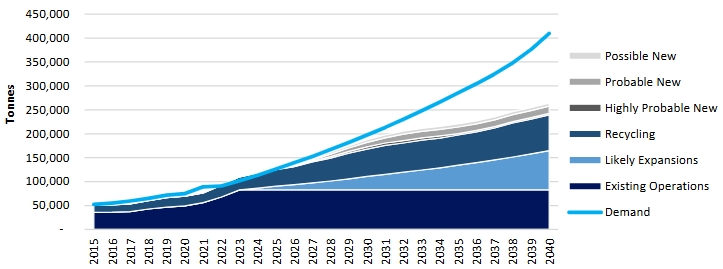
Note: Source Adamas Intelligence (2024)
66
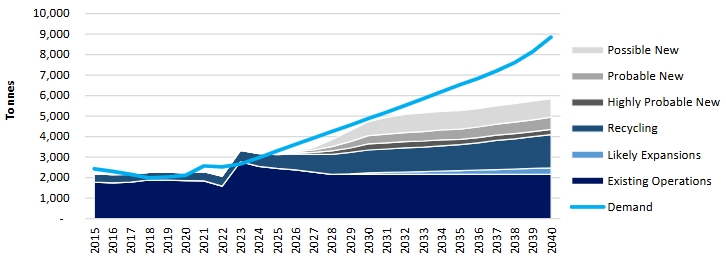
Note: Source Adamas Intelligence (2024)
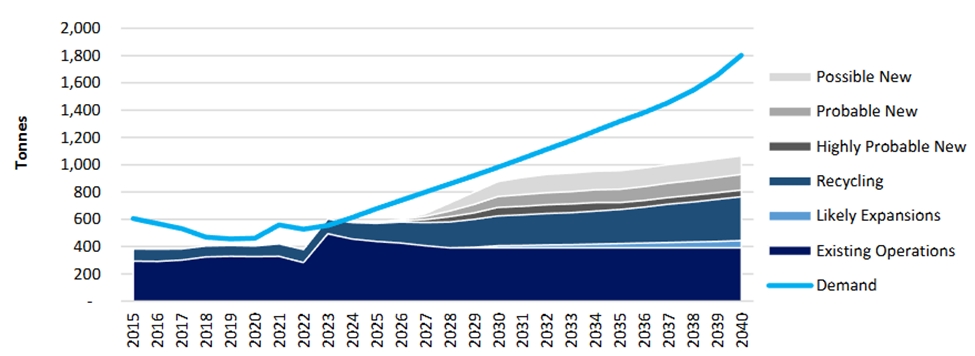
Note: Source Adamas Intelligence (2024)
According to Adamas Intelligence, through 2040, MREO will experience a production shortfall. According to Rare Earths Forecast Report, Benchmark Mineral Intelligence, Q4 2024, the anticipated supply gap in 2040 for Dy and Tb will be equivalent to approximately 116 times the annual production of the Mt. Weld mine in Australia, assuming Dy and Tb production of approximately 50tpa and excluding any expansions. The Mt. Weld mine is one of few major producers of Dy and Tb outside of China. Further, according to Adamas Intelligence, prices for magnetic rare earths are expected to increase by over 100% over the next 15 years.
Additional monazite concentrate supply is needed to meet the required feedstock needs of western monazite-based rare earths refiners. We believe our Shiloh Project has the distinctive potential to supply western monazite-based rare earths refiners with concentrate.
Separated rare earth oxides are specialty chemicals, not exchange-traded commodities, and are typically priced in U.S. dollars per kilogram. Prices are negotiated through private contracts and reflects product purity, oxide composition, delivery terms, and prevailing demand. While the Shiloh Project is still under evaluation regarding its final products, the Alpha Project and Constellation Project are anticipated to produce a mixed rare earth carbonate—an intermediate material used in the production of refined, separated rare earth oxides.
Payability represents the proportion of contained rare earth elements value (based on spot oxide prices) that is realized upon sale of mixed rare earth carbonate. Payability depends on the concentration of high-value elements, total rare
67
earth oxide grade, impurity levels, and offtake processing costs. We intend to produce a high-quality mixed rare earth carbonate with low impurities and elevated magnet rare earth elements. Our technical analyses assume a payability of 70%.
Corporate History
We were incorporated in February 2025 under the laws of the Cayman Islands as “Rare Earths Americas Ltd.” Our Redomestication took effect on October 15, 2025. Following the Redomestication, our name changed to “Rare Earths Americas, Inc.”
In July 2025, in two transactions, each contingent upon the completion of the other, we acquired our Predecessor, AMBPL, and FRE Australia (the “Acquisition”). Consideration paid to the shareholders of AMBPL and FRE Australia consisted of shares of our common stock and warrants exercisable for shares of our common stock. REA and AMBPL were entities under common control at the acquisition date.
In June 2025, we established T.E. Liberty, a wholly-owned subsidiary of REA organized under the laws of Texas, and REA Management Company, LLC (“REA Management”), a then-wholly-owned subsidiary of REA organized under the laws of Texas, to serve as our U.S. management and operating platforms. Initially incorporated as Piedmont Rare Earths, LLC in North Carolina, FRE US was organized to serve as the party to the option agreements entered into in Georgia. Effective December 31, 2025, we completed a merger of REA Management into REA, which resulted in all employees of REA Management becoming employees of REA as of January 1, 2026.
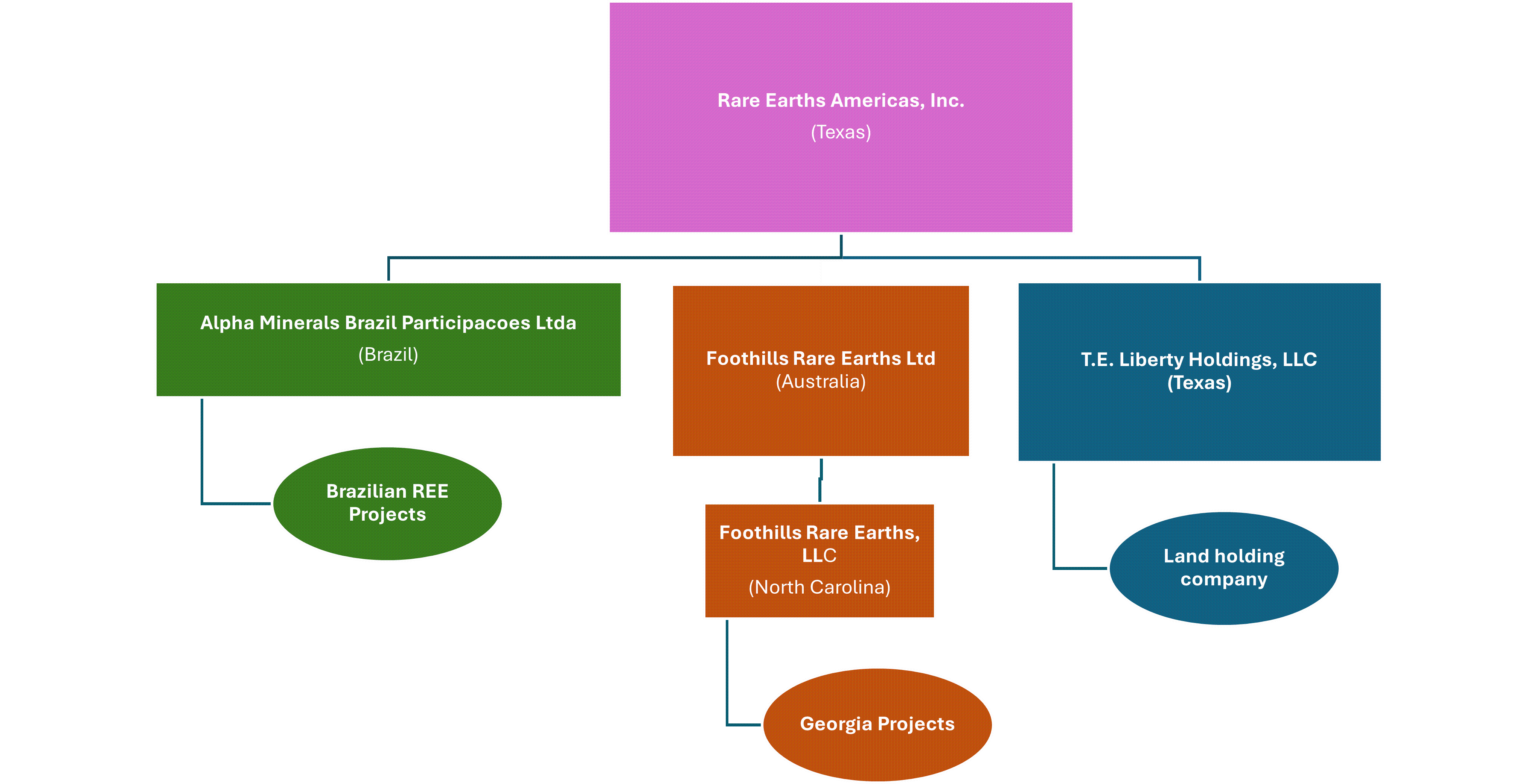
Since our formation, we have focused on assembling and advancing a portfolio of exploration-stage projects: the Shiloh Project in Georgia, USA; Alpha Project in Bahia, Brazil; and Constellation Project in Minas Gerais, Brazil. We have prepared technical report summaries for each of our material properties in accordance with S-K 1300, filed as Exhibits 96.1, 96.2 and 96.3 to the registration statement of which this prospectus forms a part.
We have not generated revenue to date. Our operations have consisted primarily of acquiring exploration rights, conducting geophysical surveys and drilling programs, preparing technical studies, and establishing the organizational and governance framework to support the advancement of our projects.
68
Our Business Strategy
Our objective is to grow the value of our assets and position the Company as a leading U.S. supplier of critical minerals. To achieve this, we intend to:
Through this integrated strategy, we aim to create a scalable platform capable of delivering secure, sustainable, and strategically important supplies of rare earth elements to the global market, while enhancing long-term value for our shareholders.
We believe the long-term prospects for rare earth elements, more specifically heavy rare earth elements, continue to be strong. In part, this reflects the acknowledgment of the U.S. Government that critical minerals, including rare earth elements, are essential for national security and economic resilience, followed by adoption of policies to facilitate domestic mineral production, including by offering expedited permitting, reconsidering regulatory bottlenecks, and providing capital and technical assistance. We have assembled a team with extensive mining sector-related experience, including exploration, development, permitting, operations and capital markets, to execute our strategy and pursue the market opportunity available to us. Further, our management team has extensive experience with permitting and development of large-scale mining projects.
Market Opportunity and Growth
Rare earth elements are fundamental across a number of sectors, such as robotics, defense applications, electric vehicles, wind power systems, renewable energy systems, and consumer electronics. Demand for such sectors is expected to grow. Adamas Intelligence projects demand for robotics to grow at a CAGR of 24% from 2024 to 2040. Robotics is projected to become the largest rare earths demand category by 2040 and is expected to account for over 16% of REO demand by 2040, requiring over 70,000 tonnes p.a. of REO for robots across manufacturing, transport, and logistics (Adamas Intelligence projections are for general robots, originally driven by low-tech consumer robots, and in later years driven more heavily by humanoid robots). The increased demand for humanoid robotics is projected to lead to an unprecedented increase in demand for rare earth elements, with various industry estimates for humanoid robot scale-up. For example, Goldman Sachs projects 1 million in annual production of humanoid robots by mid-2030s, BofA Securities projects 1 million in annual production by 2030 and 3 billion in operation by 2060, Morgan Stanley predicts 134 million in operation by 2040 and 1 billion in operation by 2050, the Tesla Earnings Call in July 2024 predicts long-term demand for over 20 billion units of general purpose humanoid robots, and the Tesla Earnings Call in April 2025 predicts 1 million units of Tesla’s Optimus humanoid robot produced annually by 2030.
69
According to Rare Earths Forecast Report, Benchmark Mineral Intelligence, Q4 2024, 280 of new Mt. Weld sized mines would be required to meet the anticipated demand for Dy and Tb for 100mm of humanoid robot annual production, assuming 4kg of permanent magnets per robot with 4% Dy and Tb content and assuming Dy and Tb production of approximately 50tpa, excluding any expansions.
Demand for electric vehicles is projected to grow at a CAGR of 10% from 2024 to 2040, driven by cheaper batteries, improved charging, and policy support. Electric vehicles today use up to approximately six times more metals than internal combustion engine vehicles, with each electronic vehicle today using approximately 2-3 kg of rare earth magnets (The future of four wheels is all electric, Goldman Sachs, February 16, 2024). Demand for advanced air mobility is projected to grow at a CAGR of 17% from 2024 to 2040, led by drones shifting to electric vertical take-off and landing (“eVTOL”), which requires higher power and torque density than electric vehicles. A passenger eVTOL is expected to use approximately 10-20 times more magnets than an electric vehicle (Rare Earth Market Overview & Outlook: EVs, Robotics and AAM, Adamas Intelligence, Q1 2025). Demand for clean energy is projected to grow at a CAGR of 8% from 2024 to 2040. A 3MW wind turbine requires approximately 2,000 kg of rare earth magnets (How are rare earths used, Lynas Rare Earths). Global renewable energy targets adopted at the UN’s COP28 require renewable energy capacity to increase by three times by 2030 (COP28 Tripling Renewable Capacity Pledge, International Energy Agency, June 2024). Demand for consumer electronics is expected to grow at a CAGR of 2% from 2024 to 2040, driven by global tech and smart device adoption. Rare earth elements are used in phones, laptops, headphones, tablets and smart home devices, and elements such as Y, Eu, and Tb are critical for displays and LEDs.
According to Adamas Intelligence, MREO are projected to grow at a CAGR of 8.3% through 2035, driven by accelerating global clean energy and defense requirements.
China continues to account for around 70% of global rare earth elements mined supply, highlighting the strategic need for Western-aligned suppliers. The U.S. has designated REEs as “critical minerals,” with various federal and state-level incentive programs in place to foster supply chain diversification.
Our dual-jurisdiction portfolio positions us to contribute to this emerging U.S.–Brazil corridor. Our growth plan includes: advancing exploration to define compliant resource estimates, expanding our technical and exploration teams, conducting scoping and feasibility studies, accelerating drilling programs and land acquisition, including in new districts and exploration zones, exploring offtake and partnership opportunities, and evaluating downstream processing potential in collaboration with governmental and industrial stakeholders.
Government Regulations, Environmental, Health and Safety
Our mineral interests are subject to an extensive array of laws, regulations, permits, and approvals at the federal, state and local levels in the U.S. and in Brazil, covering areas including mining activities, environmental protection, permitting, health and safety, land use, and reclamation.
United States
Our exploration efforts and proposed development in Georgia will be governed primarily by the Georgia Department of Natural Resources (“GDNR”) and Environmental Protection Division (“GEPD”); the target areas of the Shiloh Project are on private lands. GDNR and GEPD regulate a broad spectrum of activities—ranging from exploration, mineral claims, land reclamation, water and air emissions to occupational health and safety. Permitting may include requirements such as industrial stormwater coverage, hazardous materials handling, industrial wastewater discharge, and air emission permits. We intend to leverage evolving U.S. policy to accelerate and prioritize permitting for critical minerals projects.
In addition to state oversight, certain aspects of our activities may also be subject to regulation by federal agencies, including the U.S. Environmental Protection Agency, the U.S. Army Corps of Engineers, the Mine Safety and Health Administration, and the Occupational Safety and Health Administration. These agencies may impose additional permitting, environmental, health, and safety requirements on our operations, and in particular as federal policy continues to evolve in response to the strategic importance of critical minerals.
70
We aim to maintain compliance in all material respects with these regulations throughout our operations, though future legislative or regulatory changes may impose heightened requirements, delay permitting, or necessitate substantially increased capital outlays.
Brazil
Our projects in Brazil are subject to Decree-Law 227, 1967 (the “Mining Code”) and environmental assessment and licensing procedures enforced by national and state environmental authorities. Key components of the regulatory landscape include obtaining exploration and mining authorizations, undertaking environmental baseline studies, community consultations, and developing environmental management and reclamation plans. Our U.S. relationships will seek to engage with special trade initiatives that support bilateral cooperation between Brazil and the U.S. on critical mineral supply chains.
The Alpha Project is located in the State of Bahia, Brazil, which we believe maintains a generally supportive regulatory environment for mining activities and may offer permitting advantages, including relatively clearer processes and potentially shorter timelines compared to certain other jurisdictions in Brazil. Notwithstanding these perceived advantages, permitting remains subject to the discretion of applicable authorities, project-specific factors, and compliance with federal and state requirements.
Environmental, Health and Safety (“EHS”)
We subject our field operations to EHS policies and practices, including safety training, contractor oversight, emergency preparedness, and environmental stewardship. Consistent with industry best practices, we require that our contractors adhere to health and safety standards and hold relevant training and policies. Any incident of non‑compliance—such as environmental releases, injury, or regulatory infraction—could result in fines, corrective or other regulatory enforcement actions, or other penalties.
Naturally Occurring Radioactive Material (“NORM”)
Rare earth element mineralization, particularly monazite-bearing sands, may contain thorium and uranium, which in turn can generate heightened radioactivity in tailings and residues. Management of these materials must comply with applicable radiation safety standards and disposal requirements.
Legal Risks and Permitting Challenges
Future operations may be affected by amendments to, or stricter enforcement or interpretation of, existing rules and regulations laws as well as new regulatory initiatives, whether in environmental, health, safety, reclamation, or permitting domains. We may face delays or increases in cost, especially if new regulatory thresholds or licensing requirements are enacted.
Government Support and Policy Context
In the U.S., rare earth elements have been designated “critical minerals,” leading to enhanced government focus on developing domestic supply chains. For example, incentive mechanisms, certain tax credits, and efforts from agencies such as the Department of Energy and Department of War, serve to advance domestic critical minerals development. Nonetheless, reliance on such incentives is uncertain, and continued shifts in government policy may influence strategic and financial planning.
Our Mineral Projects
The following is a summary of our mineral projects. See “Properties” for additional information.
Shiloh
The Shiloh Project is located in Harris and Talbot Counties, Georgia, approximately 110 km from Atlanta. The project comprises approximately 1,927 total acres. It is located approximately 110 km south southwest of Atlanta, Georgia, 40 km southeast of LaGrange, Georgia and 40km northeast of Columbus, Georgia. The properties host monazite enriched in Nd, Pr, Dy, and Tb. Initial exploration that occurred in early 2025 included high-resolution geophysical
71
surveys, over 3,500 meters of grid drilling, and diamond drilling programs. Results confirm widespread structurally controlled intrusion-related vein/disseminated rare earth deposit, including structural emplacement of monazite within foliated gneiss and high-grade hard rock rare earth mineralization. The project benefits from robust nearby infrastructure, including rail and public highways access, low-cost electricity, and proximity to eastern U.S. ports. Continued exploration in 2026 includes additional geophysical surveys, drilling, and metallurgical testing, aimed at establishing an initial mineral resource estimate. Further, we plan to focus on the development of new discovery zones in Shiloh, including significant land acquisition, prospecting, staffing, survey(s) and drilling.
High-grade free-dig monazite sands such as those found in Shiloh can be mined using free digging methods, without drilling and blasting. Extracted monazite sands can be processed through relatively simple techniques to produce rare earths concentrate, which can be directly sold to Western rare earths producers to process. This provides us with the ability to pursue a multi-phased development approach for Shiloh, whereby initial concentrate sales generate cash flow to help fund downstream buildout, enabling vertical integration and margin expansion. Compared to projects that require full downstream processing, this approach offers the opportunity for streamlined permitting, as well as requires lower initial capital and operating expenses. A monazite concentrate operation could help fund subsequent downstream separation and magnet production.
The Shiloh Technical Report Summary is provided as Exhibit 96.1 to the registration statement of which this prospectus forms a part, and presents exploration results; a mineral resource estimate has not been prepared for the Shiloh Project at this time. Further information about our Shiloh Project is set forth in this prospectus under the section titled “Properties — Shiloh Project.” Between 2021 and 2025, over 4,105 meters of saprolite core were recovered via direct-push technology (“DPT”) and sonic drilling from 494 boreholes (which includes Lazer Creek). In 2025, a 908-meter diamond drill program was completed across 13 holes in January, and a 541.6-meter DPT program was completed in May. Sampling intervals ranged from 0.3 to 5 meters. Notable intercepts include 20.01% TREO over 15 cm and +1.0 m weighted composites intercepts exceeding 10% TREO in several holes at the Newbill target. We believe the current assay approach introduces a conservative estimate of TREO concentrations.
The following table shows higher grade samples from direct-push drilling in 2025:
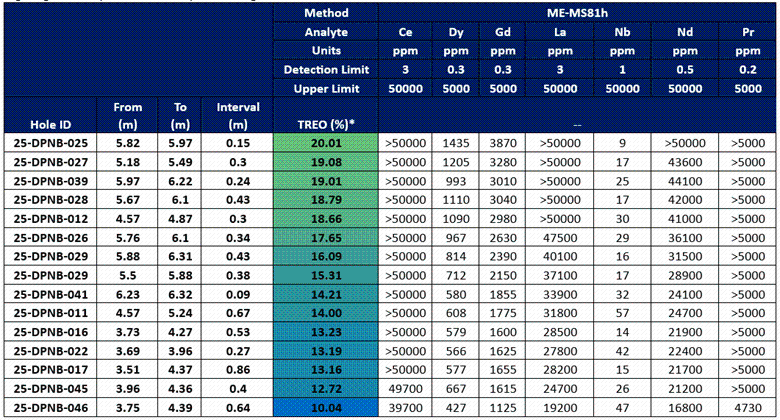
* Other parameters contributing to the total rare earth oxide (TREO) calculation are not shown.
> The reported result is at the upper detection or calibration limit of the method.
The above table presents a subset of higher grade range assay results from the 2025 DPT drilling at the Newbill property and is intended to provide a concise snapshot of elevated TREO values observed during that campaign.
72
Results have been selected and applied consistently across the dataset. Specifically, the above table includes only samples with TREO% concentrations of at least 10%, showcasing elevated REEs and excludes other results that do not meet those thresholds or would distort a fair presentation if shown in isolation. Samples are organized from highest (green) to lowest TREO% values (blue). As documented in the Shiloh Technical Report Summary, 2021, 2022 and 2025 drilling returned a wide range of TREO values, with 2025 DPT programs yielding numerous short-interval assays at or above 2% TREO (Table 10 of the Shiloh Technical Report Summary).
TREO was calculated including the following oxides: La2O3, Ce2O3, Pr2O3, Nd2O3, Sm₂O₃, Eu₂O₃, Gd₂O₃, Tb₂O₃, Dy₂O₃, Ho₂O₃, Er₂O₃, Tm₂O₃, Yb₂O₃, Lu₂O₃, and Y₂O₃. Where analytical results exceeded the upper method detection limit, the method detection limit value was assigned for calculation purposes. This approach introduces a conservative estimate and may result in underreporting of actual TREO% concentrations. The true values may be higher but cannot be accurately quantified within the validated range of the method. Accordingly, caution is advised when interpreting TREO values derived under these conditions.
The selection of drill hole samples is limited to discrete sample intervals collected and logged by lithological and mineralization contacts, with standard DPT sample lengths generally between approximately 0.3 m and 1.5 m. Isolated “Spike” assays over very short downhole lengths are not presented without accompanying context unless they occur within a broader run of mineralization or are otherwise significant to demonstrate grade tenor at the scale at which DPT samples were collected.
Routine quality assurance and quality control (QA/QC) samples (certified reference material (CRM’s), blanks and duplicates) along with low grade or barren intervals, are excluded from the above table because they are not “higher grade” samples and their inclusion would not assist investors in understanding the nature of elevated TREO occurrences. Reported lengths are downhole lengths; true width cannot be reliably estimated at this stage given the drilling methods, spacing and early stage geologic models.
Sampling, preparation and analytical procedures are described in the Shiloh Technical Report Summary. 2025 assays were prepared at ALS Mineral Analysis Laboratories (ALS) facility in Reno, Nevada and analyzed at ALS’s Vancouver Canada facility for fusion/ inductively coupled plasma mass spectrometry (ICP‑MS) method ME-MS81/ME-MS81h. Laboratories are ISO/ International Electrotechnical Commission (IEC) 17025-accredited for the specified methods. Drillhole location and total depth are presented in Table 9 and analytical results in Table 10 of the Shiloh Technical Report Summary, along with QA/QC results. Only parameters that are part of the TREO% calculation are shown in the TRS. These exploration results are not mineral resources or reserves and do not demonstrate economic viability.
The table below presents statistics for analyzed samples above low grade cutoff (TREO≥2%) for the 2021, 2022 and 2025 drilling programs.
Property |
Dead Tree |
Newbill |
Pig Trail |
||
Year |
2022 |
2025 |
2021 |
2022 |
2025 |
Sample Count |
1 |
42 |
4 |
2 |
16 |
TREO % (min) |
2.26 |
2.18 |
2.06 |
2.46 |
2.05 |
TREO % (max) |
2.26 |
20.01 |
3.41 |
3.77 |
12.78 |
TREO % (avg) |
2.26 |
8.73 |
2.58 |
3.11 |
4.84 |
Interval Avg (m) |
0.38 |
0.54 |
0.8 |
0.76 |
0.49 |
73
Depth Min (m) |
6.02 |
0 |
0 |
6.1 |
0.91 |
Depth Max (m) |
6.40 |
21.32 |
7.62 |
7.62 |
15.5 |
Depth Avg (m) |
6.21 |
5.51 |
3.94 |
6.86 |
5.93 |
Of the 3,056 drilling samples collected between 2021, 2022 and 2025 and reviewed for laboratory analysis, 65 samples exceeded the low-grade zone cutoff (TREO ≥ 2%). These higher-grade samples were distributed across three properties: Dead Tree, one sample at an average depth of 6.2 m bgs; Newbill, forty-two samples averaging 5.5 m bgs; and Pig Trail, twenty-two samples with an average depth of 5.7 m bgs. Among these, Newbill samples show the highest TREO average of approximately 9% and maximum value near 20%.
Preliminary metallurgical testing has been conducted on material from the Shiloh Project to evaluate the processing characteristics and recovery potential of rare earth mineralization. Metallurgical work completed to date includes mineralogical characterization, ammonium sulfate leach testing, monazite concentration testing, magnetic separation, gravity separation, flotation testing, heavy liquid separation, and sieve size–by–size assay analysis. These programs were designed to confirm monazite as the dominant rare earth–bearing mineral and to assess the amenability of both saprolitic and bedrock-hosted material to physical concentration methods. In addition, Quantitative Evaluation of Minerals by Scanning Electron Microscopy (“QEMSCAN”) and other mineralogical analyses were performed to evaluate mineral associations, metallurgical variability, and the presence of deleterious elements. The metallurgical testing remains at an early stage and has been conducted at a laboratory scale to inform ongoing exploration, processing concept development, and future metallurgical test programs.
The table below presents an illustrative example of rare earth element distribution. The distribution percentages are based on Shiloh sample 25‑DPNB‑025 over a 0.15m interval from 5.82 to 5.97m, using ME‑MS81h results. Percentages were calculated by dividing the grade (ppm) of each individual rare earth element by the total combined grade (ppm) of Ce, Dy, Er, Eu, Gd, Ho, La, Lu, Nd, Pr, Sm, Tb, Tm, Y and Yb.
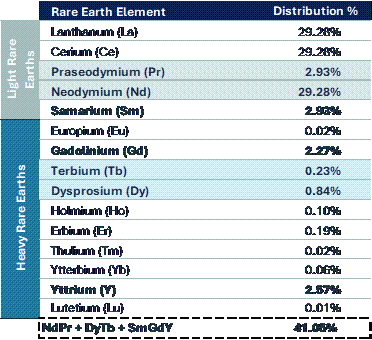
74
Future work programs and recommendations from the Shiloh Technical Report Summary include, among other things, to:
We expect that development of the Shiloh Project will require a budget of US$13.5 million.
Alpha
The Alpha Project is located in Bahia State, Brazil, approximately 120 km from the Port of Ilhéus. The project resources are located within nine granted exploration permits covering approximately 100 km². Mineralization occurs as ionically adsorbed clays within the weathering profile of the Jequié Complex. As of October 31, 2025, the Alpha Project hosts an inferred mineral resource of 201.7 million tonnes grading 1,520 ppm TREO (using a 1,000 ppm cutoff), containing approximately 322 tonnes of NdPr and 38.5 tonnes of DyTb. The project is wholly owned by the Company. Nearby infrastructure includes federal highways, municipal roads, and proximity to petrochemical reagents and port facilities. Ongoing work includes further drilling, surveying, and metallurgical testing to refine geological models and advance resource classifications. The Alpha Technical Report Summary is provided as Exhibit 96.3 to the registration statement of which this prospectus forms a part. Further information about our Alpha Project is set forth in this prospectus under the section titled “Properties — Alpha Project.”
Preliminary metallurgical test work at the Alpha Project evaluated the leaching behavior and recovery potential of ionic clay-hosted rare earth mineralization using bench-scale ammonium sulphate leachability testing on systematically collected drill samples at 1 m intervals across the regolith, ensuring representative vertical coverage. A total of 1,078 leach tests were completed by SGS Geosol between 2022 and 2024, and 1,154 by ALS Geochemistry between 2023 and 2024, for 2,232 tests overall. Results were comparable to those from adjacent ionic adsorption clay projects and infer amenability to ion‑exchange leaching under atmospheric conditions. Optimization test work is planned to advance flowsheet development.
Although IAC deposits generally report lower TREO grades relative to hard-rock rare earth deposits, they offer simplified mining methods and may contain a higher percentage of Dy, Tb, and other heavy rare earth elements relative to TREO content. Unlike hard-rock deposits, IAC mineralization occurs as loosely bound rare earth ions adsorbed onto clay minerals. As a result, mining may be conducted without drilling and blasting, crushing and grinding circuits are generally not required and leaching is typically conducted at ambient temperatures using low-concentration reagents. These characteristics may result in lower operating costs and lower capital intensity compared to conventional hard-rock rare earth projects. The Alpha Project hosts rare earth element mineral resources that warrant further exploration and evaluation. A two-phase work program is recommended. Phase A will focus on generating additional exploration data and materials, while Phase B will address targeted test work and technical analysis.
Phase A aims to improve understanding of the controls on mineralisation and to delineate additional prospective zones. Infill drilling and technical studies will be undertaken to potentially upgrade mineral resources from the inferred to higher-confidence mineral resource classifications. Phase A is estimated to require a budget of US$2.58 million to complete.
Results from Phase A exploration will provide representative drill samples for metallurgical testing and will provide a basis for an updated appraisal of the deposits If results are positive, the Alpha Project will advance to Phase B, which will involve the analysis of key modifying factors, including mining and processing considerations, to update the Initial Assessment and mineral resource estimates. Phase B is estimated to require a budget of US$1.15 million.
We expect that Phase A and Phase B, collectively, will require a budget of US$3.73 million.
75
Additional details on Phase A and Phase B activities and their respective estimated costs can be seen in the figures below:
Budget for Phase A Work Program |
|
Item |
Total Cost (US$) |
Surface exploration and ground geophysics1 |
$250,000 |
Auger drilling - 2,250 m1 |
$1,000,000 |
Core drilling - 8,000 m1 |
$1,250,000 |
High resolution satellite DEM |
$10,000 |
Minerology testwork |
$70,000 |
Total |
$2,580,000 |
Budget for Phase B Work Program |
|
Item |
Total Cost (US$) |
Metallurgical testwork |
$250,000 |
Mineral Resource estimation |
$100,000 |
Mining studies |
$300,000 |
Infrastructure assessment |
$100,000 |
Environmental, social and permitting assessment |
$400,000 |
Total |
$1,150,000 |
1. Program budgets are inclusive of assay, personnel, equipment, consumables and transport costs.
Constellation
The Constellation Project is located near Poços de Caldas in Minas Gerais, Brazil, a district with a long mining history. The project consists of 37 granted permits covering approximately 59.5 km², including six mining concessions and 31 exploration permits. Mineralization occurs as high-grade ionic clays derived from the Poços de Caldas alkaline complex, hosting NdPr and DyTb. As of October 31, 2025, the project contains an inferred mineral resource of 266.2 million tonnes grading 2,637 ppm TREO, with contained NdPr of approximately 564 tonnes and DyTb of 26.9 tonnes. Infrastructure access is strong, with proximity to highways, power lines, gas pipelines, and the Port of Santos. Planned programs include additional drilling, infill surveys, and expanded metallurgical testing. The Constellation Technical Report Summary is provided as Exhibit 96.2 to the registration statement of which this prospectus forms a part. Further information about our Constellation Project is set forth in this prospectus under the section titled “Properties — Constellation Project.”
Preliminary metallurgical test work at the Constellation Project evaluated the leaching behavior and recovery potential of ionic clay–hosted rare earth mineralization using bench‑scale ammonium sulphate leachability testing on systematically collected drill samples. ALS Lima completed 3,374 ammonium sulphate leach tests in 2024 on drill
76
samples representing. Cerium was excluded from the threshold because it does not readily leach under the mild acid conditions characteristic of ionic clay processing and therefore does not contribute to leach solution grades or influence cut‑off determinations. The sample distribution adequately represented the saprolite domain used in the resource model, ensuring the metallurgical dataset was appropriate for supporting estimation work. An optimization test program is planned to advance process development.
77
The Constellation Project hosts rare earth element mineral resources that warrant further exploration and evaluation. A two-phase work program is recommended. Phase A will focus on generating additional exploration data and materials, while Phase B will address targeted test work and technical analysis.
Phase A will aim to improve understanding of the controls on mineralization and to delineate additional prospective zones in regional exploration concessions. Infill drilling and technical studies will be undertaken to potentially upgrade mineral resources from the inferred to higher-confidence mineral resource classifications. Phase A is estimated to require a budget of US$3.34 million to complete.
Results from Phase A exploration will provide representative drill samples for metallurgical testing and will provide a basis for an updated appraisal of the deposits. If results are positive the project will advance to Phase B, which will involve the analysis of key modifying factors, including mining and processing considerations, to update the Initial Assessment and mineral resource estimates. Phase B is estimated to require a budget of US$1.15 million.
We expect that Phase A and Phase B, collectively, will require a budget of US$4.49 million.
Additional details on Phase A and Phase B activities and their respective estimated costs can be seen in the figures below:
Budget for Phase A Work Program |
|
Item |
Total Cost |
Surface exploration and ground geophysics1 |
250,000 |
Core drilling – 5,000 m1 |
1,500,000 |
Auger drilling - 9,000 m1 |
1,500,000 |
High resolution satellite DEM |
20,000 |
Minerology testwork |
70,000 |
Total |
3,340,000 |
Budget for Phase B Work Program |
|
Item |
Total Cost |
Metallurgical testwork |
$250,000 |
Mineral resource estimation |
$100,000 |
Mining studies |
$300,000 |
Infrastructure assessment |
$100,000 |
Environmental, social and permitting assessment |
$400,000 |
Total |
1,150,000 |
1. Program budgets are inclusive of assay, personnel, equipment, consumables and transport costs.
78
Other Mining Properties
Additionally, we hold rights to several additional, non-material, early-stage exploration projects, most notably our Homer Project (Goiás, Brazil) and Liberty Peak (Georgia, United States).
The Homer Project hosts multiple, large carbonatite clusters with potential for rare earth and niobium – located in a region containing the world’s preeminent niobium mines. The State of Goiás has a wide range of significant mining projects. Niobium is a critical material, primarily used in small quantities to enhance the strength, durability, and corrosion resistance of steel without adding weight. There are 527 carbonatite intrusions known globally, yet only approximately 60 are known to host Nb and REEs, and fewer than 10 are in production; however, carbonatites account for approximately 95% of global niobium production (Emma R. Humphreys-Williams, Sabin Zahirovic; Carbonatites and Global Tectonics. Elements 2021; 17 (5): 339–344; Niobium Market: Market Share by Occurrence, Mordor Intelligence, 2024). Brazil is home to numerous high-grade carbonatite complexes and accounts for approximately 90% of global niobium mine production (Mineral Commodity Summaries, USGS Geological Survey, January 2024).
The Homer Project is at an early exploration stage, and is a non-material project with no mineral resources defined to date. We hold 64 exploration licenses in connection with the Homer Project, covering over 123,400 ha (1,233 km2). The Homer Project is located 180km from Goiânia and 975km from Santos Port, close to a paved highway. During the first quarter of 2026, we started an active drilling campaign, based on field work, sampling and prospecting work performed in 2024 and 2025.
We control 1,233 km² of tenements at Homer, covering a large and highly prospective niobium district. Within this area, we have identified three large magnetic anomalies, each indicating potential for rare earth–niobium deposits, including:
79
A location map for the Homer Project is shown below:
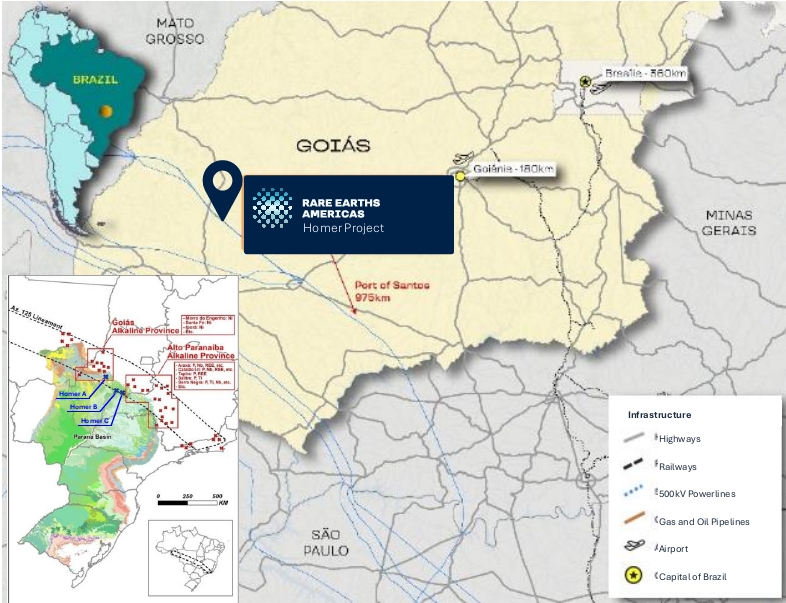
Liberty Peak is a regional exploration area that represents a potentially district-scale exploration target within the Shiloh Project in Western Georgia. The target area is located northeast of our initial Shiloh exploration area and encompasses a large, contiguous geophysical anomaly centered near Barnesville in Lamar County. Our interpretation of recently compiled regional geophysical datasets indicates that the Liberty Peak anomalies are significantly larger than our initial exploration footprint and may represent a broader mineralized system within the regional geologic framework. Liberty Peak was delineated through analysis of regional airborne magnetic and radiometric datasets, supplemented by newly acquired high-resolution airborne geophysical surveys. These surveys collectively cover approximately 500 km² of the broader project region and highlight strong, coherent radiometric and magnetic anomalies.
Preliminary reconnaissance and prospecting work conducted within the Liberty peak target zone have confirmed the presence of monazite-bearing sands with the potential for an underlying hard rock source. These early observations support our interpretation and suggest the potential for a large-scale mineralized system; however, the area remains at an early stage of exploration. To date, we have not completed systematic drilling within the Liberty Peak target zone, and the extent, continuity, and grade of any mineralization remain unknown. Accordingly, there can be no assurance that further exploration will result in the discovery of economically recoverable mineral resources.
We are actively advancing land acquisition and mineral rights consolidation across priority portions of the Liberty Peak area, while planning follow-up exploration programs. These programs are expected to include detailed surface sampling, geologic mapping, ground geophysical surveys, and exploratory drilling designed to evaluate the extent and economic potential of the anomaly. Exploration activities at Liberty Peak are expected to occur over the next 12 to 18 months as part of our broader exploration strategy for the Shiloh Project.
80
Exploration Stage Company
None of our mineral projects have an operating mine or have ever produced any minerals in commercial quantities. We have not demonstrated the existence of mineral reserves at any of our projects, and therefore each of our projects is in the exploration stage and we are considered an exploration stage company. We are conducting on-site exploration activities at the Shiloh Project, Alpha Project and Constellation Project, and we plan to conduct additional exploration activities at each of these projects. See “Properties — Shiloh Project — Planned Exploration and Related Programs”, “Properties — Alpha Project — Planned Exploration and Related Programs,” and “Properties — Constellation Project — Planned Exploration and Related Programs.” We expect to remain an exploration stage company for the foreseeable future. To exit the exploration stage and become a development stage company and, ultimately, commence mining at any of our projects, it will be necessary for us to demonstrate the existence of proven or probable mineral reserves at one or more of our projects, and complete one or more feasibility studies that would enable us to obtain financing on reasonable terms and in amounts sufficient to establish and operate the applicable mining operations.
The following chart shows the positions of the Shiloh Project, Alpha Project and Constellation Project on the Lassonde Curve:
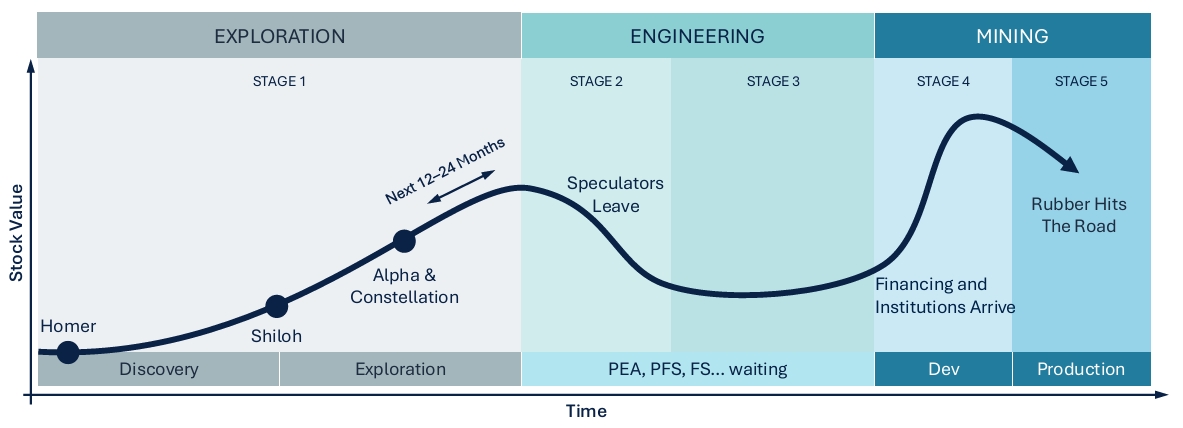
Summary of Mineral Resource Estimates
The following table summarizes our mineral resource estimates as shown in the Alpha Technical Report Summary and Constellation Technical Report Summary.
|
|
Measured mineral resources |
|
|
Indicated mineral resources |
|
Measured + indicated mineral resources |
|
Inferred mineral |
|
|||||||||
ALPHA PROJECT (Poços de Caldas, Brazil) Effective Date: October 31, 2025: |
|
|||||||||||||||||||
|
|
Amount |
|
Grades/ |
|
Amount |
|
Grades/ |
|
Amount |
|
Grades/ |
|
Amount |
|
Grades/ |
|
|||
(amounts are in millions of metric tons): |
|
— |
|
— |
% |
|
— |
|
— |
% |
|
— |
|
— |
% |
|
201.7 Mt |
|
1,520 ppm TREO |
|
Notes to the mineral resource table with respect to the Alpha Project:
81
REE Oxide |
Avg. Proportion of Recovered TREO (%) |
Current Spot Price ($/kg) |
Forecast Price |
Value at 70% Payability ($/kg) |
Contribution to Avg. Basket Value ($/kg) |
Proportion of Avg. Basket Value(%) |
|||
La2O3 |
24.3 |
|
1.4 |
1.0 |
0.2 |
0.4 |
|||
CeO2 |
6.7 |
|
1.5 |
1.0 |
0.1 |
0.1 |
|||
Pr6O11 |
6.3 |
|
158.6 |
111.0 |
7.0 |
12.2 |
|||
Nd2O3 |
24.3 |
|
154.8 |
108.3 |
26.3 |
46.0 |
|||
Sm2O3 |
4.3 |
|
4.3 |
3.0 |
0.1 |
0.2 |
|||
Eu2O3 |
0.6 |
|
34.7 |
24.3 |
0.1 |
0.3 |
|||
Gd2O3 |
3.7 |
|
80.5 |
56.3 |
2.1 |
3.6 |
|||
Tb4O7 |
0.5 |
|
1550.8 |
1085.5 |
5.8 |
10.1 |
|||
Dy2O3 |
3.2 |
|
503.5 |
352.5 |
11.4 |
19.8 |
|||
Ho2O3 |
0.6 |
|
171.2 |
119.8 |
0.7 |
1.2 |
|||
Er2O3 |
1.8 |
|
58.0 |
40.6 |
0.7 |
1.3 |
|||
Yb2O3 |
1.3 |
|
17.5 |
12.3 |
0.2 |
0.3 |
|||
Lu2O3 |
0.2 |
|
910.8 |
637.6 |
1.3 |
2.2 |
|||
Y2O3 |
21.9 |
|
8.0 |
5.6 |
1.2 |
2.1 |
|||
|
Average TREO Basket Value $/kg: |
57.2 |
100.0 |
|
|||||
82
CONSTELLATION PROJECT (Poços de Caldas, Brazil)
Effective Date: October 31, 2025:
|
|
Amount |
|
Grades/ |
|
Amount |
|
Grades/ |
|
Amount |
|
Grades/ |
|
Amount |
|
Grades/ |
|
|||
(amounts are in millions of metric tons): |
|
— |
|
— |
% |
|
— |
|
— |
% |
|
— |
|
— |
% |
|
266.2 Mt |
|
2,637 ppm TREO |
|
Notes to the mineral resource table with respect to the Constellation Project:
REE Oxide |
Avg. Proportion of Recovered TREO (%) |
Current Spot Price ($/kg) |
Forecast Price |
Value at 70% Payability ($/kg) |
Contribution to Avg. Basket Value ($/kg) |
Proportion of Avg. Basket Value (%) |
La2O3 |
52.6 |
|
1.4 |
1.0 |
0.5 |
1.2 |
CeO2 |
6.3 |
|
1.5 |
1.0 |
0.1 |
0.1 |
Pr6O11 |
8.5 |
|
158.6 |
111.0 |
9.4 |
21.2 |
Nd2O3 |
23.9 |
|
154.8 |
108.3 |
25.9 |
58.4 |
Sm2O3 |
2.3 |
|
4.3 |
3.0 |
0.1 |
0.2 |
Eu2O3 |
0.4 |
|
34.7 |
24.3 |
0.1 |
0.2 |
83
Gd2O3 |
1.3 |
|
80.5 |
56.3 |
0.7 |
1.7 |
|
Tb4O7 |
0.1 |
|
1550.8 |
1085.5 |
1.6 |
3.6 |
|
Dy2O3 |
0.7 |
|
503.5 |
352.5 |
2.5 |
5.6 |
|
Ho2O3 |
0.1 |
|
171.2 |
119.8 |
0.1 |
0.2 |
|
Er2O3 |
0.3 |
|
58.0 |
40.6 |
0.1 |
0.3 |
|
Yb2O3 |
2.6 |
|
17.5 |
12.3 |
0.3 |
0.7 |
|
Lu2O3 |
0.5 |
|
910.8 |
637.6 |
3.0 |
6.7 |
|
Y2O3 |
0.0 |
|
8.0 |
5.6 |
0.0 |
0.0 |
|
|
Average TREO Basket Value $/kg: |
44.4 |
100.0 |
||||
Mining Rights
We, or our subsidiaries, are a party to various leases, options and other mining rights agreements with third parties, such as landowners, pursuant to which we hold mining rights in our material projects.
84
Shiloh Project
The project area in Georgia is secured through a combination of option agreements that collectively define a significant land position in Harris and Talbot Counties. We have secured a strategically-located total project area of approximately 1,927 acres. A location map for the Shiloh Project is shown below:
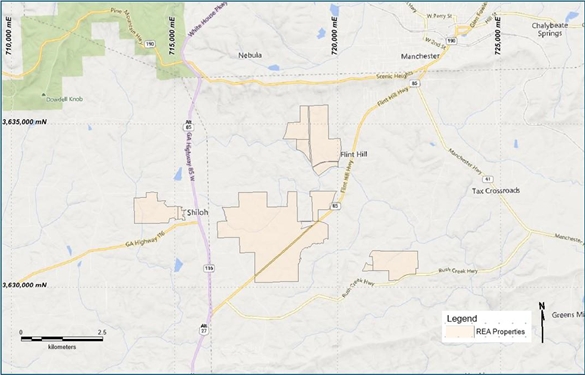
On February 25, 2021, FRE US, formerly known as Piedmont Rare Earths, LLC prior to its name change in March 2021, entered into an option agreement with a local landowner in Georgia (the “Optionor”) to purchase land parcels in Talbot County, Georgia (the “Newbill Option”). The Newbill Option covers a total of approximately 263.66 acres in Talbot County, Georgia, with a term ending on February 28, 2027, during which time commercial mining is not permitted. The Newbill Option does not provide for automatic extension, and any extension would require a mutually agreed written amendment between the parties. The Newbill Option grants FRE US the exclusive right to conduct exploration, drilling, surveys, technical studies and permitting at the property, and an option to purchase the property, with commercial mining of the property prohibited during the option period.
85
The Newbill Option required an initial payment within 30 days of signing of the option agreement, followed by annual payments until February 28, 2026. Remaining option payments are due by February 28, 2026, at $125 per acre (totaling $32,958). Additionally, a drilling bonus of $1 per foot (core, reverse circulation, sonic, or similar exploration) is payable annually by February 28, 2026 for footage drilled by FRE US within the property in the previous calendar year. If, during the option period, FRE US deems that minerals occur on or within the property in sufficient qualities and/or quantities, and elects to exercise the purchase option, the parties will enter into a purchase agreement consistent with the terms in the option agreement, for a purchase price of 125% of the fair market value of the property, as determined either by mutual agreement of the parties or by an appraisal conducted by a Member of the Appraisal Institute. The value added to the property by the exploration for minerals or the discovery of minerals shall not be included in the fair market value determination. Pursuant to such purchase agreement, the Optionor will retain a production royalty and a 12-month right to remove timber after closing. The retained production royalty will be perpetual and three percent (3%) of net smelter returns on concentrates or products produced from any part of the property, payable annually on the same February 28 cadence and covering the prior calendar year’s production. Additionally, under such purchase agreement, the Optionor will grant FRE US a right of first offer and refusal on the sale of royalty.
The following table provides a summary of royalties, encumbrances, payees, triggers, and related terms in the Newbill Option.
Item |
Description |
Option Terms |
Exclusive Option: Piedmont RE receives exclusive and irrevocable right to purchase, explore, and evaluate the property in Talbot County, GA. |
Option Period:From execution until February 28, 2027,unless extended or terminated earlier. |
|
Option Payments: Annual escalating payments to maintain the option: |
|
2021– $100/acre ($26,366 total) |
|
2022– $105/acre ($27,684 total) |
|
2023– $110/acre ($29,003 total) |
|
2024– $115/acre ($30,321 total) |
|
2025– $120/acre ($31,640 total) |
|
2026 – $125/acre ($32,958 total) |
Additionally, FRE US and FRE Australia, each an indirect and direct wholly owned subsidiary of us and FRE US a wholly owned subsidiary of FRE Australia, are parties to an option and project evaluation agreement with Southeast Metals, LLC (“SEM”) and the four members of SEM (the “Members”) (“the “SEM Option”). The SEM Option covers land and mineral interests in Harris and Talbot Counties, Georgia, spanning approximately 1662.828 acres, as well as certain rights of access to the lease area, as set forth in the Mining Lease Agreement between SEM and Weyerhaeuser Company (the “SEM Lease”). The SEM Option (i) grants FRE US the exclusive option to purchase 100% of the membership interest of SEM, (ii) authorizes FRE US to perform geological survey and exploration work on the covered property (as defined therein) during the option period to determine suitability for commercial mining and exploitation, (iii) provides FRE US with access to all historical data and due diligence material related to the exploration mining business previously developed by SEM or in SEM’s possession or control, and (iv) grants FRE US certain rights with the respect to the covered property. The SEM Lease requires royalty payments on production of Rare Earth Element Products and Byproducts (each as defined therein) by SEM and its successor and assigns, including the grant of a non-participating overriding royalty interest to Weyerhaeuser Company on such production occurring from within a defined area of interest outside the lease area that will survive termination or expiration of the lease.
Annual rental payments due under the SEM lease are $0 for each of the first three years of the lease, and $75,000 beginning in year four of the lease, with the amount subject to annual adjustment based on the Consumer Price Index (“CPI”). The CPI was assigned to the starting month of October 2022 and is rounded up to the nearest $100 and shall be adjusted upwards only annually. These rental payments are creditable against royalties due in the same lease year. The SEM Lease provides for a 5% royalty on net smelter return–style value of products and byproducts produced and
86
sold from the leased premises. Foothills/SEM must also make annual rental payments of $75,000 (CPI adjusted), which are creditable against royalties due in the same lease year. In addition, Weyerhaeuser retains a 1% overriding royalty on production from properties acquired within the defined Area of Interest (AOI) counties. Should Foothills exercise the SEM Option, Foothills will assume the obligations of SEM in regards to the Weyerhaeuser Lease discussed herein.
The following table provides a summary of royalties, encumbrances, payees, triggers, and related terms in the SEM Option:
Category |
Party Owed |
Rate / Trigger |
Production Royalty |
Weyerhaeuser Company |
5% of the weighted average quarterly Fair Market Value (FMV)per short ton (2,000 Ibs) on Products (REE-bearing material) from Lease Area |
Byproduct Royalty |
Weyerhaeuser Company |
5% of FMV per applicable weight or volume of Byproducts (non-REE minerals produced as secondary products). Same valuation method as above,using London Metal Exchange pricing where applicable. FMV Determination: The higher of (a) the average quarterly published price (e.g., mineralprices.com) or (b) Gross Sales Price (actual sale price). If not an arm’s-length sale,FMV reverts to comparable arm’s-length pricing. No deductions for transport, taxes, or selling costs. Hedging gains/losses are excluded. |
Area of Interest (AOI) Royalty |
Weyerhaeuser Company |
Coverage: Applies to any Outside Lease Area Interest in 10 counties of GA (Harris, Talbot, Muscogee, Meriweather, Pike, Upson, Lamar, Monroe, Jones, and Jasper) + Lee County,AL (. Royalty Rate: 1% of FMV of Products and Byproducts from any such AOI property. Duration: Survives lease termination; continues as long as SEM or successors hold interest. Instrument: Granted by separate recorded Area of Interest Royalty Grant and Agreement. |
Put Option Royalty (Processing Facilities Area) |
Weyerhaeuser Company |
If Weyerhaeuser requires SEM to purchase any portion of the Lease Area used for processing or tailings: Purchase price = 125% of fair market value of unimproved land. Weyerhaeuser may elect to retain a Put Option Royalty of 5% on production from that sold area (same terms as lease royalties). Formalized by Royalty Grant Agreement and survives lease termination. |
REA Share Consideration |
Rare Earths Americas Ltd. equity component |
Equity substitution for prior U.S. Elements shares |
Pursuant to the SEM Option, FRE US agrees to provide SEM with a bi-monthly written report outlining all material activities conducted on the covered property in connection with mineral exploration. The option period for the SEM
87
Option ends on the earliest of (i) August 1, 2026, (ii) the date five days after the satisfaction or waiver of conditions precedent set forth in the option agreement, but in no event more than 120 days following the exercise date of the option, or (iii) termination of the agreement. The SEM Option does not provide for automatic extension. However, the option period may be extended by mutual written agreement of the parties through an amendment to the option agreement. Pursuant to the SEM Option, each Member grants to FRE US the option to purchase 100% of the ownership interests in SEM. If FRE US exercises the purchase option, FRE US and FRE Australia, as applicable, are required to pay:
If we are not listed on or have not been conditionally admitted to the official list of an Exchange within three months of the exercise date or FRE Australia does not own 100% of FRE US, FRE US and FRE Australia may pay in REA Shares in lieu of cash payment of $2,000,000. If FRE US or FRE Australia choose to pay in REA Shares, the number of REA Shares will be determined by the volume weighted average of shares for the 15 trading days immediately prior to the closing date, if listed and traded on an Exchange, by the proposed initial public offering price of us or an Alternate Entity, if conditionally admitted to an exchange, or upon agreement of the parties if not conditionally admitted or if we do not own 100% of FRE US.
For purposes of the SEM Option only, “REA Share” means an ordinary fully paid share in our capital, and “Exchange” means the ASX, a recognized US stock exchange (NYSE, Nasdaq or AMEX), the TSX or TSX Venture Exchange or the London Stock Exchange.
Brazil
Under Brazilian laws, the Brazilian Federal Government owns all mineral resources. Under Article 176 of the Brazilian Constitution, all mineral deposits (jazidas) belong to the Brazilian Federal Government, regardless of whether or not the deposits are in active production.
Mining is regulated by the Mining Code, which contains the mining regulations that came into force in December 2017, and other regulations issued by the National Mining Agency (“ANM”), formerly known as National Department of Mining Production.
Brazil also has legislation and legal guarantees related to the exploitation and use of water rights.
Alpha Project
The Alpha Project comprises nine granted exploration permits registered with Brazil’s NMA that have a total area of approximately 99.76 km². These concessions are listed in Table 3‑1 and shown on Figure 3‑1 of the Alpha Technical Report Summary. Eight of the concessions host mineral resource estimates.
The Alpha Project includes four deposit areas within the following concessions:
88
The concessions listed in Table 3-1 of the Alpha Technical Report Summary are granted for a range of commodities as defined under the Mining Code. The ANM process permits the holder to adjust the commodity title prior to the granting of a mining concession, provided the holder demonstrates technical justification through exploration results.
In addition to the titles listed in Table 3‑1, we hold title to 27 concessions in non-contiguous blocks distributed across the broader region. Collectively, these concessions cover 386 km² and to date have not been the subject of significant mineral exploration work. No formal assessment of their exploration potential has been made, and they are not included in the Alpha Project area that is the subject of the Alpha Technical Report Summary.
A location map for the Alpha Project is shown below:
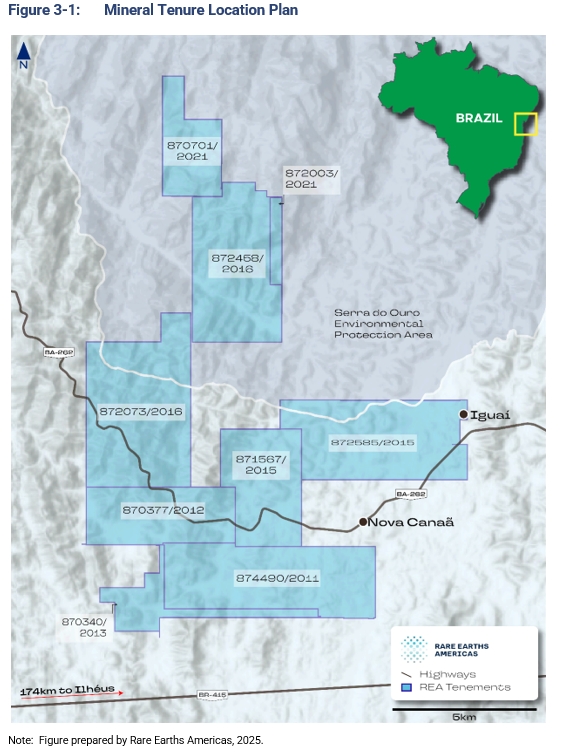
Constellation Project
Our interests in the Constellation Project are held pursuant to mining rights lease agreements (the “Constellation Leases”) and mining rights purchase option agreements (the “Constellation Options”) between our subsidiary, AMBPL, and various lessors and grantors, as applicable. The Constellation Project is comprised of 21 concession areas totalling 5,948 hectares (see also Chapter 3.4 of the Constellation Technical Report Summary) of which:
89
Private option agreements between our wholly-owned subsidiary AMBPL and the respective landowners grant us the exclusive right to access, enter and occupy each property for the purpose of mineral exploration and, upon exercise of the option, to obtain mineral rights for each property. A summary of the option agreements is given in the following sub-sections. In addition to the titles listed in Table 3‑1 of the Constellation Technical Report Summary, we hold title to 19 concessions in non-contiguous blocks distributed across the broader region. Collectively, these concessions cover 18.9 km² and to date have not been the subject of significant mineral exploration work. No formal assessment of their exploration potential has been made and they are not included in the Constellation Project area that is the subject of the Constellation Technical Report Summary.
The Constellation Leases comprise a series of agreements with Mineracao Andradense Ltda. and Mineracao Alto da Serra de Andradas Ltda., each dated August 17, 2023, in the form of 10-year leases on the underlying mining rights, including mining concessions for the exploration of minerals in 800.572/1969, 804.059/1971 and 808.966/1968. The agreements grant AMBPL the right to explore and evaluate the applicable properties. The agreements each require AMBPL to pay a non-refundable down payment of R$50,000.00. Further, effectiveness of the lease agreements is subject to certain conditions, including, among other things, AMBPL conducting research regarding the possibility of mining rare earth elements and associated minerals, to be reflected in a report in accordance with applicable Brazilian mining regulations; communication by the lessors with the ANM regarding the existence of mineral substances in the area covered by the mining rights not included in the original mining concession ordinance; preparation of an economic utilization plan by the parties indicating the changes to the initial mining plan that resulted in the mining concession ordinance and all other documents required to claim the amendment to the mining concession ordinance, including the possibility of exploring new mineral, through the ANM; and the signing and registration of a lease agreement that meets certain specified regulatory conditions. Once the required conditions have been met, or waived in writing by AMBPL, as applicable, such date referred to as the Closing Date, a fixed payment of US$1,000,000 in Brazilian reais is required. In consideration for each of the leases, AMBPL must also pay variable monthly installments of 5% of the monthly net revenue resulting from the exploration of the applicable mining right beginning after the start of mining operations in the applicable mining right area. Pursuant to the Constellation Leases, AMBPL may occupy the area covered by the mining right and carry out mining, processing, classification, storage and other operations inherent to exploitation of the minerals, as of the Closing Date.
The Constellation Options comprise two mining rights purchase option agreements, with JJBF Ltda. (“JJBF”) as grantor of one of such options (as amended, the “JJBF Option”), and Green Mining Company Ltda. (“GMC,” which assumed Terra Goyana Mineradora Ltda. and Bautek Minerais Industriais Ltda.’s rights and obligations under the option agreement), EDEM Empresa de Dezenvolvimento Em Mineracao e Participacoes and Sintertec Minerais Industriais Ltda. (collectively, the “GMC Grantors”) as grantors of the other option (as amended, the “GMC Option”). The option to exercise each of the Constellation Options lies entirely with AMBPL.
The JJBF Option required payment of a non-refundable premium of R$200,000.00 for the right to exercise the option, and requires payment of an exercise price to acquire mining rights with respect to the mining concessions for 813.944/1971 held by JJBF. If AMBPL chooses to exercise the JJBF Option, it must pay the equivalent of an aggregate of US$15 million, in three installments, as follows:
90
The JJBF Option also requires a share of mining profits to be paid to JJBF.
For purposes of the Constellation Options and the Greenfield Agreement (as defined below) only, “REA US Shares” means shares of common stock of REA that are publicly traded on a recognized United States stock exchange (e.g., NYSE American, NYSE, or NASDAQ) (the “Exchange”), which may have resulted from any of the following types of liquidity events: (i) an initial public offering resulting in REA US Shares being publicly traded on an Exchange; (ii) the merger of REA into a company whose shares are publicly traded on an Exchange, or the merger of REA by a public company whose shares are publicly traded on an Exchange; or (iii) the sale or transfer of a controlling interest in REA to a public company whose shares are publicly traded on the Exchange (each referred to as a “Liquidity Event”). Pursuant to the JJBF Option, REA US Shares issued to JJBF, if any, will not be registered under the Securities Act and will be subject to standard restrictions applicable to shares not registered under the Securities Act.
The initial term of the JJBF Option terminated on December 31, 2025. As a Liquidity Event related to the REA US Shares had not occurred by the end of the initial term, AMBPL elected to extend the term until December 31, 2026 for an additional premium of US$100,000. Pursuant to the JJBF Option, if a Liquidity Event does not occur fifteen days prior to the additional term, AMBPL may, in its sole discretion, exercise the option by paying the exercise price installments in Brazilian reais; however, if a Liquidity Event occurs after the exercise and prior to the payment of all installments, then any remaining installments must be paid in REA US Shares, unless JJBF expressly agrees to payment in Brazilian reais.
Under the GMC Option, AMBPL is required to pay an exercise price to acquire certain mining rights held by the GMC Grantors, including mining concessions for 818.865/1971 and 830.914/2013, an exploration permit and mining application for 806.199/1973, and exploration permits for 832.149/2022 and 832.150/2022. The mining rights covered by the GMC Option also include assignment of an exploration application registered with the ANM for 832.221/2021 (the “Exploration Application”) once exploration authorization is approved. If AMBPL chooses to exercise the GMC Option, it must pay the GMC Grantors the equivalent of an aggregate of US$5.16M through the issuance of REA Shares, valued at the closing price on the date of the Liquidity Event.
For purposes of the GMC Option only, “REA Shares” means shares issued by Rare Earths Americas Pty Ltd., or by a company that succeeds or is its parent company, that are publicly traded on the Australian Stock Exchange or another exchange that may replace it (“ASX”), which may have resulted from any of the following types of liquidity events: (i) an initial public offering for public trading on the ASX of the shares of REA, a company that succeeds it or is its parent company; (ii) a merger of REA by a company whose shares are admitted to trading on the ASX, or a merger, by REA of a public company whose shares are admitted to trading on the ASX; or (iii) a sale or transfer of control of REA to a public company whose shares are admitted to trading on the ASX (a “Liquidity Event”).
The term of the GMC Option terminates on June 30, 2026. If a Liquidity Event has not materialized by June 30, 2026, AMBPL may extend the term for up to two additional periods of 135 days each, upon prior payment of an additional premium of US$300,000 in Brazilian reais per extension. If a Liquidity Event does not occur by the end of the term or the additional term, AMBPL may, in its sole discretion, exercise the option by paying the exercise price in Brazilian reais.
If the GMC Grantors have not yet received the notice of approval of exploration authorization for the Exploration Application on the exercise date, AMBPL may partially exercises the purchase option at a reduced exercise price of US$4,375,315.18, in which event AMBPL will retain the right for the option with respect to the Exploration Application for an additional 12 months after the exercise notice date for an exercise price of US$784,684.82. Further, if the area of the Exploration Application is reduced for any reason, the exercise price or partial exercise price will be reduced in proportion to the total number of hectares of the mining rights.
Homer Project
On December 26, 2025 (the “Greenfield Effective Date”), AMBPL entered into a Mineral Rights Assignment and Covenants Agreement (the “Greenfield Agreement”) with Greenfield Exploration Ltda. (“Greenfield”), which
91
provides for the full assignment by Greenfield to AMBPL of a mining right registered with the ANM, covering approximately 1,999.46 hectares in Paraúna, Goiás. The assignment is subject to approval by the ANM.
Pursuant to the Greenfield Agreement, AMBPL shall pay Greenfield as consideration: (a) the Brazilian reais equivalent of AUD 250,000 within three business days of the Greenfield Effective Date, subject to the filing of an assignment request with the ANM; (b) REA Restricted Shares (as defined below) valued to total AUD 500,000 within three business days after the financial settlement of a Liquidity Event (or, if no Liquidity Event occurs within six months of the Greenfield Effective Date, AMBPL may make such payment in local currency or terminate the Greenfield Agreement as provided therein); (c) AUD 750,000 within five days after filing the Final Exploration Report (as defined in the Greenfield Agreement) with ANM (which must be filed no later than April 22, 2027), payable, in AMBPL’s sole discretion, in Brazilian reais or, if applicable following an initial public offering, in REA US Shares or REA Restricted Shares; and (d) AUD 500,000 within 24 months of the Greenfield Effective Date, subject to extension for certain specified delays, payable, in AMBPL’s sole discretion, in Brazilian reais or, if applicable following a Liquidity Event, in REA US Shares or REA Restricted Shares. All amounts payable under the foregoing are to be allocated 80% to Greenfield and 20% to Focus Capital Partners Pty Ltd (“Focus”).
For purposes of the Greenfield Agreement only, “REA Restricted Shares” means REA US Shares subject to a lockup for a period of six months from the Liquidity Event date.
If the ANM ultimately denies the assignment of the mining right, the Greenfield Mining Rights Agreement provides that parties will negotiate alternatives on the same commercial terms for 30 days, with the agreement terminating if the parties fail to reach agreement.
Pursuant to the Greenfield Agreement, REA US Shares or REA Restricted Shares issued to Greenfield and Focus, if any, will not be registered under the Securities Act and will be subject to standard restrictions applicable to shares not registered under the Securities Act.
92
A location map for the Constellation Project is shown below:
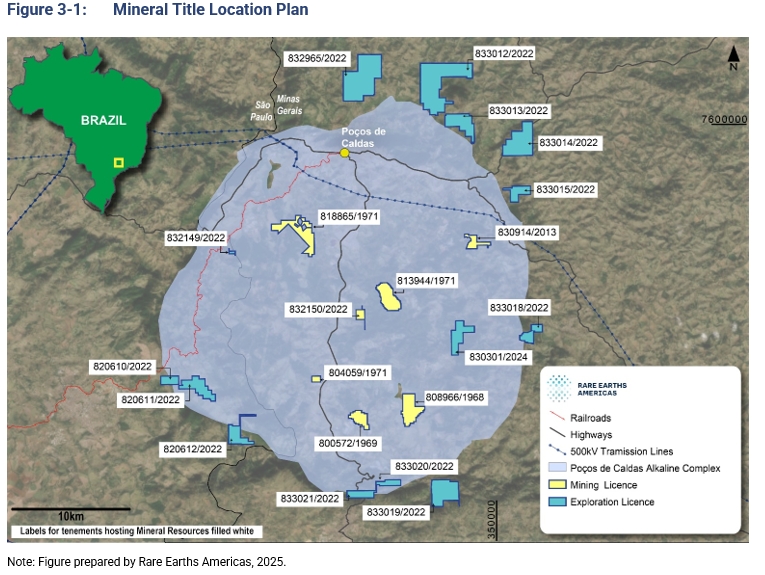
Competition
The mining industry in general is extremely competitive in all of its phases, and we compete with many companies possessing greater financial and technical resources. Competition in the metals mining industry is primarily for: mineral rich properties that can be developed and produced economically; technical expertise to find, develop, and operate such properties; labor to operate the properties; and capital for the purpose of funding such properties. Many competitors not only explore for and mine rare earth metals but also conduct refining and marketing operations on a global basis. Such factors may result in us being unable to acquire desired properties, to recruit or retain qualified employees or to acquire the capital necessary to fund our operations and develop mining properties. Existing or future competition in the mining industry could materially adversely affect our prospects for mineral exploration and success in the future. See “Risk Factors — Risks Related to Our Business — An increase in the global supply of magnet rare earth elements or, dumping, predatory pricing and other tactics by our competitors or state actors may adversely affect our profitability.”, “Risk Factors — Risks Related to Our Business — We depend on key personnel for the success of our business. We may be unable to attract and retain qualified mining and technical personnel, which could materially and adversely affect our business and the execution of our strategic plans.”, “Risk Factors — Risks Related to the Rare Earth Elements Mining Industry — The mining industry is highly competitive.”, and “Risk Factors — General Risks — We operate in an intensely competitive business environment. We may not be as successful as our competitors incorporating AI into our business or adapting to a rapidly changing marketplace.”
93
Facilities and Equipment
We lease and maintain our executive office at 101 W. Main Street, Manchester, Georgia 31816. In support of our exploration activities, we also maintain field offices in the state of Georgia and in Brazil. We do not currently own any real property. We believe these facilities adequately support our current operations, and additional space can be secured if needed under commercially reasonable terms.
Human Capital
As of March 31, 2026, we have engaged twelve (12) full-time employees, one (1) part-time employee and eight (8) consultants. Three (3) consultants serve us full-time and five (5) consultants serve us part-time. These employees and consultants provide management, technical, and administrative services to us.
Legal Proceedings
From time to time, we may become involved in legal proceedings or be subject to claims arising in the ordinary course of our business. We are not currently a party to any material proceedings. Regardless of outcome, such proceedings or claims could have an adverse impact on us because of defense and settlement costs, diversion of resources and other factors, and the possibility of unfavorable outcomes.
94
PROPERTIES
The information regarding the Shiloh Project that is set forth in this prospectus, including in this “Properties” section: (i) is derived from the technical report summary titled “Technical Report Summary Shiloh Project, Georgia” dated November 7, 2025 (the “Shiloh Technical Report Summary”), a copy of which is filed as Exhibit 96.1 to the registration statement of which this prospectus forms a part; and (ii) does not purport to be a complete summary of, is subject to all the assumptions, qualifications and procedures set out in, and is qualified in its entirety with reference to the full text of, the Shiloh Technical Report Summary. The Shiloh Technical Report Summary was prepared in accordance with S-K 1300 and is dated and signed by Geosyntec Consultants, Inc. (“Geosyntec”). Geosyntec is a third-party firm that employs a professional geologist whose education and experience satisfy the requirements of a “qualified person” under S-K 1300 and who prepared the Shiloh Technical Report Summary. Neither Geosyntec nor such qualified person is affiliated with us or has any interest in us. Geosyntec has approved the summary of the Shiloh Technical Report Summary set forth in this “Properties” section.
The information regarding the Alpha Project that is set forth in this prospectus, including in this “Properties” section: (i) is derived from the technical report summary titled “Updated Alpha Project Bahia, Brazil Technical Report Summary” dated March 25, 2026 (the “Alpha Technical Report Summary”), a copy of which is filed as Exhibit 96.3 to the registration statement of which this prospectus forms a part; and (ii) does not purport to be a complete summary of, is subject to all the assumptions, qualifications and procedures set out in, and is qualified in its entirety with reference to the full text of, the Alpha Technical Report Summary. The Alpha Technical Report Summary was prepared in accordance with S-K 1300 and is dated and signed by McGarry Geoconsulting Corp. (“McGarry Geoconsulting”), and Karst Geo Solutions LLC (“Karst Geo Solutions”). McGarry Geoconsulting and Karst Geo Solutions are third-party firms that employ professional geologists whose education and experience satisfy the requirements of a “qualified person” under S-K 1300 and who prepared the Alpha Technical Report Summary. Neither McGarry Geoconsulting, Karst Geo Solutions, nor such qualified persons is affiliated with us or have any interest in us. McGarry Geoconsulting and Karst Geo Solutions have each approved the summary of the Alpha Technical Report Summary set forth in this “Properties” section.
The information regarding the Constellation Project that is set forth in this prospectus, including in this “Properties” section: (i) is derived from the technical report summary titled “Updated Constellation Project Minas Gerais, Brazil Technical Report Summary” dated March 25, 2026 (the “Constellation Technical Report Summary”), a copy of which is filed as Exhibit 96.2 to the registration statement of which this prospectus forms a part; and (ii) does not purport to be a complete summary of, is subject to all the assumptions, qualifications and procedures set out in, and is qualified in its entirety with reference to the full text of, the Constellation Technical Report Summary. The Constellation Technical Report Summary was prepared in accordance with S-K 1300 and is dated and signed by McGarry Geoconsulting, and Karst Geo Solutions. McGarry Geoconsulting and Karst Geo Solutions are third-party firms that employ professional geologists whose education and experience satisfy the requirements of a “qualified person” under S-K 1300 and who prepared the Constellation Technical Report Summary. Neither McGarry Geoconsulting, Karst Geo Solutions, nor such qualified persons is affiliated with us or have any interest in us. McGarry Geoconsulting and Karst Geo Solutions have each approved the summary of the Constellation Technical Report Summary set forth in this “Properties” section.
For a description of the key assumptions, parameters and methods used to estimate mineral resources disclosed in this prospectus, as well as data verification procedures and a general discussion of the extent to which the estimates may be affected by any known environmental, permitting, legal, title, taxation, sociopolitical, marketing or other relevant factors, please review the Shiloh Technical Report Summary, Alpha Technical Report Summary, and Constellation Technical Report Summary, as applicable, each of which is incorporated by reference in this prospectus.
Summary Disclosure of Mineral Properties
The following table presents an overview of each of our mineral projects. There have been no previous resource estimates for each of our mineral projects. The estimates contained within the Alpha Technical Report Summary and the Constellation Technical Report Summary are the initial estimates for those properties. No mineral resources have been estimated for the Shiloh Project. For additional information about the projects, see “Business — Our Mineral Projects.” Each of the Shiloh Project, Alpha Project, and Constellation Project are material to our business or financial condition. Technical report summaries pursuant to S-K 1300 with respect to each of the Shiloh Project, Alpha Project, and Constellation Project are filed as Exhibits 96.1, 96.3, and 96.2, respectively, to the registration statement, of which
95
this prospectus forms a part. Summaries of each of those technical report summaries are set forth below under the captions “Properties — Shiloh Project,” “Properties — Alpha Project,” and “Properties — Constellation Project.”
Project |
|
Location |
|
Ownership interests |
Operator |
Description of mineral rights, form of ownership and acreage. |
|
Primary Commodities |
Royalties and other encumbrances |
Key permit conditions |
Shiloh Project |
|
Shiloh, Georgia, USA, spanning Harris and Talbot counties. |
|
REA owns mineral and surface rights through lease, option, and acquisition agreements. |
FRE US |
Two options, consisting of (i) an option and project evaluation agreement(1) that grants an option to purchase all membership interests in SEM, which holds rights to explore and develop certain land parcels covering approximately 1,662.8 acres in Harris and Talbot Counties, Georgia, under a mining lease, and (ii) an option agreement(2) that grants the exclusive right to access, enter, occupy, and use for exploration, surveys, technical studies, and the option to purchase certain land parcels covering approximately 263.7 acres in Talbot County, Georgia. |
|
NdPr and DyTb. |
Royalty payments on production of rare earth element products and byproducts required under the mining lease, including non-participating overriding royalty interest to the lessor on production occurring from within a defined area outside the lease area. |
Exploration activities on private lands are not subject to permit approval. |
|
|
|
|
|
|
|
|
|
|
|
Alpha Project |
|
Bahia State, Brazil. |
|
Wholly owned by us pursuant to exploration permits. |
REA |
9 granted exploration permits that cover a total area of approximately 99.76 km2, with 4 deposit areas containing mineral resources. We also hold title to 27 tenements covering 386 km².(3) |
|
High-grade ionic clay rich in DyTb and NdPr. |
Production from any future mining operations will be subject to a federal royalty of 2% of gross revenue. A landowner royalty may also be payable, determined by agreement with the landowner or, if no agreement exists, an amount equal to half of the federal royalty. The Alpha Project is also subject to a private 2.5% gross revenue royalty applicable to 100% of the reported mineral resources.
|
Final Exploration Reports (“RFPs") for six Alpha tenements were submitted in 2023 and are under ongoing ANM review. We do not anticipate impediments to approval, after which we will be eligible to apply for mining concessions. One tenement has an RFP due in January 2026, and RFPs for the remaining tenements are due in 2028. Permits are subject to ANM filing regulations and environmental compliance monitoring by INEMA. Land access by surface owner agreement or as provided under the Mining Code. |
|
|
|
|
|
|
|
|
|
|
|
Constellation Project |
|
Near Poços de Caldas, Brazil. |
|
Wholly owned by us pursuant to exploration permits and concessions. |
AMBPL |
21 granted permits covering approximately 59.5 km², with concessions located over a large area, 20 km in north–south extent, from Poços de Caldas to the north and Andradas to the south. There are six mining concessions and 15 exploration permits. 13 concessions are directly owned by us or our subsidiaries or affiliates, and 8 concessions are subject to option agreements(4) with Brazilian companies, granting us the exclusive right to access, enter and occupy each property for the purpose of mineral exploration and, upon exercise of the option, to obtain mineral rights for each property.
In the surrounding region, we also hold title to 19 tenements covering 183 km². There are 17 exploration permits. directly owned by us or our subsidiaries or affiliates, and one mining permit application and one exploration permit application that are subject to option agreements with Brazilian companies. |
|
High-grade ionic clay rich in DyTb and NdPr. |
The Roseria, Varginha and Clube da Uva deposits are subject to a private royalty equal to 5% of net revenue from concession production in favor of Mineração Andradense Ltda. Production from any future mining operations will be subject to a federal royalty of 2% of gross revenue. A landowner royalty may also be payable, determined by agreement with the landowner or, if no agreement exists, an amount equal to half of the federal royalty. The Andradas deposit is subject to a private royalty equal to 2.5% of gross revenue from concession production in favor of Brazil Royalty Corp Participações e Investimentos Ltda. No material encumbrances are known. A portion of regional tenement 833012/2022, which does not host mineral resources, is intersected by a Municipal Environmental Protection Area which does not constitute a title encumbrance and mining within such areas is not prohibited. However, activities in such areas are subject to additional environmental licensing and permitting |
Permits are subject to ANM filing regulations and environmental compliance monitoring by SEMAD. Land access by surface owner agreement or as provided under the Mining Code. |
96
|
|
|
|
|
|
|
|
|
requirements. The Pio Cipó deposit and two exploration tenements which do not host mineral resources are bisected by transmission lines that may impose localized constraints. |
|
|
|
|
|
|
|
|
|
|
|
|
Homer Project |
|
Goiás State, Brazil |
|
Wholly owned by us pursuant to exploration permits. |
REA |
58 granted exploration permits that cover a total area of 1,118km2 and six exploration permit applications that cover a total area of 115km2(5) |
|
Carbonatite prospective for P, V, Ti DyTb and NdPr. |
Production from any future mining operations will be subject to a federal royalty of 2% of gross revenue. A landowner royalty may also be payable, determined by agreement with the landowner or, if no agreement exists, an amount equal to half of the federal royalty. No private royalties or title encumbrances are known.
|
Permits are subject to ANM filing regulations and environmental compliance monitoring by Secretaria de Estado de Meio Ambiente e Desenvolvimento Sustentável de Goiás. RFPs for permits are due in 2026. Land access by surface owner agreement or as provided under the Mining Code. |
|
|
|
|
|
|
|
|
|
|
|
Pernambuco Project |
|
Near Recife, Brazil |
|
Wholly owned by us pursuant to exploration permits. |
REA |
33 granted exploration permits that cover a total area of 443km2 and six exploration permit applications that cover a total area of 73km2(5) |
|
Prospective for DyTb and NdPr. |
Production from any future mining operations will be subject to a federal royalty of 2% of gross revenue. A landowner royalty may also be payable, determined by agreement with the landowner or, if no agreement exists, an amount equal to half of the federal royalty. No private royalties or title encumbrances are known.
|
Permits are subject to ANM filing regulations and environmental compliance monitoring by respective State Environmental Secretariats. RFPs for permits are due in 2027. Land access by surface owner agreement or as provided under the Mining Code. |
|
|
|
|
|
|
|
|
|
|
|
Espinosa Project |
|
States of Minas Gerais and Bahia, Brazil |
|
Wholly owned by us exploration permits. |
REA |
23 granted exploration permits that cover a total area of 297km2 |
|
Prospective for DyTb and NdPr. |
Production from any future mining operations will be subject to a federal royalty of 2% of gross revenue. A landowner royalty may also be payable, determined by agreement with the landowner or, if no agreement exists, an amount equal to half of the federal royalty. No private royalties or title encumbrances are known.
|
Permits are subject to ANM filing regulations and environmental compliance monitoring by respective State Environmental Secretariats. RFPs for permits are due in 2027. Land access by surface owner agreement or as provided under the Mining Code. |
|
|
|
|
|
|
|
|
|
|
|
Tocantins Project |
|
State of Tocantins |
|
Wholly owned by us pursuant to exploration permits. |
REA |
One granted exploration permit that covers a total area of 20km2 |
|
Prospective for DyTb and NdPr. |
Production from any future mining operations will be subject to a federal royalty of 2% of gross revenue. A landowner royalty may also be payable, determined by agreement with the landowner or, if no agreement exists, an amount equal to half of the federal royalty. No private royalties or title encumbrances are known. |
Permits are subject to ANM filing regulations and environmental compliance monitoring by respective State Environmental Secretariats. RFPs for permits are due in 2027. Land access by surface owner agreement or as provided under the Mining Code. |
|
|
|
|
|
|
|
|
|
|
|
Ceara Project |
|
State of Ceatra |
|
Wholly owned by us pursuant to an exploration permit. |
REA |
One granted exploration permit that cover a total area of 0.3km2 |
|
Prospective for Lithium, DyTb and NdPr. |
Production from any future mining operations will be subject to a federal royalty of 2% of gross revenue. A landowner royalty may also be payable, determined by agreement with the landowner or, if no agreement exists, an amount equal to half of the federal royalty. No private royalties or title encumbrances are known. |
Permits are subject to ANM filing regulations and environmental compliance monitoring by respective State Environmental Secretariats. RFPs for permits are due in 2027. Land access by surface owner agreement or as provided under the Mining Code. |
97
The following map shows the locations of our mineral projects.
98
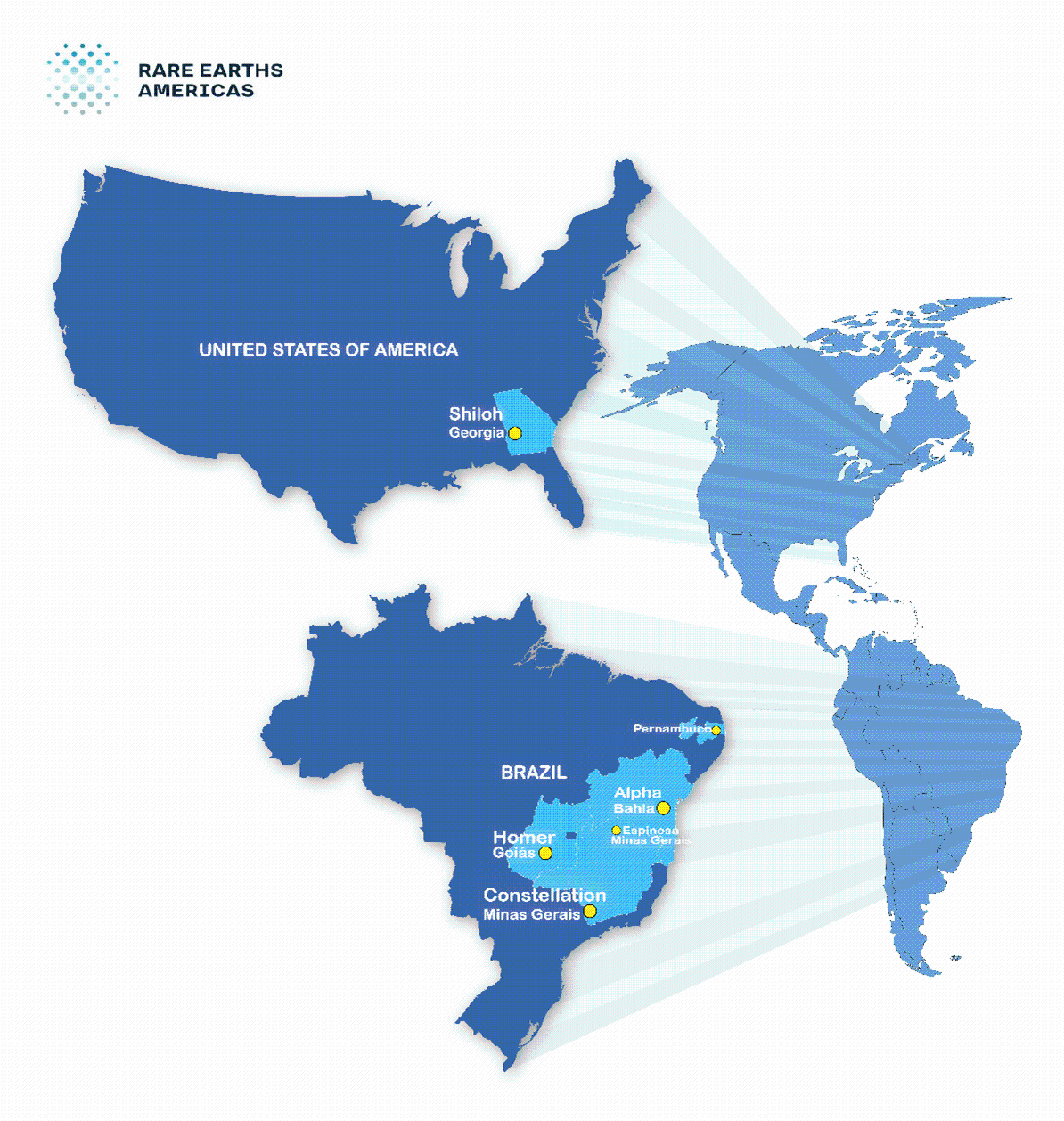
Exploration Stage Company. None of our mineral projects have an operating mine or have ever produced any minerals in commercial quantities. We have not demonstrated the existence of mineral reserves at any of our projects, and therefore each of our projects is in the exploration stage and we are considered an exploration stage company. We are conducting on-site exploration activities at the Shiloh Project, Alpha Project and Constellation Project, and have plans to conduct additional exploration activities, including drilling, at each of these projects, as well as at the Homer Project, which project is in early exploration stage and we do not consider to be a material project. See “Properties — Shiloh Project — Planned Exploration and Related Programs”, “Properties — Alpha Project — Planned Exploration and Related Programs,” and “Properties — Constellation Project — Planned Exploration and Related Programs.” We expect to remain an exploration stage company for the foreseeable future. To exit the exploration stage, become a development stage issuer and, ultimately, commence mining at any of our projects, it will be necessary for us to demonstrate the existence of proven or probable mineral reserves at one or more of our projects, and complete one or more feasibility studies that would enable us to obtain financing on reasonable terms and in amounts sufficient to
99
establish and operate the applicable mining operations. The Shiloh Project is an early-stage exploration project, and a mineral resource estimate has not been estimated.
Summary of Mineral Resource Estimates. There have been no previous resource estimates for each of our material mineral projects. The following table summarizes our initial mineral resource estimates as shown in the Alpha Technical Report Summary and Constellation Technical Report Summary. The Shiloh Technical Report Summary presents exploration results only and does not include mineral resource estimates.
Our internal controls include a comprehensive Quality Assurance/Quality Control program for all exploration and production drilling. This includes the insertion of certified reference materials (standards), blanks, and duplicate samples into the sample stream. All assaying is performed by independent, ISO-certified laboratories. We perform periodic 'blind' re-assays and inter-laboratory checks to ensure analytical consistency. The estimation of mineral resources is performed by, or under the supervision of, a 'Qualified Person' as defined by S-K 1300. Internal controls over the determination of 'reasonable prospects for economic extraction' include the use of commodity price assumptions provided by industry experts. Metallurgical recovery factors are based on representative lab testing and are verified.
Development of our mineral resources estimates conform to industry best practices and are regularly reviewed by internal and external parties to audit processes for resource estimation. Mineral resources are estimates that contain inherent risk and depend upon geologic interpretation and statistical inferences from drilling and sampling, which may prove to be unreliable. See “Risk Factors” for additional information.
For both the Alpha Project and Constellation Project, mineral resources reported are estimated, based on initial assessments, using a cut-off of 1,000 ppm total rare earth oxides (“TREO”), which was determined based on $57/kg TREO for the Alpha Project and $44/kg TREO for the Constellation Project; these values are an average recovered value using a ten-year forecast of rare earth oxide prices to 2040, as published by Adamas Intelligence in the Q1 2025 Rare Earth Pricing Quarterly Outlook. The cut-off includes mining, processing, and general and administrative costs. Costs related to waste mining, transportation, and capital expenditures are excluded.
Summary of Mineral Resources
Measured mineral resources |
|
Indicated mineral resources |
|
Measured + indicated mineral resources |
|
Inferred mineral |
|
||||||
ALPHA PROJECT (Poços de Caldas, Brazil) |
||||||
|
|
Amount |
|
Grades/ |
|
|
Amount |
|
Grades/ |
|
|
Amount |
|
Grades/ |
|
|
Amount |
|
Grades/ |
|
|
(amounts are in millions of metric tons): |
|
- |
|
- |
% |
|
- |
|
- |
% |
|
- |
|
- |
% |
|
201.7 Mt |
|
1,520 ppm TREO |
|
|
CONSTELLATION PROJECT (Poços de Caldas, Brazil) |
|
|||||||||||||||||||
|
|
Amount |
|
Grades/ |
|
|
Amount |
|
Grades/ |
|
|
Amount |
|
Grades/ |
|
|
Amount |
|
Grades/ |
|
(amounts are in millions of metric tons): |
|
- |
|
- |
% |
|
- |
|
- |
% |
|
- |
|
- |
% |
|
266.2 Mt |
|
2,637 ppm TREO |
|
Project |
Alpha |
Constellation |
MREO (% TREO)1 |
24% |
22% |
NdPr (% TREO) |
21% |
21% |
DyTb (% TREO) |
3% |
1% |
1. MREO is comprised of light rare earth oxides – Nd and Pr – and heavy rare earth oxides – Dy and Tb. MREO % of TREO represents the proportion of total rare earth oxides comprised of magnet rare earth elements.
100
Internal Controls. Our internal controls relating to QA/QC to date have consisted primarily of reviewing records maintained by prior owners of the Shiloh claims, Alpha claim and Constellation claims as to the chain of custody of samples, including samples used for laboratory analyses, and satisfying ourselves that the procedures followed with respect to such custody was consistent with industry standards. As noted below, we plan to conduct additional exploration activities that involve sampling, including drilling, at each of our projects. Before commencing those activities, and conducting assays of such sampling and the reporting of results from those assays, we intend to establish sampling and analytical QA/QC protocols that are consistent with industry standards including, without limitation, the following: (i) for each project’s data, establishing an accurate, reliable and defensible database that can be used to produce updated estimates of mineralization and feasibility studies; (ii) sampling to verify known mineralization; (iii) confirming that samples (from both surface collection or drilling) are of the highest possible quality; (iv) establishing procedures to ensure the security and integrity of samples from point of origin to analytical laboratory; and (v) implementing industry-standard QA/QC procedures to confirm the accuracy and reliability of the laboratory analyses, including the use of duplicate samples (i.e., two or more samples from the same sample submitted to the laboratory for analysis as if they were separate samples), blanks (i.e., samples containing no detectable mineralization) and standards (i.e., samples with known assay values), and confirming assay values from the original assay laboratory by submitting the same sample to a second laboratory.
Shiloh Project
Description and Location. The Shiloh Project is located in Shiloh, Georgia, USA spanning Harris and Talbot counties. The properties are approximately 110 km south-west from Atlanta, the state capital of Georgia. The project center is located at approximate geographic centered coordinates of latitude 32.8045°N and longitude -84.6792°W. The current book value of the Shiloh Project property and its associated plant and equipment is US$53,592.
The Shiloh Project is focused on monazite mineralization, rich in the rare earth elements NdPr and DyTb. The following maps show the location of the Shiloh Project.
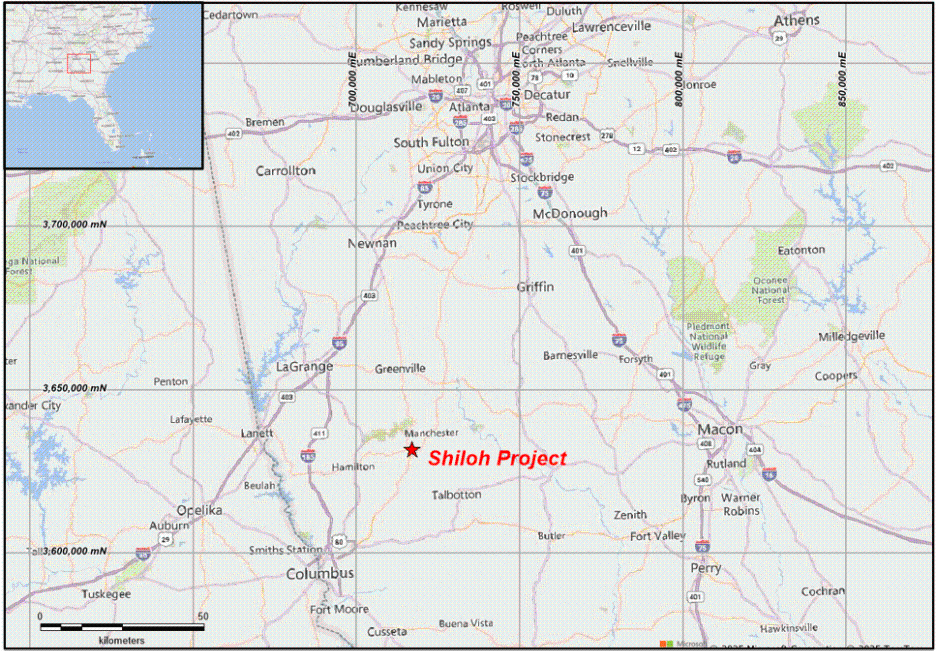
The following map shows the layout of the Shiloh claims.
101
Shiloh Project Mineral Claims
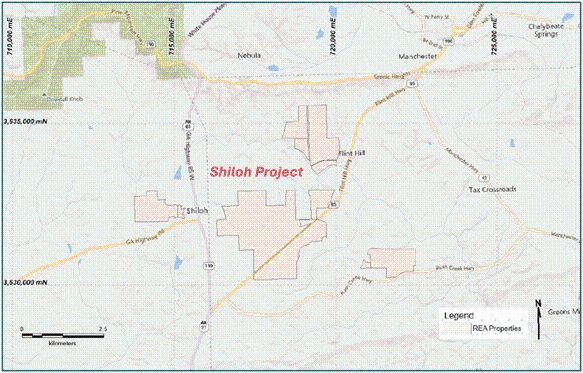
The Shiloh Project is an “exploration stage property.” No mining operations have ever been conducted at the Shiloh Project by us or any previous owner. We anticipate completing further exploration activities at the Shiloh Project, as described below in this prospectus under the sub-caption “Properties — Shiloh Project — Planned Exploration and Related Programs.” Through such further exploration activities, we expect to develop additional information to more precisely identify and delineate mineralization at the Shiloh Project and to determine the potential locations for extracting such deposits. The additional information may allow us, in conjunction with a qualified person, to estimate mineral resources.
Physiography and Climate. The topography of the Shiloh Project area is generally characterized by gently rolling hills, bounded to the north and south by two prominent east–west trending ridges. Southern Georgia has a humid subtropical climate with short, mild winters and hot summers. The area around the project area experiences summer temperatures ranging from approximately 29°C to 34°C. Winter temperatures are more variable with an average high of 13°C and average low of 2°C. Average annual precipitation ranges from 120 centimeters (“cm”) to 140 cm. Snowfall or freezing precipitation in the area is rare. The region’s relatively mild climate enables year-round exploration minimal disruption from weather-related conditions. Seasonal variations and weather events would be expected to have a small effect on the efficiency of exploration, any future surface mining, and concentrator plant operations. Negative impacts would be on a limited basis and last less than a few days. Any future mining activities could be conducted year-round.
Geology and Mineralization. The Shiloh Project is underlain by felsic gneisses and saprolitic material that host rare earth element mineralization, primarily in the form of monazite. Exploration from 2020 to 2025 included radiometric surveys, prospecting, and multiple drilling campaigns, culminating in a 908-meter diamond drill program across 13 holes.
Mineralization ranges from widespread low-grade zones (0.5-2% TREO) to localized higher-grade pockets exceeding 10% TREO. These high-grade zones are typically 1-2 meters thick and correlate with iron and manganese staining within or along contacts of the felsic gneiss. Recent drilling confirmed the down-plunge extension of high-grade-range material first identified in Trench 6, as described in the Shiloh Technical Report Summary, trending south-southeast, with notable intercepts from the Newbill direct-push drilling program, as described in the Shiloh Technical Report Summary.
102
Ownership. FRE US holds rights to approximately 1,927 acres in Harris and Talbot Counties, Georgia, through a combination of option and acquisition agreements. These include the Newbill Option, which grants FRE US the exclusive right to access, enter, occupy, and use for exploration, surveys, technical studies, and the option to purchase approximately 263.7 acres in Talbot County, and the SEM Option, which grants FRE US an option to purchase all membership interests in SEM, which holds rights to explore and develop certain land parcels covering approximately 1,662.8 acres in Harris and Talbot Counties under a mining lease. These agreements allow FRE US access to both surface and mineral estates, enabling uninterrupted exploration, development, and mining activities. The ownership reflects a framework for long-term project advancement. See “Business—Mining Rights—Shiloh Project” for additional information.
Surface Access. FRE US holds mineral and surface rights through a combination of lease, option, and acquisition agreements, including the Newbill Option and the SEM Option.
Infrastructure. The Shiloh Project has access to robust rail and road infrastructure, as well as low-cost electricity sources. The location of the Shiloh Project also provides direct rail access to multiple major ports across the eastern U.S. We access the property via a well-developed network of primary and secondary paved roads. Larger, private properties include gravel access roads used for agricultural and logging operations within the project boundaries. Interstate Highway I-85, located approximately 10 km east of the Shiloh Project area, provides direct access to Atlanta and Hartsfield Jackson International Airport. Additionally, an active CSX rail line runs through Manchester, Georgia, roughly 8 km to the east northeast of the Shiloh Project area. The city of Shiloh operates its own municipal water system, which provides reliable access to water for the Shiloh Project. The primary source of water is the Crystalline-Rock Aquifer. A potential workforce for the Shiloh Project is available in the towns surrounding the project area, including the nearby Atlanta metropolitan region.
Environmental Matters and Permitting. The Shiloh Project is currently in the exploration phase and is not subject to environmental and permitting requirements applicable to surface mining operations in Georgia. The project is governed by environmental and permitting requirements applicable to exploration-level activities in Georgia. In accordance with Section 12-7 of the Official Code of Georgia Annotated and the Georgia Construction Stormwater General Permits (GAR100001, GAR100002, or GAR100003), land disturbance activities under one acre are exempt from general construction stormwater permitting. The current permitting framework outlines timelines and conditions for land disturbance, and no violations or fines have been reported to date. Social considerations remain focused on maintaining transparent communication with local stakeholders and minimizing environmental impact through best management practices, such as low-impact drilling, use of existing trails, and erosion control.
Exploration History. Prior to our operations in the Shiloh Project area, the Shiloh Project was operated by Southeast Metals, LLC (SEM) along with Dr. Robert Cook, Professor of Geology at Auburn University. Initial exploration of the Shiloh Project area was conducted through a magnetic survey and geophysics. Such exploration efforts identified strong anomalies (eTh) that correspond to monazite sources. Following such exploration, Geotech Ltd, a leading airborne geophysical survey mapping firm, conducted a high-resolution survey of the area and identified targets for prospecting and land acquisition. To date, more than 4,105 meters of grid drilling has been conducted in the initial project area of the Shiloh Project. Such drilling has led to the discovery of ultra-high-grade boulders and confirmation of widespread monazite sands from shallow depths, rich in NdPr and DyTb. Diamond drilling conducted in January and February 2025 confirmed high grade hard rock rare earth mineralization drill intercepts, with assays completed in April 2025. Exploration efforts have led to the discovery of rare earth elements with some of the highest TREO concentrations reported globally, observing boulder assays of up to 20.01% TREO and trenching intercepts up to 30.98% TREO and demonstrating potential for equally high-grade rare earth source rock at depth. Initial ground prospecting led to the discovery of monazite sands located to the north-east of the initial project area.
Exploration and Related Programs. Exploration activities at the Shiloh Project have included an airborne survey and analysis of U.S. Department of Energy flight lines, systematic program of surface sampling, helicopter-borne and ground-based geophysical surveys, geological mapping, and drilling campaigns conducted between 2020 and 2025. Initial prospecting identified areas of interest, prompting high-resolution geophysical surveys conducted in 2021, which acquired 1,984 line-km of magnetic and radiometric data using advanced instrumentation and standard industry practices. Subsequent ground surveys and detailed mapping refined target zones, while drilling in 2021, 2022, and 2025 provided subsurface data supporting mineralization interpretations. These integrated exploration efforts have delineated anomalous zones with elevated rare earth element concentrations and established a data set underpinning ongoing evaluation and exploration at the Shiloh Project.
103
The following map shows drill hole locations at the Shiloh Project.
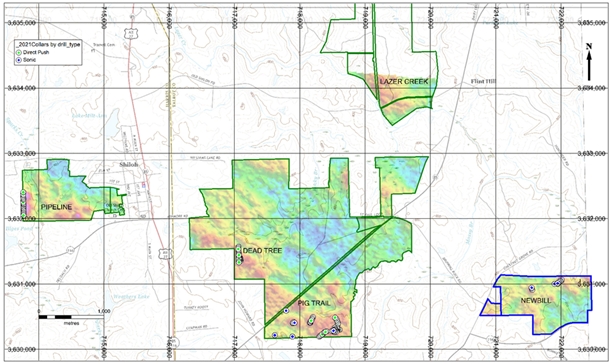
The following table shows higher grade samples from direct-push drilling in 2025:
* Other parameters contributing to the total rare earth oxide (TREO) calculation are not shown.
> The reported result is at the upper detection or calibration limit of the method.
104
The above table presents a subset of higher grade range assay results from the 2025 DPT drilling at the Newbill property and is intended to provide a concise snapshot of elevated TREO values observed during that campaign. Results have been selected and applied consistently across the dataset. Specifically, the above table includes only samples with TREO% concentrations of at least 10%, showcasing elevated REEs and excludes other results that do not meet those thresholds or would distort a fair presentation if shown in isolation. Samples are organized from highest (green) to lowest TREO% values (blue). As documented in the Shiloh Technical Report Summary, 2021, 2022 and 2025 drilling returned a wide range of TREO values, with 2025 DPT programs yielding numerous short-interval assays at or above 2% TREO (Table 10 of the Shiloh Technical Report Summary).
TREO was calculated including the following oxides: La2O3, Ce2O3, Pr2O3, Nd2O3, Sm₂O₃, Eu₂O₃, Gd₂O₃, Tb₂O₃, Dy₂O₃, Ho₂O₃, Er₂O₃, Tm₂O₃, Yb₂O₃, Lu₂O₃, and Y₂O₃. Where analytical results exceeded the upper method detection limit, the method detection limit value was assigned for calculation purposes. This approach introduces a conservative estimate and may result in underreporting of actual TREO% concentrations. The true values may be higher but cannot be accurately quantified within the validated range of the method. Accordingly, caution is advised when interpreting TREO values derived under these conditions.
The selection of drill hole samples is limited to discrete sample intervals collected and logged by lithological and mineralization contacts, with standard DPT sample lengths generally between approximately 0.3 m and 1.5 m. Isolated “Spike” assays over very short downhole lengths are not presented without accompanying context unless they occur within a broader run of mineralization or are otherwise significant to demonstrate grade tenor at the scale at which DPT samples were collected.
Routine QA/QC samples (CRM’s, blanks and duplicates) along with low grade or barren intervals, are excluded from the above table because they are not “higher grade” samples and their inclusion would not assist investors in understanding the nature of elevated TREO occurrences. Reported lengths are downhole lengths; true width cannot be reliably estimated at this stage given the drilling methods, spacing and early stage geologic models.
Sampling, preparation and analytical procedures are described in the Shiloh Technical Report Summary. 2025 assays were prepared at ALS facility in Reno, Nevada and analyzed at ALS’s Vancouver Canada facility for fusion/ inductively coupled plasma mass spectrometry (ICP‑MS) method ME-MS81/ME-MS81h. Laboratories are ISO/ International Electrotechnical Commission (IEC) 17025-accredited for the specified methods. Drillhole location and total depth are presented in Table 9 and analytical results in Table 10 of the Shiloh Technical Report Summary, along with QA/QC results. Only parameters that are part of the TREO% calculation are shown in the TRS. These exploration results are not mineral resources or reserves and do not demonstrate economic viability.
The table below presents statistics for analyzed samples above low grade cutoff (TREO≥2%) for the 2021, 2022 and 2025 drilling programs.
Property |
Dead Tree |
Newbill |
Pig Trail |
||
Year |
2022 |
2025 |
2021 |
2022 |
2025 |
Sample Count |
1 |
42 |
4 |
2 |
16 |
TREO % (min) |
2.26 |
2.18 |
2.06 |
2.46 |
2.05 |
TREO % (max) |
2.26 |
20.01 |
3.41 |
3.77 |
12.78 |
TREO % (avg) |
2.26 |
8.73 |
2.58 |
3.11 |
4.84 |
Interval Avg (m) |
0.38 |
0.54 |
0.8 |
0.76 |
0.49 |
Depth Min (m) |
6.02 |
0 |
0 |
6.1 |
0.91 |
Depth Max (m) |
6.40 |
21.32 |
7.62 |
7.62 |
15.5 |
105
Depth Avg (m) |
6.21 |
5.51 |
3.94 |
6.86 |
5.93 |
About Geosyntec. Geosyntec performed a detailed review of the Shiloh drill and geological data to confirm the accuracy and reliability of the data used in the Shiloh Technical Report Summary. No limitations were placed on Geosyntec to conduct data verification. The sampling methods, security, and analytical procedures used by prior owners of the project in their drilling campaigns were deemed by Geosyntec as adequate for an exploration stage project.
No mineral resources have been estimated for the Shiloh Project.
Assumptions. Of the 3,056 drilling samples collected between 2021, 2022 and 2025 and reviewed for laboratory analysis, 65 samples exceeded the low-grade zone cutoff (TREO ≥ 2%). These higher-grade samples were distributed across three properties: Dead Tree, one sample at an average depth of 6.2 m bgs; Newbill, forty-two samples averaging 5.5 m bgs; and Pig Trail, twenty-two samples with an average depth of 5.7 m bgs. Among these, Newbill samples show the highest TREO average of approximately 9% and maximum value near 20%.
Sample and sampling method disclosure. Between 2021 and 2025, FRE Australia submitted approximately 3,056 samples collected from the Shiloh Project for analysis. To ensure data quality and reliability, we implemented a comprehensive QA/QC program that included CRMs, blanks, and field duplicates. The CRMs were sourced from OREAS using material from the Mount Weld Project in Australia, with three different standards representing low-grade (0.53% TREO), medium-grade (2.08% TREO), and high-grade (9.88% TREO) mineralization that aligned with expected grades at Shiloh.
The QA/QC program also incorporated blanks consisting of commercially available white marble chips to detect any contamination during sample processing, and field duplicates to assess sampling precision. Duplicate samples were collected differently based on the drilling method: half-core splits for direct push sampling, half to quarter splits for sonic core, and quarter-splits for diamond drilling. This systematic approach to quality control helps validate the accuracy and precision of the analytical results that form the basis for resource estimation.
Exploration Results Summary. Based on the exploration activities conducted between 2020 and 2025, the Shiloh Project demonstrates compelling geological, mineralogical, and structural characteristics consistent with a structurally controlled metamorphic-hydrothermal rare earth element vein/disseminated deposit. The mineralization is hosted within foliated felsic gneiss and saprolitic material derived from Grenville-age metamorphic rocks, both mineralized with rare earth elements predominantly occurring as monazite.
The mineralized zones exhibit strong structural control, with rare earth element enrichment localized along foliation planes, shear zones, and brecciated contacts. Iron and manganese staining, quartz veining, and breccia textures further support a hydrothermal origin for the mineralizing fluids. These features are consistent across multiple trenches and drillholes, particularly at the Newbill and Pig Trail targets, where high-grade range intercepts well exceeding 10% TREO have been confirmed through direct-push, sonic and diamond drilling.
Mineralization is interpreted to have formed through structurally focused hydrothermal processes, possibly during or following regional metamorphism, with rare earth element-bearing fluids precipitating monazite within zones of enhanced permeability and deformation.
Data verification protocols, including QA/QC checks, certified reference materials, and cross-validation of assay results, confirm the reliability of the 2021, 2022, and 2025 datasets. Core recovery metrics and mineralogical analyses further support the integrity of the geological model.
In conclusion, the Shiloh Project presents a viable exploration-stage rare earth element asset with demonstrated mineralization, favorable structural controls, and a path toward more detailed exploration. To that end, we continue systematic exploration at the Shiloh Project, which includes direct push and diamond drilling, infill drilling, trenching, sampling and metallurgical test work. Continued drilling, metallurgical testing, and geologic modeling are recommended to advance the project.
106
Alpha Project
Description and Location. The Alpha Project is located at 40°9′40.51″W and 14°44′27.53″S, approximately 270 km southwest of Salvador, the capital of Bahia State in northeastern Brazil. The project tenements lie within the municipal boundaries of Iguaí and Nova Canaã, provincial towns situated immediately east of the Alpha Project area. The current book value of the Alpha Project property and its associated plant and equipment is US$ . The following map shows the location of the Alpha Project.
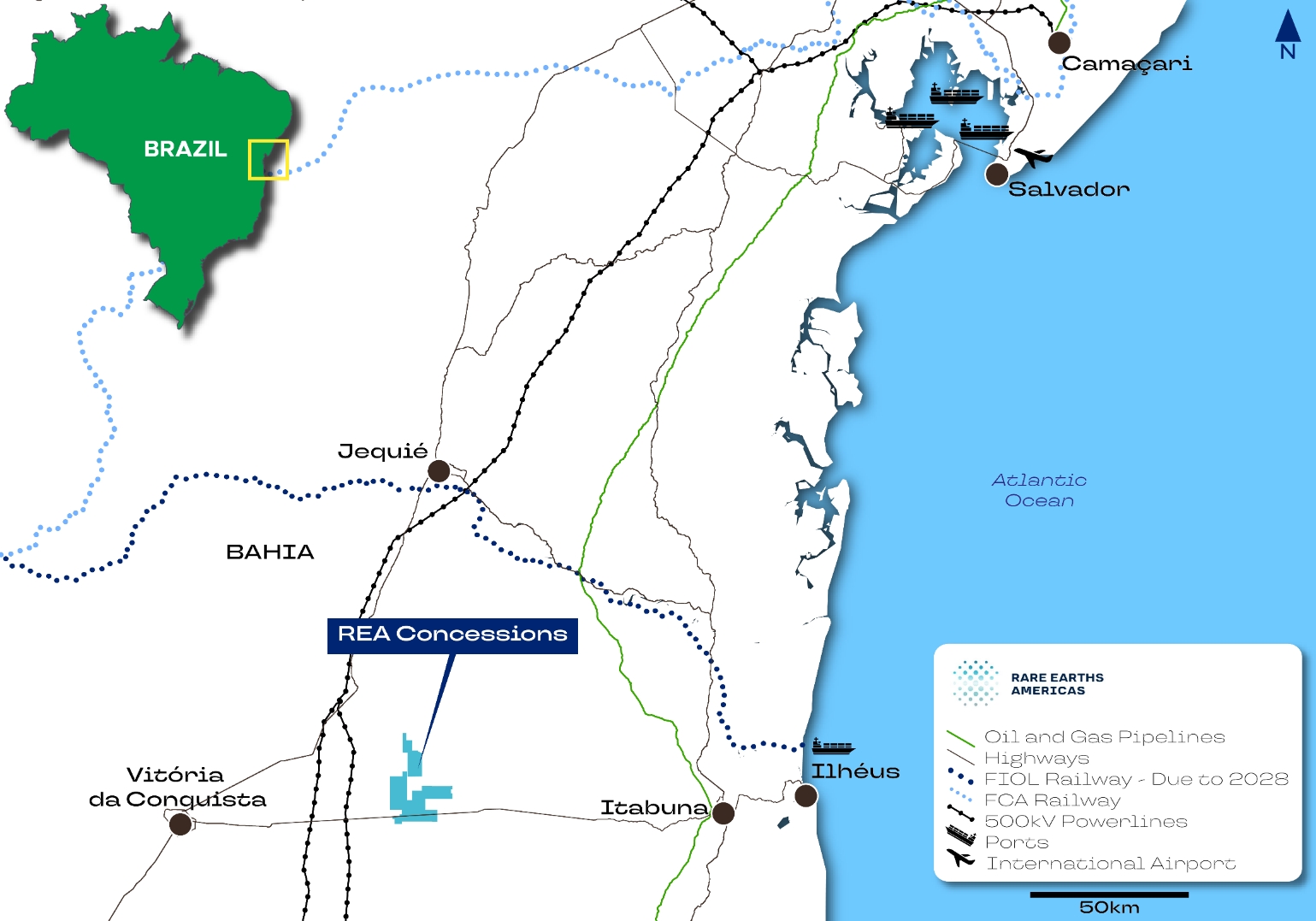
The following map shows the layout of the Alpha Project tenements.
107
Alpha Project Tenements
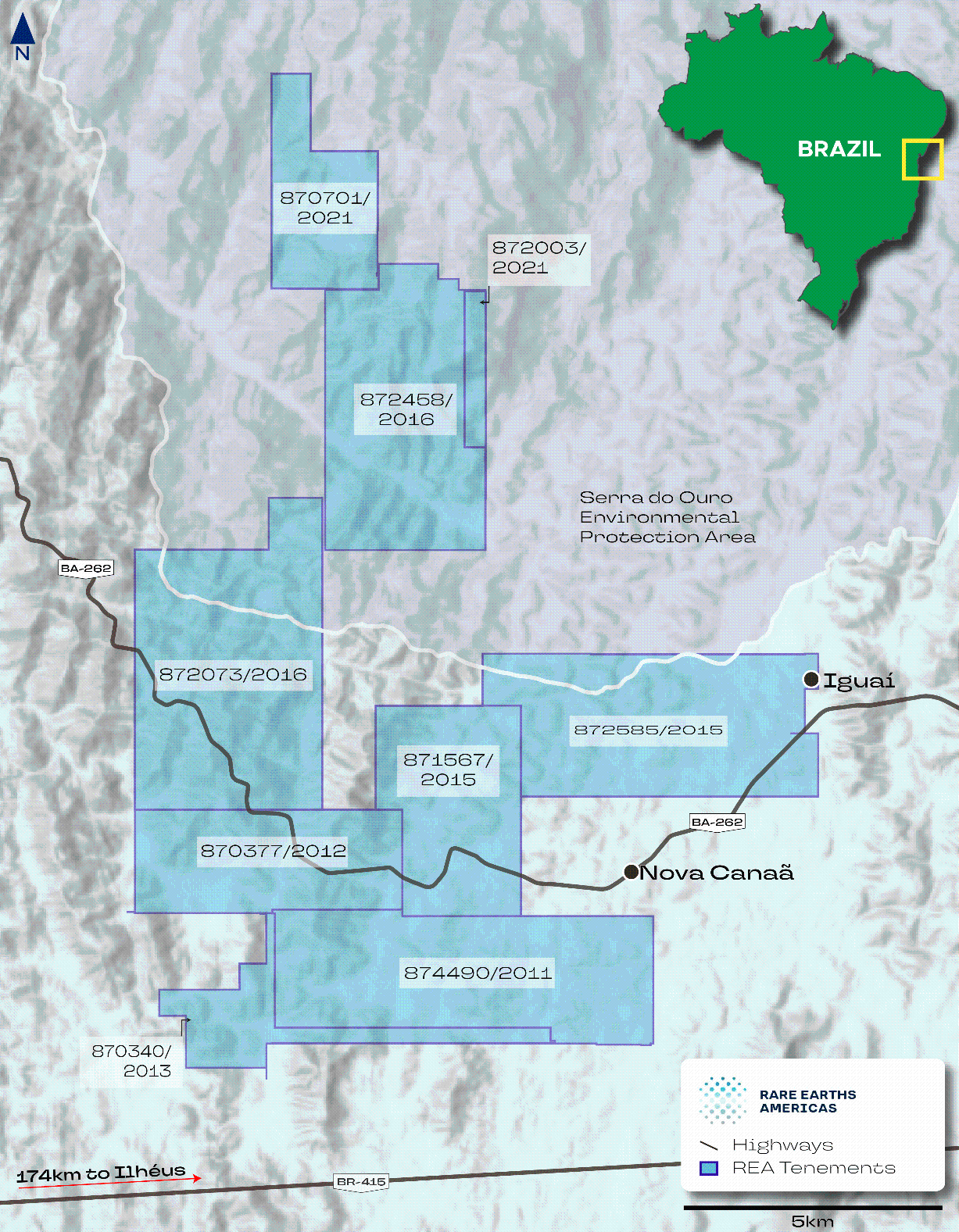
The Alpha Project is an exploration stage project. No mining activities have ever been conducted at the Alpha Project by us or any previous owner.
Physiography and Climate. The Alpha Project is located in a topographic region that encompasses a wide strip of land characterized by crystalline bedrock, forming a north-south running plateau approximately 100 km inland from the coast.
108
The climate in the Alpha Project area is tropical savanna, classified as 'Aw' under the Köppen climate classification system. The average annual temperature is about 22.3°C. The highest average temperatures are observed in March, reaching around 23.9°C. July is the coldest month, with temperatures averaging 20.2°C. The annual precipitation in the area averages 633 mm. Rainfall is irregularly distributed, with most of the rain occurring from October-April, enabling any future mining at the Alpha Project to occur year-round.
Geology and Mineralization. The Alpha Project is situated within the Jequié Complex, an Archean-age tectono-structural block comprising rare earth element enriched granulites, supracrustal sequences, and batholithic intrusions of the Volta do Rio and Poço Preto metaplutonic suites. At the Alpha Project, weathering of the crystalline basement has liberated rare earth elements, which occur in the form of ionically adsorbed mineralization within a well-developed weathering profile, consistent with the IAC deposit style.
The regolith profile, including mottled zones and mineralized saprolite, is laterally continuous across large parts of the deposit area. Drilling has confirmed sufficient geological continuity of mineralized horizons to support the estimation of inferred mineral resources.
Due to the presence of residual cover and the regolith-dominated profile, the underlying bedrock geology and its control on rare earth element distribution is not yet well understood. Additionally, the current drill spacing is too wide to resolve local variations in regolith thickness or the vertical position of mineralized zones with the confidence required for higher confidence resource classifications.
Further geological work and infill drilling, with appropriate studies, will be necessary to improve confidence in the geological model and to support the estimation of indicated or measured resources.
Ownership. The Alpha Project is wholly owned by REA.
Surface Access. To date REA has secured verbal agreements and signed consent declarations from landowners permitting exploration and drilling activities at the Alpha Project. However, REA does not currently hold formal surface access agreements for activities beyond exploration and drilling. Negotiations for such agreements have not yet commenced. REA intends to initiate formal discussions regarding broader surface rights as the project progresses.
All tenements have sufficient area to accommodate mining activities. In addition, there is sufficient space within the existing tenements, outside the defined mineral resource area, to host the infrastructure required for a potential processing operation at the Alpha Project.
At this stage, any additional land required outside the current tenement package is expected to be limited in extent and could be purchased or leased within the local district. The area surrounding the Alpha Project is largely rural, comprising privately held pastoral and agricultural land, and land availability is not currently considered a constraint.
Infrastructure. All Alpha Project tenements are within approximately 35 km of Brazil's major federal highway BR-116 to the west and 80 km of BR-101 to the east. These highways provide direct access to the country's key infrastructure and industrial centers. The tenements can be easily reached from either highway, first by paved highway BA-262 which passes through the Sapacaia, Nova Canaã and Rio das Pombas deposits; and then by a network of partially paved and unpaved roads. All deposit areas are within 1-2 km of municipal road networks. Exploration sites within the tenement areas can be accessed using off-road vehicles via existing agricultural tracks or tracks established by REA through open pasture, plantations, or forests.
The Alpha Project area is located approximately 270 km southwest of Salvador, the capital of Bahia State in Northeast Brazil. The approximate center of the property is 40°9'40.5"W and 14°44'27.5"S (375,000E, 8,370,000N SIRGAS 2000 UTM Zone 24S).
The Alpha Project is surrounded by small population centers that are classified as cities and towns. The closest municipality to the project center, Iguaí, has a population of approximately 27,000 people and offers various amenities to support mineral exploration, including: food, accommodation, fuel, automotive services, and medical facilities. Within the Alpha Project area, there are several small settlements. The region's land use comprises primarily cattle grazing, subsistence farming, plantations (coffee, cocoa, cereals, and cassava), and tourism.
109
The Alpha Project concessions are crossed by three perennial rivers: Rio Preto, Rio do Vigário and the Rio das Pombas. The Project is situated on a hard-rock aquifer with low productivity that is not considered to be sensitive to mining extraction. Piped water supplied by the state utility company can be accessed in the municipalities of Iguaí and Nova Canaã along highway BA-262, which passes through the permit area.
The Alpha Project is less than 500 km by road from the Camaçari petrochemical complex that produces ammonium sulphate and sulfuric acid at a low cost, which are key reagents for the processing IAC mineralization.
The Port of Ilhéus, located within 120 km of the property, can be accessed via highway BR-415 and can facilitate the transportation of freight, heavy machinery, consumables, and mineral products associated with mining.
All of the current manual labor requirements for the Alpha Project, which consist of exploration activities, are met by personnel from nearby communities. Recruitment from outside the area may be required to secure experienced and competent senior personnel for mining operations.
Environmental Matters and Permitting. Current activities at the Alpha Project are limited to mineral exploration. In the state of Bahia, the Instituto do Meio Ambiente e Recursos Hídricos (“INEMA”) is the designated authority responsible for monitoring environmental compliance, including the rehabilitation of drill pads and other surface disturbances resulting from exploration activities.
All exploration work undertaken to date, including auger drill pad construction and access road development, has been conducted in accordance with applicable state and local environmental regulations.
REA acknowledges that any future advancement beyond the exploration stage will be subject to additional environmental permitting at both the state and federal levels. This will include requirements for environmental impact assessments, stakeholder engagement, and site rehabilitation plans.
Project tenements 870701/2021, 872458/2016, and 872003/2021, which host the Rio Preto deposit, lie within the Serra do Ouro Environmental Protection Area (“APA”). Tenements 872073/2016 and 872585/2015, which include the Sapacaia and Rio das Pombas deposits, are partially covered by the same conservation unit.
According to Federal Law 9.985/2000, an APA is classified as a form of conservation unit for sustainable use (Article 14, Item I), with the objective of making nature conservation compatible with the sustainable use of part of its natural resources (Article 7, Paragraph 2). In general, the law does not impose prohibitions on the development of potentially or effectively polluting activities, such as mining. However, it is required that any rules imposed in the Management Plan of the conservation unit be observed and that, within the scope of environmental licensing, there is coordination with the management body of the conservation unit.
In the Brazilian legal framework, mining activities within sustainable use areas are not explicitly prohibited at the federal, state, or municipal levels. Activities in these areas must reconcile economic development with environmental preservation. Mining operations impacting these areas require licensing approval from the respective zone's management authority. This authorization is contingent upon conducting thorough environmental impact assessment studies.
To the extent known to the qualified persons, there are no significant environmental liabilities on the Alpha Project as of the date of the Alpha Technical Report Summary.
All exploration activities at the Alpha Project to date have been conducted in accordance with applicable federal and state regulations. The Alpha Project is located in the state of Bahia, Brazil, and is subject to oversight by both the ANM and INEMA, which are responsible for environmental permitting at the state level.
Next permitting milestones:
110
Future permitting milestones:
Following acceptance of the RFPs by ANM, REA will prepare and submit an Economic Development Plan (“EDP”) to ANM. The EDP, which will be supported by a Scoping Study, must demonstrate the technical and economic viability of the proposed mining operation. Approval of the EDP by ANM is required prior to the issuance of the mining concession.
In parallel with the ANM process, REA will initiate the environmental licensing process with the Secretaria de Estado de Meio Ambiente e Desenvolvimento Sustentável (SEMAD). This process typically consists of three stages:
Each license is granted following the submission and review of the required environmental impact assessments and supporting documentation.
The initial Alpha Project exploration licenses were staked for the purpose of iron ore exploration during the period 2015 to 2017, and for granite quarrying in 2015. REA is not aware of any historical exploration data collected by the previous exploration license holders.
In 2021, AMBPL conducted a review of the CBPM regional-scale airborne geophysical surveys. Based on the presence of prospective anomalies associated with the Volta do Rio Plutonic Suite, exploration licenses were acquired by AMBPL, between 2021 and 2023.
Exploration and Related Programs. Exploration and drilling completed to date are appropriate for the regolith-hosted ionic clay rare earth mineralization at the Alpha Project. Drill collars were surveyed using a handheld global positioning system (“GPS”) instrument referenced to SIRGAS 2000 UTM 24S and projected to a 30 meter digital terrain model (“DTM”); future programs should use differential GPS and higher-resolution topography to improve accuracy for resource modelling and future engineering studies.
Sufficient drilling and sampling data have been collected to support the geological interpretation and mineral resource estimates. Hole spacing ranges from 320 meters (with infill drilling on a diamond pattern) to 225 meters and 160 meters in the most densely drilled places. The geology and mineralization controls are well understood, and the exploration techniques and QA/QC protocols employed are appropriate for this deposit style. The rare earth assay and leach recovery datasets are of adequate quality and quantity for mineral resource estimation.
111
REA’s drilling, sampling, assaying, and QA/QC have been completed in line with good industry practice.
In the opinion of the qualified persons, the current dataset is sufficient to support the mineral resource estimates disclosed. Additional drilling, improved surveying, and further metallurgical testing are recommended to refine the model and advance resources to higher confidence categories.
Mineral Resource Estimates. The depth, geometry, and grade of rare earth bearing saprolite on the properties make them amenable to exploitation by open cut mining methods. At the Alpha Project, reasonable prospects for economic extraction are specified for 33% of the resource model (201.7 Mt) that falls within a resource constraining conceptual pit shell. McGarry Geoconsulting and Karst Geo Solutions visited the project site, verified the historical drillhole database, and gained an understanding of historical QA/QC procedures implemented with respect to the drill samples. The historical exploration data used in the Alpha Project mineral resource estimates was obtained through documented procedures and involved verification and validation of exploration and production data, prior to consideration of geological modelling or mineral resource estimation. No limitations were placed on the qualified person to conduct data verification. In the opinion of McGarry Geoconsulting and Karst Geo Solutions, the data was suitable and adequate for the estimation of mineral resources at the Alpha Project.
The resource estimates are based on the Rio Preto, Sapacaia, Rio das Pombas, and Nova Canaã prospects, the locations of which are highlighted on the following map.
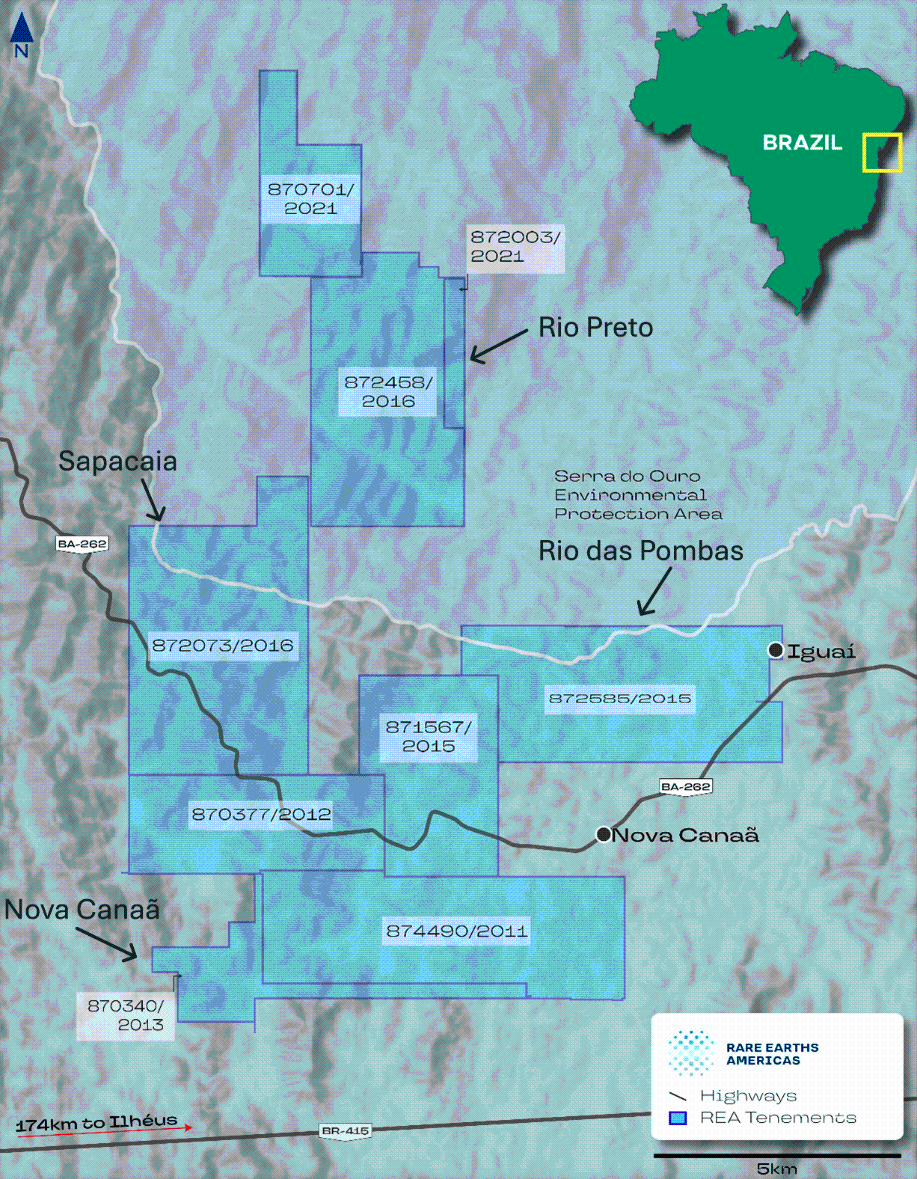
The Alpha Project mineral resource estimates presented in the table below are reported using the mineral resource definitions set out in S-K 1300.
112
Alpha Project Inferred Mineral Resource Estimates
Category |
Deposit |
Tonnes |
TREO |
Nd2O3 + Pr6O11 |
Dy2O3 + Tb4O7 |
Cut-Off Grade |
Recovery |
|
|
(Mt) |
(ppm) |
(ppm) |
(ppm) |
(ppm TREO) |
% |
Inferred |
Rio Preto |
80.8 |
1,478 |
327 |
41.1 |
1,000 |
27 |
Sapacaia |
50.6 |
1,846 |
356 |
33.9 |
22 |
||
Rio das Pombas |
56.5 |
1,370 |
298 |
40.0 |
30 |
||
Nova Canaã |
13.8 |
1,184 |
260 |
34.4 |
35 |
||
Total |
201.7 |
1,520 |
322 |
38.5 |
27 |
Notes to accompany mineral resource table:
REE Oxide |
Avg. Proportion of Recovered TREO (%) |
Current Spot Price ($/kg) |
Forecast Price |
Value at 70% Payability ($/kg) |
Contribution to Avg. Basket Value ($/kg) |
Proportion of Avg. Basket Value(%) |
|||
La2O3 |
24.3 |
|
1.4 |
1.0 |
0.2 |
0.4 |
|||
CeO2 |
6.7 |
|
1.5 |
1.0 |
0.1 |
0.1 |
|||
Pr6O11 |
6.3 |
|
158.6 |
111.0 |
7.0 |
12.2 |
|||
Nd2O3 |
24.3 |
|
154.8 |
108.3 |
26.3 |
46.0 |
|||
Sm2O3 |
4.3 |
|
4.3 |
3.0 |
0.1 |
0.2 |
|||
Eu2O3 |
0.6 |
|
34.7 |
24.3 |
0.1 |
0.3 |
|||
Gd2O3 |
3.7 |
|
80.5 |
56.3 |
2.1 |
3.6 |
|||
Tb4O7 |
0.5 |
|
1550.8 |
1085.5 |
5.8 |
10.1 |
|||
Dy2O3 |
3.2 |
|
503.5 |
352.5 |
11.4 |
19.8 |
|||
Ho2O3 |
0.6 |
|
171.2 |
119.8 |
0.7 |
1.2 |
|||
Er2O3 |
1.8 |
|
58.0 |
40.6 |
0.7 |
1.3 |
|||
Yb2O3 |
1.3 |
|
17.5 |
12.3 |
0.2 |
0.3 |
|||
Lu2O3 |
0.2 |
|
910.8 |
637.6 |
1.3 |
2.2 |
|||
Y2O3 |
21.9 |
|
8.0 |
5.6 |
1.2 |
2.1 |
|||
|
Average TREO Basket Value $/kg: |
57.2 |
100.0 |
|
|||||
113
Participações e Investimentos Ltda.
The estimates contained within the Alpha Technical Report Summary are the initial estimates for those properties.
The following input assumptions, as discussed in Section 11.11 of the Alpha Technical Report Summary, were applied to determine reasonable prospects for economic extraction:
As discussed in Sections 7 and 8 of the Alpha Technical Report Summary, drilling consists of 30 diamond core holes (1,013 m), 15 sonic drill holes (398 m) and 936 auger holes (15,422 m). The mineral resource estimate was based on all drilling data completed to July 16, 2024. The database close-out date reflects the date of the last assay information and is August 13, 2024.
Drill companies and methods included Alpha Minerals Brazil Participações Ltda., a wholly owned subsidiary of the Company, who used a hand-held petrol-powered auger, Brazil Royalty Corp. Participações e Investimentos Ltda, who used an Eijkelkamp Compact RotoSonic V rig for sonic and diamond core drilling. Holes were collared using HQ drill, producing 63.5 mm diameter core, and advanced with NQ rods, producing 47.6 mm diameter core, once fresh, and unoxidized bedrock was encountered.
Auger holes were geologically logged in the field, and a representative fraction was retained in a chip tray for reference. Auger samples were photographed. Sonic and diamond core holes were transported from the drill site to logging facilities in covered boxes. The sonic and diamond core drill core was measured to assess recovery, then geologically logged and photographed wet in core boxes immediately before sampling.
For both auger, sonic and diamond core drill holes, logging included qualitative determinations of primary and secondary lithology units, weathering profile units (mottled zone, lateritic zone, saprock, saprolite, etc.), as well as the color and textural characteristics of the rock.
Recovered auger sample material, and sonic and diamond drill core, was measured, and recovery expressed as a percentage recorded in the database. Recovery rates for auger drilling in regolith is 99%. The average recovery for sonic core drilling in regolith is 95%. The average recovery for diamond core drilling is 78% in regolith and 95% in rock. For core drilling methods, poor recoveries less than 85% typically occur 5–10 m below surface in areas of
114
unconsolidated cover. There was no observed relationship between sample recovery and grade or sample bias due to preferential loss or gain of fine or coarse material.
Drill collars were located using a handheld GPS instrument. The accuracy of the locations is sufficient to support the inferred mineral resource confidence classification. No down hole surveys were completed on any of the drill holes due to their shallow depths.
The mineralization is interpreted to be flat in the weathered profile, so the drilling is vertically perpendicular to mineralization and drilled mineralization thickness is interpreted to correspond to true thickness. Any variations to rare earth element distribution within the horizontal layering were not defined.
Based on the available data, drilling and logging are adequate to support mineral resource estimation.
Auger, sonic and drill core sub-samples submitted for assaying had an average weight of 1 kg. Grab samples had an average weight of 1 kg. For all sample types, field duplicates were completed at a frequency of 1:20 samples. Collected auger sample interval lengths were 1 m, with some variation depending on sample recovery and geological unit boundaries. Core and sonic drill samples were split to obtain quarter core sub-samples for assaying. Core sample intervals were typically 1 m in length, with a minimum of 0.55 m and a maximum of 2.0 m, taking into account lithological boundaries.
Sample collection, preparation, and transportation was managed by Rare Earths Americas. Chain-of-custody procedures consist of sample submittal forms sent to the laboratory with sample shipments to make certain that all samples are received by the laboratory.
Density measurements were completed on 163 fragments of sonic drill core, typically about 10 cm in length and 300 cm3 in volume, collected from across deposit. The water displacement method was used for density measurement. Simple averages generated for each material type were assigned to mineral resource models for each deposit.
SGS Geosol in Vespasiano, Minas Gerais, Brazil (SGS Geosol) has been the primary assay laboratory for the Project since mineral exploration sampling commenced in March 2022. SGS Geosol is independent of the Company and holds ISO 9001 certification and 17025 accreditations. Approximately 74% of the assays (3,642 samples) in the database were generated by SGS Geosol. In early 2024, Rare Earths Americas began periodically sending drill samples for preparation to ALS Belo Horizonte, Brazil (ALS Belo Horizonte) and with assaying completed at the ALS Lima facility in Peru (ALS Lima). ALS Belo Horizonte and ALS Lima are independent of the Company, and both hold ISO 17025 accreditations and ISO 9001 certification. Approximately 26% of the assays (1,293 samples) in the database were generated by ALS Lima.
Sample preparation methods included drying, crushing to 75% passing 3 mm, and pulverizing to 95% passing 75 µm (SGS Geosol) or 85% passing 75 µm (ALS Belo Horizonte). SGS Geosol used a lithium borate fusion followed by inductively-coupled plasma mass spectrometry (ICP-MS) determination for a multi-element suite. ALS Lima used lithium borate fusion followed by an ICP-MS determination (ALS code ME-MS81), to generate a multi-element suite. Botn methods provide a total rare earth element analysis, and values for the potentially deleterious elements uranium and thorium. At both laboratories, the assay technique used for major oxides and components was lithium borate fusion followed by ICP optical emission spectroscopy (OES) analysis.
All exploration conducted was accompanied by a QA/QC program, which included the systematic insertion of CRMs, blank material, and the collection of field duplicate samples along with the exploration samples. QA/QC sample results were monitored by the exploration team independently from the analytical laboratories and were periodically reviewed by McGarry Geoconsulting. The results of the QA/QC samples summitted by Rare Earth Americas during exploration do not indicate significant issues with the analytical data. The performance of CRM, blanks and field duplicates indicate satisfactory performance of field sampling protocols and assay laboratories in providing acceptable levels of precision and accuracy.
Constellation Project
Description and Location. The Constellation Project is located in a renowned IAC rare earth province, approximately 190 km north of São Paulo and 450 km from Belo Horizonte, near the city of Poços de Caldas. The Poços de Caldas alkaline complex has a long history of mining, including uranium, bauxite and clay. The Constellation Project consists
115
of non-contiguous tenement blocks situated in the southern part of Minas Gerais State and in neighboring São Paulo State. The mineral resource estimates are limited to the following seven nearby but non-contiguous tenements in Minas Gerais which have a combined area of approximately 14.4 km2: Pio Cipó, Pedra Preta, Varginha, Roseira, Mato Queimado, Clube da Uva and Andradas. These tenements are distributed across an area 20 km east-west by 20 km north-south. The centroid of this area is located at approximately 46°32'21.29 W and 21°55'46.41 S. The current book value of the Constellation Project property and its associated plant and equipment is US$ .
The Constellation Project is an IAC rare earth project. The following map shows the location of the Constellation Project.
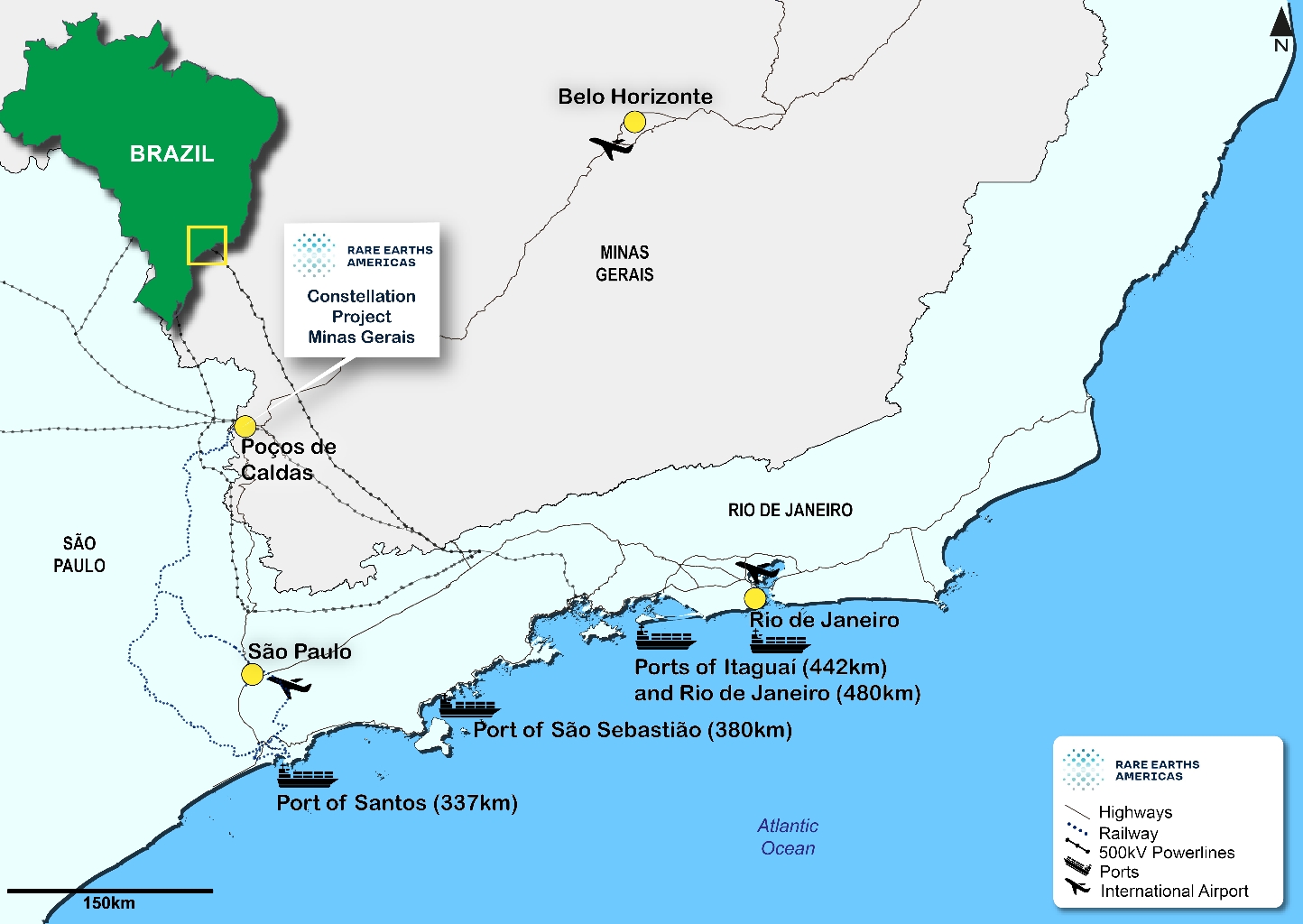
The following map shows the layout of the properties within the Constellation Project.
116
Constellation Project Mineral Properties
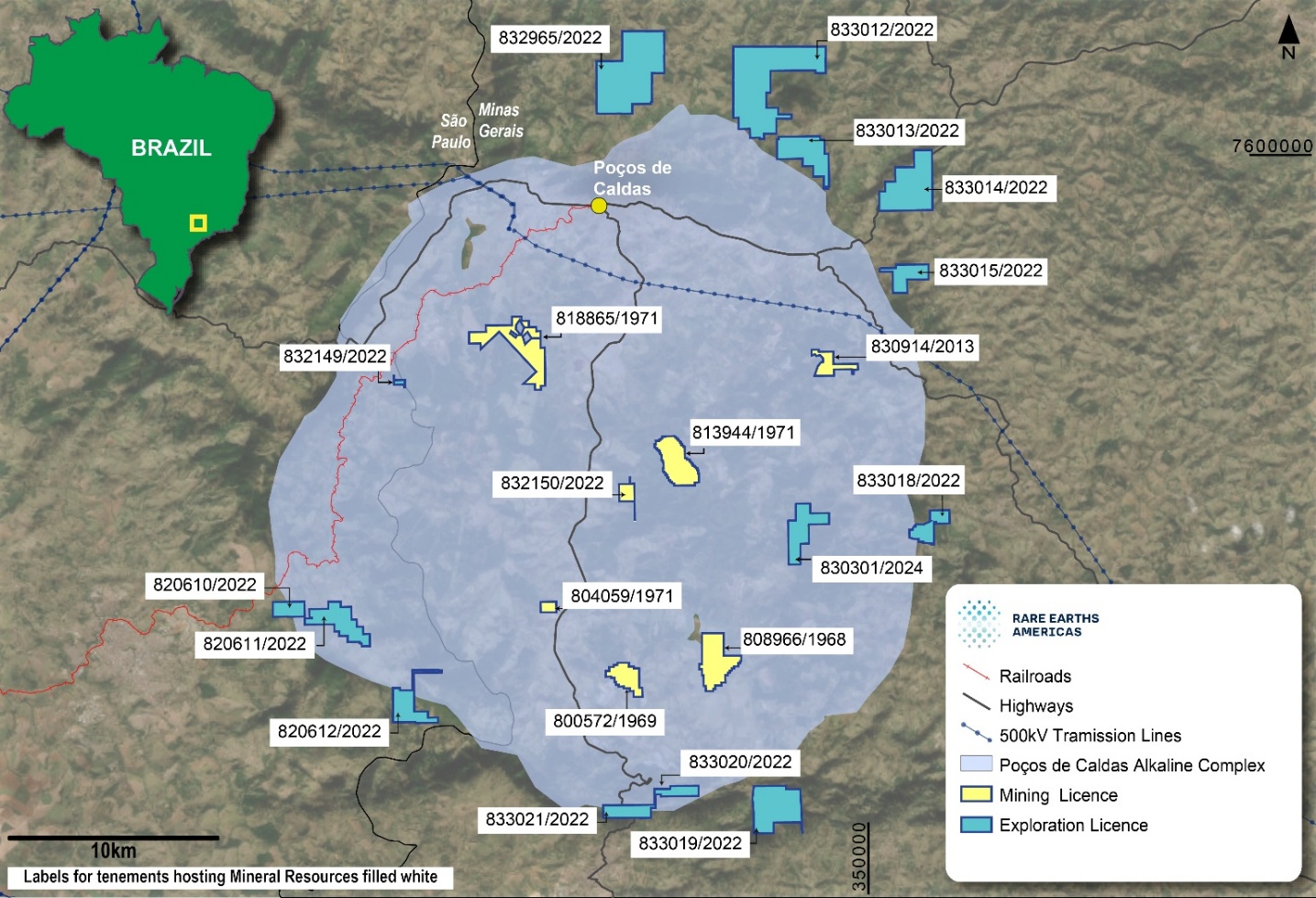
The Constellation Project is an exploration stage property. No mining activities have ever been conducted at the Constellation Project by us or any previous owner.
Physiography and Climate. The Poços de Caldas plateau lies in a transition zone between the seasonal semi-deciduous forests of the Atlantic Forest biome and the high-altitude grassland savanna formations of the Cerrado biome. Most of the tenement areas have been altered by agricultural activities. The Poços de Caldas Basin supports a diverse range of farming activities, including temporary crops such as beans, onions, potatoes, soybeans, corn, and various horticultural products, as well as permanent crops such as olive trees. The region also contains planted forest areas, primarily composed of eucalyptus plantations. Overall, the vegetation cover across the project areas has been extensively modified by agricultural and plantation use. Protected native forest biomes are limited in extent, and the current land use is compatible with the current stage of mineral project development.
The climate in the Constellation Project area is tropical savanna, classified as 'Aw' under the Köppen climate classification system. The average annual temperature is about 22.3°C. The highest average temperatures are observed in March, reaching around 23.9°C. July is the coldest month, with temperatures averaging 20.2°C. The annual precipitation in the area averages 633 mm. Rainfall is irregularly distributed, with most of the rain occurring from October-April. Any future mining operations would occur year-round.
Geology and Mineralization. The Constellation Project hosts rare earth element mineralization in the form of ionically adsorbed rare earth elements bound to clay minerals within the regolith developed over the regional Poços de Caldas alkaline complex. Although IAC deposits are not currently classified within the USGS Mineral Deposit Model series, the deposit type is well defined in the geological literature.
117
The Poços de Caldas region is characterized by an elevated plateau with steep escarpments and a roughly circular morphology approximately 35 km in diameter. This elevated structure is the surface expression of the Poços de Caldas alkaline complex, one of the world’s largest alkaline intrusions. The plateau reaches elevations of 1,300 meters above sea level (“masl”) to 1,600 masl, contrasting sharply with the surrounding lower relief terrain (around 800-1,000 masl). The permits that host mineral resources range in elevation from 1,250 masl to 1,350 masl. The highest elevations occur on the Pedra Preta tenement at the center of the Poços de Caldas complex where they reach 1,450 masl. The lowest elevation of 950 masl occurs on the Andradas tenement where a valley intersects the southern rim of the Poços de Caldas complex.
On the Pio Cipó, Roseira, and Varginha tenements, topography is gently undulating with hills bisected by subdued radial and dendric drainage, with changes in elevation limited to 100 meters or less. The Pedra Preta tenement at the center of the Poços de Caldas complex occurs on a broad, elevated crest extending to a maximum elevation 1,450 masl, which is 100 meters higher than the surrounding north-northwest orientated drainage channels. The Andradas tenement on the southern rim of the Poços de Caldas alkaline complex is characterized by roughly east-west ridgeline intersected by radial drainage depression resulting in a steep elevation difference of approximately 400 meters across the tenement area.
Ownership. The Constellation Project is held through a combination of direct ownership and option agreements. REA holds 21 concessions, including 6 mining concessions and 15 exploration permits. Of these, 13 concessions are directly owned by us or our subsidiaries or affiliates, and 8 concessions are subject to option agreements with Brazilian companies including Mineração Andradense Ltda, JJBF and Green Mining Company Ltda. (which assumed Terra Goyana Mineração Ltda. and Bautek Minerais Industriais Ltda.’s rights and obligations under such option agreement). Private option agreements between AMBPL and the respective landowners grant us the exclusive right to access, enter and occupy each property for the purpose of mineral exploration and, upon exercise of the option, to obtain mineral rights for each property. The Constellation Project is wholly-owned by us. We hold 37 granted permits registered with ANM that cover a total area of approximately 59.5 km². The concessions are located over a large area, 20 km in north–south extent, from Poços de Caldas to the north and Andradas to the south. The mining concessions and exploration concessions are shown in the following map.
118
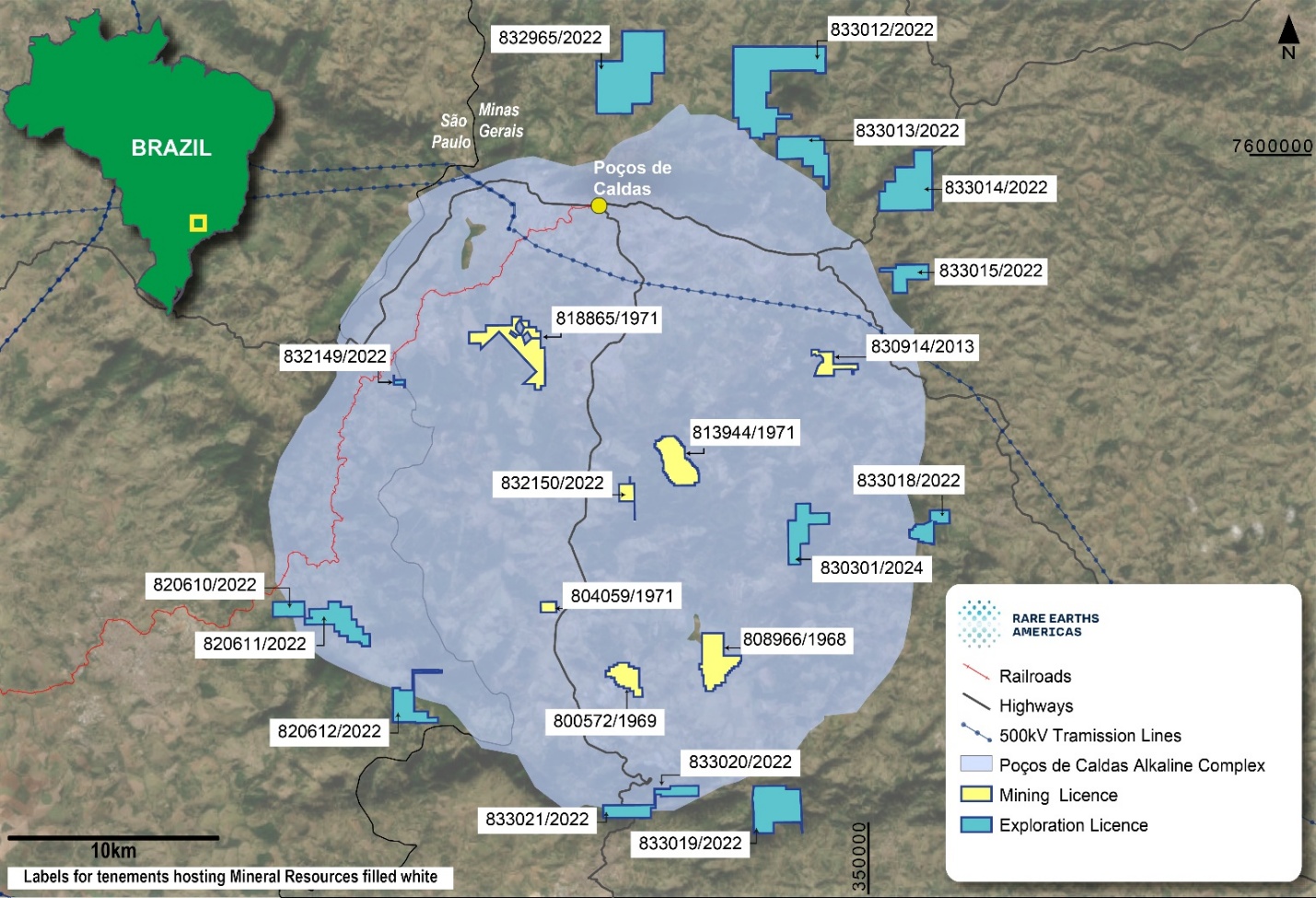
The Constellation Project includes seven mineral resource deposit areas within the following concessions: 818865/1971 - Pio Cipó, 813944/1971 - Pedra Preta, 808966/1968 - Varginha, 800572/1969 – Roseria, 830914/2013 - Mato Queimado, 804059/1971 - Clube da Uva, and 833020/2022 - Andradas. See “Business—Mining Rights—Constellation Project” for additional information.
Surface Access. REA does not currently hold any formal agreements with landowners for surface access rights at the Constellation Project and has not yet started negotiating any such agreements. Exploration activities to date have been conducted under informal access arrangements with landowner consent. REA anticipates initiating formal surface rights discussions as the Constellation Project advances. All tenements have sufficient area to accommodate mining activities. In addition, there is sufficient space within the existing Pio Cipó concession, outside the defined mineral resource area, to host the infrastructure required for a potential processing operation at the Constellation Project. At this stage, any additional land required outside the current tenement package is expected to be limited in extent and could be purchased or leased within the local district. The area surrounding the Constellation Project is largely rural and industrial, comprising privately held pastoral and agricultural land, and land availability is not currently considered a constraint.
Infrastructure. The Constellation Project is surrounded by small cities and towns. Poços de Caldas, the nearest municipality, has a population of approximately 168,640 people as of the date of the Constellation Technical Report Summary, and offers amenities to support mineral exploration, including: food, accommodation, fuel, automotive services, and medical facilities. The Constellation Project is within general proximity of the Port of Santos, situated 365 km from the Constellation Project area, which could be used to support the transport of freight, heavy machinery, and mineral products to and from the Constellation Project area for any future mining operation. The Cubatão Petrochemical Complex is 338 km from the Constellation Project site, and is a source of ammonium sulphate and sulfuric acid supply.
Further, all of the mineral concessions of the Constellation Project are situated within 50 km of federal highway BR-381, which links the industrial hubs of São Paulo (270 km by road) and Belo Horizonte (460 km by road), providing
119
access to regional infrastructure. The various concessions can be reached from BR-381 via federal highway BR-459, which is located 10-15 km to the east of the Constellation Project center, or from BR-146, situated 5 km to the west of the Constellation Project center. From these highways, access within the concessions is facilitated by local all-weather roads. The Constellation Project is in close proximity to transcontinental road and rail networks, as well as international maritime links. The closest major airport is the Guarulhos–Governador André Franco Montoro International Airport in São Paulo.
We have not obtained any permits or agreements to extract water for exploration at the Constellation Project. Exploration to date has not required water use. Water for future operations could be sourced from several nearby storage facilities. The tenements are generally located within 5 to 10 km of major reservoirs, including Represa do Cipó, with a storage capacity of approximately 32 million cubic meters, and Represa Bortolan, with approximately 7 million cubic meters, as well as numerous smaller reservoirs and waterways distributed across the district. Tenements such as Pio Cipó and Varginha, which provide suitable space for locating processing facilities, are adjacent to these reservoirs and can be supplied via short pipeline connections.
The Poços de Caldas district is well served by numerous high-capacity power lines and natural gas pipelines, providing potential energy sources for future mining operations. All tenements hosting mineral resources are either crossed by, or located within approximately 4 km of, a 138 kV electrical transmission line, enabling straightforward connection to regional power infrastructure. A major natural gas pipeline runs approximately 60 km east of the district, offering an additional energy source for potential processing facilities.
All of the current manual labor requirements for the Constellation Project, which consist of exploration activities, are met by personnel from nearby communities. Recruitment from outside the area may be required to secure experienced and competent senior personnel for mining operations.
Environmental Matters and Permitting. Current activities at the Constellation Project are limited to mineral exploration. In the state of Minas Gerais, Brazil, SEMAD is the designated authority responsible for monitoring environmental compliance, including the rehabilitation of drill pads and other surface disturbances resulting from exploration activities, and environmental permitting at the state level, while in the state of São Paulo, the corresponding authority is the Secretaria de Meio Ambiente, Infraestrutura e Logística.
All exploration work undertaken to date, including auger drill pad construction and access road development, has been conducted in accordance with applicable state and local environmental regulations. Any future advancement beyond the exploration stage will be subject to additional environmental permitting at both the state and federal levels. This will include requirements for environmental impact assessments, stakeholder engagement, and site rehabilitation plans.
No formal environmental baseline studies have been conducted on the Constellation Project as of the date of the Constellation Technical Report Summary. To the extent known to the qualified persons, there are no environmental liabilities on the Constellation Project as of the date of the Constellation Technical Report Summary.
The Constellation Project is also subject to oversight by the ANM.
Next permitting milestones:
120
Future permitting milestone:
Exploration History. There is no known previous exploration for rare earth elements in the Constellation Project area prior to our interest in the project. In 2023, AMBPL undertook a countrywide mineral prospectivity review targeting rare earth elements. The review identified the Poços de Caldas alkaline intrusion as a highly prospective geological setting, with favorable bedrock mineralization and documented occurrences of ionic adsorption clay mineralization developed in the overlying regolith. Based on these results, AMBPL initiated a strategic program to secure mineral rights in the region.
Auger drilling has served as the primary form of exploration within the tenements comprising the Constellation Project. The initial exploration licenses were acquired by us in August 2023 and auger drilling commenced that month. In the first quarter of 2024, we dispatched a sonic drill rig to the Constellation Project site. By the second quarter of 2024, a total of 280 drill holes (3,817 meters) were completed, with each drill hole averaging a depth of about 14 meters. During the second half of 2024, we conducted a 133 hole auger exploration drilling campaign for 1,430 meters drilled, with an average depth of 10.7 meters per drill hole.
Encumbrances. There are no material encumbrances to the Constellation Project. A portion of regional tenement 833012/2022, which does not host mineral resources, is intersected by a Municipal Environmental Protection Area. While this intersection does not constitute a title encumbrance and mining within such areas is not prohibited, activities in such areas are subject to additional environmental licensing and permitting requirements. The Pio Cipó deposit, is bisected by transmission lines that pass across the central portion of the deposit and fall within a 250m wide corridor that covers approximately 4% of the reported mineral resource tonnes for the deposit. In addition, two regional exploration tenements 820612/2022 and 832.965/2022, which do not host mineral resources, are partially intersected by transmission lines.
121
Exploration and Related Programs. Exploration and drilling completed to date are appropriate for the regolith-hosted ionic clay rare earth mineralization at the Constellation Project. Drill collars were surveyed using handheld GPS referenced to SIRGAS 2000 UTM 24S and projected to a 30 meter DTM; future programs should use differential GPS and higher-resolution topography to improve accuracy for resource modelling and engineering studies.
Sufficient drilling and sampling data have been collected to support the geological interpretation and mineral resource estimates. The geology and mineralization controls are well understood, and the exploration techniques and QA/QC protocols employed are appropriate for this deposit style. The rare earth assay and leach recovery datasets are of adequate quality and quantity for resource estimation.
Our drilling, sampling, assaying, and QA/QC have been completed in line with good industry practice. Remaining exploration potential exists in lateral saprolite extensions, transitional saprock zones, and peripheral tenements with anomalous rare earth element geochemistry.
In the opinion of the qualified persons, the current dataset is sufficient to support the mineral resource estimates disclosed. Additional drilling, improved surveying, and further metallurgical testing are recommended to refine the model and support higher confidence mineral resource categories.
Mineral Resource Estimates. The depth, geometry, and grade of rare earth bearing saprolite on the properties make them amenable to exploitation by open cut mining methods. At the Constellation Project, reasonable prospects for economic extraction are specified for 64% of the resource model (266 Mt) that falls within a resource constraining conceptual pit shell.
For the Constellation Project, the estimate resulted in (at a 1,000 ppm TREO reporting cut-off) a global inferred mineral resource of 266.2 Mt at an average grade of 2,637 ppm TREO, containing approximately 116,479 tonnes of Nd₂O₃+Pr₆O₁₁(NdPr) and 7,151 tonnes of Dy₂O₃+Tb₄O₇(DyTb). This effective date estimate is current as of October 31, 2025
Drilling, collar surveying and geological, logging at the Constellation Project were conducted in accordance with industry-standard practices for IAC projects.
No downhole surveys were conducted due to the shallow nature of the drilling, with most auger and sonic holes drilled to depths of less than 50 meters. The vertical orientation of holes and their short lengths are expected to result in minimal deviation, and thus positional uncertainty along the drill trace is considered low.
The drilling and logging data are adequate to support mineral resource estimation.
To provide a metallurgical basis for reporting rare earth elements in the mineral resource estimate, we conducted an extensive program of bench-scale leachability testing on exploration drill samples across all deposit areas. Samples were collected at one-meter intervals through the entire regolith profile in a subset of drillholes, providing high vertical resolution and systematic coverage across the mineralized zones. Testing was conducted using ammonium sulfate ion-exchange leaching under controlled conditions selected to closely replicate the anticipated processing route. Leach recoveries for each rare earth element were estimated into the block model from sample results allowing estimation of in-situ rare earth grades and recoveries which are used to calculate a recovered block value, which forms the basis for cut-off grade determinations. The aggregate average leach recoveries from the bench-scale program are considered representative of the deposit at a bulk scale due to the systematic sampling strategy and the close match between laboratory test conditions and the planned plant process.
McGarry Geoconsulting and Karst Geo Solutions reviewed current drilling and sampling procedures, verified the location of selected drill collars, inspected site geological data collection systems, reviewed site geology, reviewed sample storage facilities and discussed QA procedures with geological personnel. McGarry Geoconsulting and Karst Geo Solutions also visited the project area and determined the majority of data, drilling, and geological records were well maintained by site personnel. The historical exploration data used in the Constellation Project resource estimates was obtained through documented procedures and involved verification and validation of exploration and production data, prior to consideration of geological modelling or mineral resource estimation. No limitations were placed on the qualified person to conduct data verification. In the opinion of McGarry Geoconsulting and Karst Geo Solutions, the data was suitable and adequate for the estimation of mineral resources at the Constellation Project.
122
The resource estimates presented in the table below are based on the estimation domain groups, within the individual concession, the locations of which are shown on the following map.
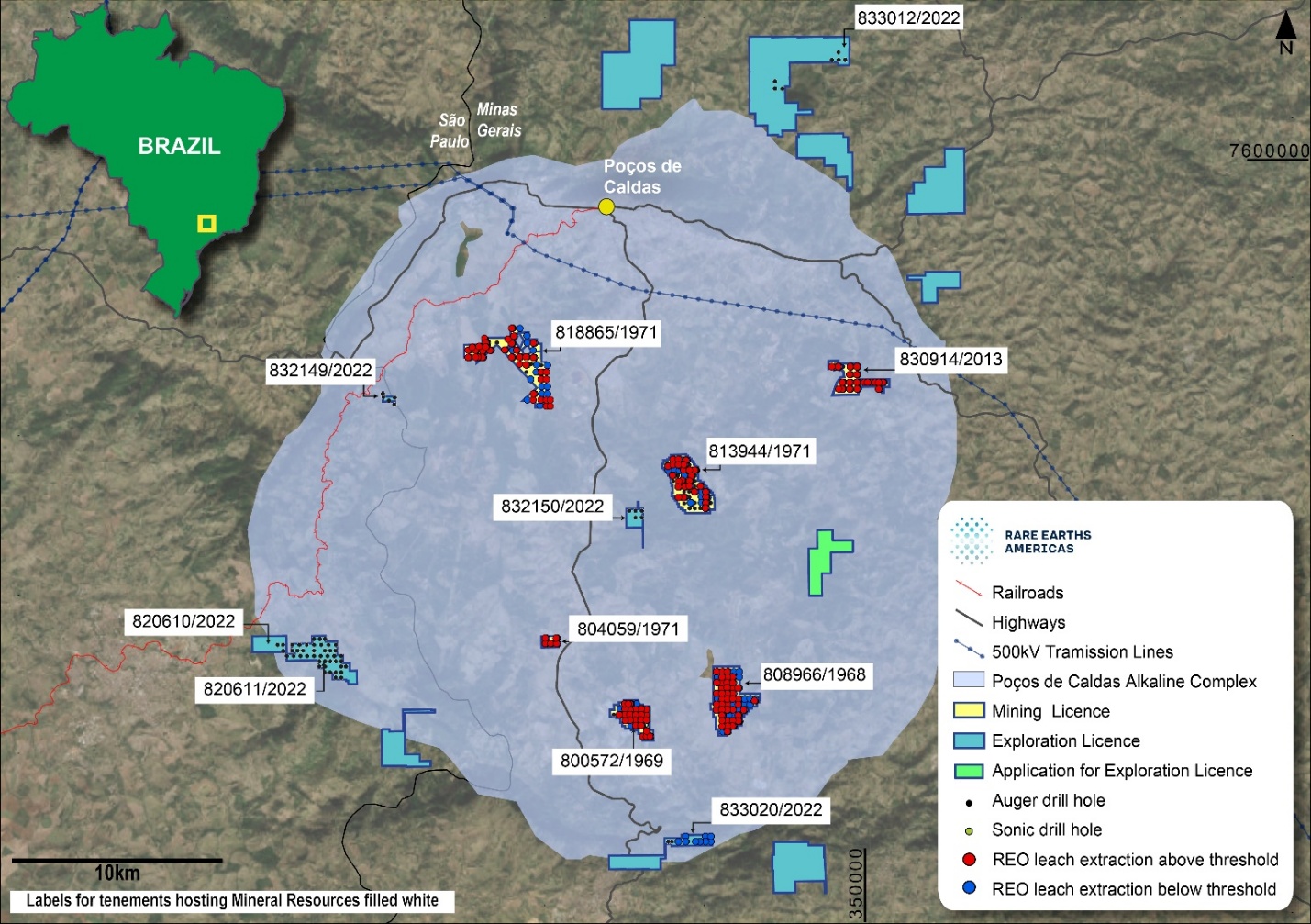
The total area of the seven deposit models is 16 km2. The total modelled volume is approximately 269 Mm3. The modelled north–south extent of individual deposits ranges up to about 3 km. The east–west extents range up to 3 km. The modelled thicknesses range up to 47 meters, and the median thicknesses range from 10-25 meters. Domain extents are provided in Table 11-1 of the Constellation Technical Report Summary.
The depth, geometry, and grade of rare earth bearing saprolite on the properties make them amenable to exploitation by open cut mining methods. At the Constellation Project, reasonable prospects for economic extraction are specified for 64% of the resource model (266 Mt) that falls within a resource constraining conceptual pit shell.
The Constellation Project mineral resource estimates presented in the table below are reported using the mineral resource definitions set out in S-K 1300.
Constellation Project Inferred Mineral Resource Estimates
Category |
Deposit |
Tonnes |
TREO |
Nd2O3 + Pr6O11 |
Dy2O3 + Tb4O7 |
Cut-Off Grade |
Recovery |
|
|
(Mt) |
(ppm) |
(ppm) |
(ppm) |
(ppm TREO) |
% |
Inferred |
Pio Cipó |
70.2 |
2,976 |
722 |
35.6 |
1,000 |
37 |
Pedra Preta |
60.7 |
3,101 |
664 |
32.8 |
29 |
||
Varginha |
53.0 |
2,157 |
350 |
16.9 |
49 |
||
Roseira |
42.3 |
2,508 |
518 |
18.6 |
36 |
123
|
Mato Queimado |
17.7 |
2,027 |
483 |
26.0 |
|
47 |
Clube da Uva |
9.6 |
2,508 |
375 |
17.0 |
35 |
||
Andradas |
12.6 |
1,928 |
513 |
28.1 |
31 |
||
TOTAL |
266.2 |
2,637 |
564 |
26.9 |
38 |
Notes to accompany mineral resource table:
REE Oxide1 |
Avg. Proportion of Recovered TREO (%) |
Current Spot Price ($/kg) |
Forecast Price |
Value at 70% Payability ($/kg) |
Contribution to Avg. Basket Value ($/kg)3 |
Proportion of Avg. Basket Value (%) |
|
La2O3 |
52.6 |
|
1.4 |
1.0 |
0.5 |
1.2 |
|
CeO2 |
6.3 |
|
1.5 |
1.0 |
0.1 |
0.1 |
|
Pr6O11 |
8.5 |
|
158.6 |
111.0 |
9.4 |
21.2 |
|
Nd2O3 |
23.9 |
|
154.8 |
108.3 |
25.9 |
58.4 |
|
Sm2O3 |
2.3 |
|
4.3 |
3.0 |
0.1 |
0.2 |
|
Eu2O3 |
0.4 |
|
34.7 |
24.3 |
0.1 |
0.2 |
|
Gd2O3 |
1.3 |
|
80.5 |
56.3 |
0.7 |
1.7 |
|
Tb4O7 |
0.1 |
|
1550.8 |
1085.5 |
1.6 |
3.6 |
|
Dy2O3 |
0.7 |
|
503.5 |
352.5 |
2.5 |
5.6 |
|
Ho2O3 |
0.1 |
|
171.2 |
119.8 |
0.1 |
0.2 |
|
Er2O3 |
0.3 |
|
58.0 |
40.6 |
0.1 |
0.3 |
|
Yb2O3 |
2.6 |
|
17.5 |
12.3 |
0.3 |
0.7 |
|
Lu2O3 |
0.5 |
|
910.8 |
637.6 |
3.0 |
6.7 |
|
Y2O3 |
0.0 |
|
8.0 |
5.6 |
0.0 |
0.0 |
|
|
Average TREO Basket Value $/kg: |
44.4 |
100.0 |
||||
124
The estimates contained within the Constellation Technical Report Summary are the initial estimates for those properties.
The following input assumptions, as outlined in Section 11.14 of the Technical Report Summary, were applied to determine reasonable prospects for economic extraction:
As discussed in Sections 7 and 8 of the Constellation Project Technical Report Summary, drilling consists of 37 sonic drill holes (1,103 m) and 277 auger holes (3,225 m). The mineral resource estimate was based on all drilling data completed to July 26, 2024. The database close-out date reflects the date of the last assay information and is July 26, 2024.
Drill companies and methods included Alpha Minerals Brazil Participações Ltd., a wholly-owned subsidiary of Rare Earth Americas, who used a hand-held petrol-powered auger, and Brazil Royalty Corp. Participações e Investimentos Ltda (an affiliate company of Rare Earth Americas with overlapping ownership to Alpha Minerals), who used an Eijkelkamp Compact RotoSonic V rig for sonic drilling.
Auger holes were geologically logged in the field, and a representative fraction was retained in a chip tray for reference. Auger samples were photographed. Sonic core holes were transported from the drill site to logging facilities in covered boxes. The sonic drill core was measured to assess recovery, then geologically logged and photographed wet in core boxes immediately before sampling.
For both auger and sonic holes, logging included qualitative determinations of primary and secondary lithology units, weathering profile units (mottled zone, lateritic zone, saprock, saprolite, etc.), as well as the color and textural characteristics of the rock.
Recovered auger sample material and sonic drill core, was measured, and recovery expressed as a percentage recorded in the database. The average recovery for auger drilling and sonic core drilling in regolith is 95%. Areas of poor
125
recovery (<85%) were limited to shallow unconsolidated cover. No systematic relationship between recovery and grade was observed, and no evidence of bias due to preferential loss of coarse or fine material was detected.
Drill collars were located using a handheld GPS instrument. The accuracy of the locations is sufficient to support the inferred mineral resource confidence classification. No down hole surveys were completed on any of the drill holes due to their shallow depths.
The mineralization is interpreted to be flat in the weathered profile, so the drilling is vertically perpendicular to mineralization and drilled mineralization thickness is interpreted to correspond to true thickness. Any variations to rare earth element distribution within the horizontal layering were not defined.
Drilling was conducted on a grid pattern at spacings of approximately 240 m. The distribution is sufficient to establish the degree of geological and grade continuity appropriate for an inferred mineral resource confidence classification.
Based on the available data, drilling and logging are adequate to support mineral resource estimation.
Auger, sonic and drill core sub-samples submitted for assaying had an average weight of 1 kg. Grab samples had an average weight of 1 kg. For all sample types, field duplicates were completed at a frequency of 1:20 samples. Collected auger sample interval lengths were 1 m, with some variation depending on sample recovery and geological unit boundaries. Sonic drill core samples were split to obtain quarter core sub-samples for assaying. Core sample intervals were typically 1 m in length, with a minimum of 0.55 m and a maximum of 2.0 m, taking into account lithological boundaries.
Sample collection, preparation, and transportation was managed by Rare Earths Americas. Chain-of-custody procedures consist of sample submittal forms sent to the laboratory with sample shipments to make certain that all samples are received by the laboratory.
Density measurements were completed on 225 fragments of sonic drill core, typically about 10 cm in length and 300 cm3 in volume, collected from across deposit. The water displacement method was used for density measurement. Simple averages generated for each material type were assigned to mineral resource models for each deposit.
SGS Geosol in Vespasiano, Minas Gerais, Brazil (SGS Geosol) has been the primary assay laboratory for the Project since mineral exploration sampling commenced in June 2023. SGS Geosol is independent of Rare Earths Americas and holds ISO 9001 certification and 17025 accreditations for selected analytical techniques. Approximately 74% of the exploration drilling assays (3,009 samples) in the database were generated by SGS Geosol. In early 2024, Rare Earths Americas began periodically sending drill samples for preparation to ALS Belo Horizonte, Brazil (ALS Belo Horizonte) and with assaying completed at the ALS Lima facility in Peru (ALS Lima). ALS Belo Horizonte and ALS Lima are independent of Rare Earths Americas, and both hold ISO 17025 accreditations for selected analytical techniques, and ISO 9001 certification. Approximately 26% of the assays (1,049 samples) in the database were generated by ALS Lima.
Sample preparation methods included drying, crushing to 75% passing 3 mm, and pulverizing to 95% passing 75 µm (SGS Geosol) or 85% passing 75 µm (ALS Belo Horizonte). SGS Geosol used a lithium borate fusion followed by ICP-MS determination for a multi-element suite. ALS Lima used lithium borate fusion followed by an ICP-MS determination (ALS code ME-MS81), to generate a multi-element suite. Both methods provide a total rare earth element analysis, and values for the potentially deleterious elements uranium and thorium. At both laboratories, the assay technique used for major oxides and components was lithium borate fusion followed by ICP OES analysis.
All exploration conducted was accompanied by a QA/QC program, which included the systematic insertion of CRMs, blank material, and the collection of field duplicate samples along with the exploration samples. QA/QC sample results were monitored by the exploration team independently from the analytical laboratories and were periodically reviewed by McGarry Geoconsulting. The results of the QA/QC samples summitted by Rare Earth Americas during exploration do not indicate significant issues with the analytical data. The performance of CRM, blanks and field duplicates indicate satisfactory performance of field sampling protocols and assay laboratories in providing acceptable levels of precision and accuracy.
126
MANAGEMENT
The following table sets forth certain biographical and other information regarding our executive officers and directors:
Name |
|
|
Age |
|
|
Position(s) |
|
Executive Officers |
|
|
|
|
|
|
|
Donald Swartz |
|
|
46 |
|
|
Chief Executive Officer, President and Director |
|
Jennifer Grafton |
|
|
50 |
|
|
Chief Operating Officer, General Counsel and Secretary |
|
Cheryl Kerr |
|
|
60 |
|
|
Chief Accounting Officer and Treasurer |
|
|
|
|
|
|
|
|
|
Non-Employee Directors |
|
|
|
|
|
|
|
Dan Shribman |
|
|
42 |
|
|
Chairman |
|
Ivy Estabrooke |
|
|
49 |
|
|
Director |
|
Reta Jo Lewis |
|
|
72 |
|
|
Director |
|
Keith Phillips |
|
|
66 |
|
|
Director |
|
Hugo Schumann |
|
|
43 |
|
|
Director |
|
The following are brief biographies describing the backgrounds of our executive officers and directors.
Executive Officers
Donald Swartz — Chief Executive Officer, President and Director
Mr. Swartz has served as our Chief Executive Officer and President since August 1, 2025 and as a member of our board of directors since April 18, 2025. Prior to being appointed as our Chief Executive Officer and President, Mr. Swartz served as Interim Chief Executive Officer of FRE Australia, from January to August 2025, and as a consultant to FRE US from January 2025 to August 2025. Prior to this, Mr. Swartz served as Chief Executive Officer of American Rare Earths Limited, a company that explores and develops mineral resources in the U.S. (ASX: ARR; OTCQX: ARRNF), from July 2023 to August 2024. From August 2024 until February 2025, Mr. Swartz was self-employed as a consultant in the mining industry. From June 2019 to July 2022, Mr. Swartz served as Senior Vice President of Vista Energy Holdings, a private mining and energy development company. Prior to his tenure at Vista Energy Holdings, Mr. Swartz held several senior executive positions at Westmoreland Coal Company (“Westmoreland”), a former U.S.-based energy company, which was previously listed on Nasdaq. At Westmoreland, he served successively as Chief Commercial Officer, Senior Vice President of Commercial, Sales and Marketing, Vice President of Sales and Marketing, and Vice President of Business Development from December 2017 to June 2019. Mr. Swartz holds a Master of Business Administration from the University of Denver and a Bachelor of Science degree in Mining Engineering from West Virginia University. Mr. Swartz served as an executive officer of Westmoreland at the time that Westmoreland filed for Chapter 11 reorganization in 2018; Westmoreland emerged from Chapter 11 bankruptcy in 2019.
We believe that Mr. Swartz is qualified to serve on our board of directors due to his extensive experience in the mining industry.
Jennifer Grafton — Chief Operating Officer, General Counsel and Secretary
Ms. Grafton has served as our Chief Operating Officer, General Counsel and Secretary since August 1, 2025. Prior to being appointed as our Chief Operating Officer, General Counsel and Secretary, Ms. Grafton served as a consultant to FRE US from February 2025 to August 2025. Prior to this, Ms. Grafton served as Executive Vice President and General Counsel of E2open Parent Holdings, Inc. (NYSE: ETWO), a cloud-based, end-to-end supply chain management software company from 2021 to 2024. Previous to E2open, Ms. Grafton worked at Westmoreland from December 2008 to July 2019, most recently serving as Chief Legal Officer, Chief Administrative Officer and Secretary. Prior to Westmoreland, Ms. Grafton worked in the corporate group of various Denver-based and national law firms focusing her practice on securities and corporate governance. She also serves as a director of Dakota Gold
127
Corp. (NYSE American: DC), a publicly traded gold exploration and development company, and serves as Lead Independent Director of Farmland Partners Inc. (NYSE: FPI), a public internally managed real estate company focused on high-quality farmland. Ms. Grafton holds a Master of Business Administration from the University of Michigan, Juris Doctorate from the University of Denver and a Bachelor of Arts in politics and government from the University of Puget Sound. Ms. Grafton served as an executive officer of Westmoreland at the time that Westmoreland filed for Chapter 11 reorganization in 2018; Westmoreland emerged from Chapter 11 bankruptcy in 2019.
Cheryl Kerr – Chief Accounting Officer and Treasurer
Ms. Kerr has served as our Chief Accounting Officer and Treasurer since February 1, 2026. Prior to being appointed our Chief Accounting Officer and Treasurer, Ms. Kerr served as a consultant to the Company from December 2025 to February 2026. Prior to this, Ms. Kerr served as Senior Director of Accounting at Lumen Technologies, Inc. (NYSE: LUMN), a global networking company from August 2021 to October 2025, where she held various roles including the Senior Director of SEC Reporting and Senior Director of Finance Separation Management and International Accounting. Before Lumen Technologies, between 2019 and 2021, Mr. Kerr worked as an accounting consultant for various companies, including Lumen Technologies. Ms. Kerr holds both a Bachelor and Master of Business Administration from the University of Oklahoma Price College of Business and is a Certified Public Accountant.
Non-Employee Directors
Dan Shribman — Chairman
Mr. Shribman has served as a director of the Company since the Company’s formation in February 2025. Mr. Shribman has served as Chief Executive Officer of Great American Holdings, a financial services company providing valuation, appraisal, asset disposition, and real estate solutions, since July 2025. In addition, he has served as the Chief Executive Officer of Clamantis Holdings, an investment and advisory firm he founded which focused on small public companies and pre-IPO private companies, since January 2025. From October 2018 to December 2024, Mr. Shribman was Chief Investment Officer of B. Riley Financial, Inc., a public holding company (Nasdaq: RILY). Prior to that, from July 2010 to July 2018, he was a Portfolio Manager at Anchorage Capital Group, a special situation asset manager. Mr. Shribman currently serves on the board of Alta Equipment Group (NYSE: ALTG), a public construction and material handling equipment dealer, and has been on the board of AltEnergy Acquisition Corp. (Nasdaq: AEAE), a public blank check company, since October 2021, where he serves as Audit Committee Chair. He previously served on the boards of The Arena Group Holdings, Inc. (NYSE: AREN) from June 2021 to November 2023, Faze Holdings (Nasdaq: FAZE) from July 2022 to August 2023, NextPoint Financial Inc. (OTCMKTS: NACQF) from August 2021 to April 2023, and Eos Energy (Nasdaq: EOSE) from November 2020 to September 2022. Mr. Shribman holds an A.B. in Economics and History from Dartmouth.
We believe that Mr. Shribman is qualified to serve on our board of directors due to his extensive experience as a director, his experience in portfolio and investment management, and his knowledge of corporate finance.
Ivy Estabrooke
Dr. Ivy Estabrooke has served as a director of the Company since October 2025. She currently serves as Strategic Account Executive for Defense at RTI International, an independent, nonprofit scientific research institute, where she has held senior roles in innovation strategy and policy since November 2022. From February 2020 to September 2022, Dr. Estabrooke was Vice President of Operations and Corporate Affairs at IDbyDNA, Inc., a commercial-stage biotechnology company acquired by Illumina, Inc. (Nasdaq: ILMN). She previously served as Vice President of Government Affairs at PolarityTE, Inc. (Nasdaq: PTE), a clinical-stage biotechnology company developing regenerative tissue products and biomaterials, from July 2018 to January 2020. Earlier in her career, Dr. Estabrooke was Executive Director of the Utah Science, Technology and Research (USTAR) Initiative, and was a Technical Program Manager with the U.S. Department of the Navy from 2008 to 2014. Dr. Estabrooke currently serves on the advisory board of URZ3 Energy Corp (TSXV: URZ.V), and served on the board of directors of Energy Fuels Inc. (NYSE: UUUU) from 2022 to 2025. Dr. Estabrooke holds a Ph.D. in Neuroscience from Georgetown University, an M.S. in National Resource Strategy from the Eisenhower School for National Security and Resource Management at the National Defense University, and a B.A. in Biological Sciences from Smith College.
128
We believe Dr. Estabrooke is qualified to serve on our board of directors due to her expertise in advancing the development and commercialization of emerging technologies at the intersection of national and economic security, as well as her extensive government affairs experience.
Reta Jo Lewis
Ms. Lewis has served as a director of the Company since October 2025. She has served as Of Counsel at Husch Blackwell since April 2026. Ms. Lewis served as the 27th Chairman, President, and Chief Executive Officer of the Export-Import Bank of the United States (EXIM) from February 2022 to January 2025. Prior to EXIM, she served as Senior Fellow and the Director of Congressional Affairs for the German Marshall Fund of the United States from March 2016 to February 2022. Previously, Ms. Lewis served as the U.S. Department of State’s first Special Representative for Global Intergovernmental Affairs from January 2010 to May 2013. Ms. Lewis practiced law as a Shareholder at Greenberg Traurig LLP from 1997 to 2000. Ms. Lewis holds a J.D. from Emory University School of Law, an M.S.A.J. from American University, and a B.A. from the University of Georgia.
We believe Ms. Lewis is qualified to serve on our board of directors due to her extensive leadership in international trade, export finance, and government affairs, as well as her deep expertise in critical-mineral supply-chain policy and global partnership development.
Keith Phillips
Mr. Keith Phillips has served on our board of directors since October 2025. Mr. Phillips served as Chief Executive of Piedmont Lithium (formerly listed on Nasdaq) from its inception in July 2017 to its merger with Sayona Mining in October 2025. Prior to joining Piedmont, Mr. Phillips had a 30-year career on Wall Street. Among other positions, Mr. Phillips led the mining investment banking teams for Merrill Lynch, J.P. Morgan, and Dahlman Rose, having previously served as head of Canadian Investment Banking Services for Goldman Sachs. Mr. Phillips serves as a executive chair of Q2 Metals (TSX.V: QTWO.V), a public company focused on mineral exploration in Canada. Mr. Phillips earned his Master of Business Administration in Finance from The University of Chicago and Bachelor of Commerce from Laurentian University in Canada.
We believe that Mr. Phillips is qualified to serve on our board of directors because of his extensive experience with mining companies, including many established global leaders, and his expertise in advising exploration and development-stage companies in achieving their strategic objectives, with a particular focus on obtaining relevance in the U.S. capital markets.
Hugo Schumann
Mr. Schumann has served as a director of the Company since October 2025. He has served as Chief Executive Officer of EverMetal Buyer Inc., a private equity–backed critical-metals recycling platform, since August 2025; as CEO-USA, for PGM of Texas, LLC since April 2025, a company dedicated to metals recycling and urban mining; and as Strategic Advisor at Colt Recycling LLC, a company dedicated to electronics recycling, since June 2025. He previously served as Chief Executive Officer–Silver at the Indian integrated mining and resources producer of zinc, lead, silver and cadmium Hindustan Zinc Limited (NSE: HINDZINC; BSE: 500188) from February 2024 to October 2024, and as Chief Financial Officer of Jetti Resources, a copper‑processing technology company, from October 2019 to January 2024. Mr. Schumann holds an M.B.A. from INSEAD and a Bachelor of Business Science from the University of Cape Town. Mr. Schumann previously served as a non‑executive director of Global Uranium & Enrichment Ltd (ASX: GUE), and currently serves as a non-executive director and member of the audit committee of IonDrive Ltd (ASX: ION).
We believe Mr. Schumann is qualified to serve on our board of directors due to his extensive experience in critical-minerals project finance, metals-recycling operations, and executive leadership across the global mining industry.
129
Family Relationships
There are no family relationships among our directors and executive officers.
Board Composition
Our certificate of formation provides that our board of directors shall initially consist of three directors, and thereafter shall be fixed from time to time by resolution of our board of directors. Currently our board of directors consists of six members: Dan Shribman, Donald Swartz, Ivy Estabrooke, Reta Jo Lewis, Keith Phillips and Hugo Schumann.
Each director shall hold office until the next annual meeting and until the election and qualification of his or her successor, or his or her earlier death, resignation or removal. Our bylaws authorize our board of directors to fill vacancies on our board of directors.
Director Independence
Under the listing standards, requirements and rules of the NYSE American (the “NYSE American Listing Rules”), independent directors must comprise a majority of our board of directors as a listed company within one year of the listing date.
Pursuant to the corporate governance standards of the NYSE American, a director will qualify as “independent” only if our board of directors affirmatively determines that he or she has no material relationship with us, either directly or as a partner, stockholder or officer of an organization that has a relationship with us. The fact that a director may own our capital stock is not, by itself, considered a material relationship. Our board of directors has undertaken a review of the independence of each director. Based on information provided by each director concerning her or his background, employment, and affiliations, including family relationships, our board of directors has determined that Mr. Shribman, Ms. Estabrooke, Ms. Lewis, Mr. Phillips and Mr. Schumann are “independent” as that term is defined under the NYSE American Listing Rules. Our board of directors has determined that Mr. Swartz, by virtue of his employment relationships with us is not independent under applicable rules and regulations of the SEC and the NYSE American. In making these determinations, our board of directors considered the current and prior relationships that each non-employee director has with our company and all other facts and circumstances our board of directors deemed relevant in determining their independence, including the beneficial ownership of our shares by each non-employee director and the transactions described in the section titled “Certain Relationships and Related Person Transactions.”
Board Leadership Structures
Our board of directors recognizes that one of its key responsibilities is to evaluate and determine its optimal leadership structure so as to provide effective oversight of management. Our bylaws and corporate governance guidelines will provide our board of directors with flexibility to combine or separate the positions of Chairman of our board of directors and Chief Executive Officer. Our board of directors currently believes that our existing leadership structure, under which Mr. Swartz serves as our Chief Executive Officer and President and Mr. Shribman serves as Chairman of our board of directors, is effective, provides the appropriate balance of authority between independent and non-independent directors, and achieves the optimal governance model for us and for our stockholders. Our board of directors will continue to periodically review our leadership structure and may make such changes in the future as it deems appropriate.
Role of Board in Risk Oversight
Although management is responsible for the day-to-day management of the risks our company faces, our board of directors and its committees take an active role in overseeing management of our risks and have ultimate responsibility for the oversight of risk management. Our board of directors regularly reviews information regarding our operational, financial, legal and strategic risks. Specifically, senior management attends quarterly meetings of the board of directors, provides presentations on operations including significant risks, and is available to address any questions or concerns raised by our board of directors.
In addition, we expect that the three committees of our board of directors which we plan to establish will assist the board of directors in fulfilling its oversight responsibilities regarding risk. The audit committee will coordinate the board of director's oversight of our internal control over financial reporting, disclosure controls and procedures, related party transactions and code of conduct and corporate governance guidelines, and management will regularly report to
130
the audit committee on these areas. The compensation committee will assist the board of directors in fulfilling its oversight responsibilities with respect to the management of risks arising from our compensation policies and programs as well as succession planning as it relates to our Chief Executive Officer. The nominating and corporate governance committee will assist the board of directors in fulfilling its oversight responsibilities with respect to the management of risks associated with board organization, membership and structure, succession planning for our directors and corporate governance. When any of the committees receives a report related to material risk oversight, the chairman of the relevant committee will report on the discussion to the full board of directors.
Board Committees
Our board of directors has established an audit committee, a compensation committee, and a nominating and corporate governance committee. The composition and responsibilities of each of the committees of our board of directors are described below. Members serve on these committees until their resignation or until otherwise determined by our board of directors. Each committee has adopted a written charter that satisfies the applicable rules and regulations of the SEC and the NYSE American. Upon the completion of this offering, each committee’s charter will be available on our website at rareearthsamericas.com. Our board of directors may establish other committees as it deems necessary or appropriate from time to time.
The NYSE American permits a phase-in period of up to one year for an issuer registering securities in an initial public offering to meet the audit committee, compensation committee and nominating and corporate governance committee independence requirements. Under the initial public offering phase-in period, only one member of each committee is required to satisfy the heightened independence requirements at the time our registration statement becomes effective, a majority of the members of each committee must satisfy the heightened independence requirements within 90 days following the effectiveness of our registration statement, and all members of each committee must satisfy the heightened independence requirements within one year from the effectiveness of our registration statement.
Audit Committee
Our audit committee consists of Ivy Estabrooke and Dan Shribman, with Hugo Schumann serving as chair. Our board of directors has determined that each member of the audit committee is independent under the NYSE American Listing Rules and Rule 10A-3(b)(1) of the Exchange Act , and can read and understand fundamental financial statements in accordance with applicable requirements. Our board of directors has also determined that Mr. Schumann is an “audit committee financial expert,” as defined under the applicable rules of the SEC. In arriving at these determinations, our board of directors has examined each audit committee member’s scope of experience and the nature of their employment in the corporate finance sector.
The audit committee’s responsibilities include:
131
Our audit committee will operate under a written charter, which will be effective upon the effectiveness of the registration statement of which this prospectus forms a part, that satisfies the applicable standards of the SEC and the NYSE American Listing Rules.
Compensation Committee
Our compensation committee consists of Reta Jo Lewis and Dan Shribman, with Keith Phillips serving as chair. Our board of directors has determined that each member of the compensation committee is independent under the NYSE American Listing Rules and is a “non-employee director” as defined in Rule 16b-3 under the Exchange Act.
The compensation committee’s responsibilities include:
Our compensation committee will operate under a written charter, which will be effective upon the effectiveness of the registration statement of which this prospectus forms a part, that satisfies the applicable standards of the SEC and the NYSE American Listing Rules.
Nominating and Corporate Governance Committee
Our nominating and corporate governance committee consists of Ivy Estabrooke and Keith Phillips, with Reta Jo Lewis serving as chair. Our board of directors has determined that each member of the nominating and corporate governance committee is independent under the NYSE American Listing Rules, a non-employee director, and free from any relationship that would interfere with the exercise of his or her independent judgment.
The nominating and corporate governance committee’s responsibilities include:
132
Our nominating and corporate governance committee will operate under a written charter, which will be effective upon the effectiveness of the registration statement of which this prospectus forms a part, that satisfies the applicable standards of the SEC and the NYSE American Listing Rules.
Compensation Committee Interlocks and Insider Participation
None of the members of our compensation committee has during the prior fiscal year been one of our officers or employees or had a relationship requiring disclosure under “Certain Relationships and Related Party Transactions.” None of our executive officers currently serves, or in the past fiscal year has served, as a member of the board of directors or compensation committee of any entity that has one or more executive officers serving on our board of directors or compensation committee.
Code of Business Conduct and Ethics
We have adopted a written code of business conduct that applies to our directors, officers and employees, including our principal executive officer, principal financial officer, principal accounting officer or controller, or persons performing similar functions. Upon the closing of this offering, a current copy of the code will be posted on the Investor Relations section of our website at rareearthsamericas.com. The information contained on our website is not part of this prospectus. If we make any substantive amendments to, or grant any waivers from, the code of business conduct and ethics for any officer or director, we will disclose the nature of such amendment or waiver on our website or in a current report on Form 8-K within four business days of such amendment or waiver.
133
EXECUTIVE COMPENSATION
The following disclosure of compensation arrangements should be read together with the compensation tables and related disclosures that follow. This discussion contains forward-looking statements that are based on our current plans and expectations regarding future compensation programs. Actual compensation programs that we adopt may differ materially from the programs summarized in this discussion. The following discussion may also contain statements regarding corporate performance targets and goals. These targets and goals are disclosed in the limited context of our compensation programs and should not be understood to be statements of management’s expectations or estimates of future results or other guidance. We specifically caution investors not to apply these statements to other contexts.
As an “emerging growth company,” within the meaning of the Securities Act, and as a “smaller reporting company” for purposes of the SEC’s executive compensation disclosure rules, we have opted to comply with the executive compensation disclosure rules applicable to “smaller reporting companies.” In accordance with such rules, we are required to provide a Summary Compensation Table and an Outstanding Equity Awards at Fiscal Year-End Table, as well as specified narrative disclosures regarding executive compensation for our last completed fiscal year. This section discusses the material components of the executive compensation program for our Chief Executive Officer and our two other most highly compensated officers for the fiscal year ending December 31, 2025, who we collectively refer to as our “named executive officers.” For 2025, our named executive officers and their positions were as follows:
We were formed in February 2025; thus, all information disclosed in this Execution Compensation section relating to fiscal year 2024 relates to our Predecessor. Our Predecessor is a limited liability company (sociedade limitada) organized under the laws of Brazil. As a Brazilian limited liability company, our Predecessor is not required to have a board of directors or fiscal council, which is an independent committee within a company responsible for supervising management’s actions and auditing the company's financial statements. Our Predecessor is otherwise required to have statutory designated managers to represent, as necessary, the Predecessor entity before local authorities, as well as to sign various operating agreements related to the exploration of our Predecessor’s different mining projects. For fiscal year 2024, the two statutory managers designated by the Predecessor’s parent company, Rare Earths Americas Limited (“REA Australia”), were Renato Aureo de Paula Gonzaga and João Paulo Agapito da Veiga. Messrs. Gonzaga and Veiga were Predecessor’s named executive officers for fiscal year 2024.
Summary Compensation Table
Name and Principal Position |
|
Year |
|
Salary ($) |
Bonus ($)(1) |
Stock Awards ($)(2) |
All Other Compensation ($) |
Total ($) |
|
||
Donald S Swartz, II |
|
2025 |
|
145,833 |
525,000 |
2,942,416(3) |
120,000(4) |
|
3,733,249 |
|
|
Chief Executive Officer |
|
2024 |
|
— |
— |
|
— |
|
— |
|
|
Jennifer Grafton |
|
2025 |
|
125,000 |
225,000 |
925,568(5) |
90,000(6) |
|
1,365,568 |
|
|
Chief Operating Officer |
|
2024 |
|
— |
— |
|
— |
|
— |
|
|
Joseph Dwyer(7) |
|
2025 |
|
97,917 |
— |
205,088(8) |
18,000(9) |
|
321,005 |
|
|
Chief Financial Officer |
|
2024 |
|
— |
— |
|
— |
|
— |
|
|
Renato Aureo de Paula Gonzaga |
|
2025 |
|
— |
— |
|
— |
|
— |
|
|
Statutory Manager (10) |
|
2024 |
|
— |
— |
|
36,109(11) |
|
36,109 |
|
|
João Paulo Agapito da Veiga |
|
2025 |
|
— |
— |
|
— |
|
— |
|
|
Statutory Manager (10) |
|
2024 |
|
— |
— |
|
14,563(12) |
|
14,563 |
|
|
134
Narrative to Summary Compensation Table
As described under the heading “Executive Officers,” Mr. Swartz and Ms. Grafton provided consulting services to our affiliated entity, FRE US, beginning in January 2025 and February 2025, respectively. Following our formation in February 2025 and the completion of the Acquisition in July 2025, effective August 1, 2025, Mr. Swartz was appointed as the Company’s Chief Executive Officer and President; Ms. Grafton as the Company’s Chief Operating Officer, General Counsel and Corporate Secretary; and Mr. Dwyer as the Company’s Chief Financial Officer. See “Management — Executive Officers.” Mr. Dwyer resigned from his role as our Chief Financial Officer and Treasurer, effective as of February 1, 2026.
In 2025, each of the Messrs. Swartz and Dwyer and Ms. Grafton entered into an employment agreement with REA Management, our then-wholly-owned U.S.-based operating subsidiary. Effective December 31, 2025, we completed a merger of REA Management into REA, which resulted in all employees of REA Management becoming employees of REA as of January 1, 2026. The employment agreements generally provide for each executive’s base salary, target bonus opportunity, reimbursement of reasonable business expenses and eligibility to participate in our equity and benefit plans. The material terms of the employment agreements are summarized below. These summaries are qualified by reference to the actual text of the agreements, which are filed as exhibits to the registration statement of which this prospectus forms a part. In addition to the key terms summarized below, each of our executives is a participant in the Rare Earths Americas, Inc. Executive Severance Plan (the “Severance Plan”), which provides for certain severance benefits upon a termination by us or our subsidiaries without “Cause.” See “Executive Compensation—Potential Payments Upon Termination or Change in Control” below for more details regarding the severance benefits provided to our executive officers under the employment agreements, and Exhibit 10.14 for a copy of our Severance Plan described therein. See “Executive Compensation—Equity Incentive Plans” below for more details regarding the equity incentives provided to Executive Officers.
Donald S Swartz, II
Consulting Agreement
On January 2, 2025, FRE US entered into a consulting agreement with Griffin and Fleming LLC, an entity affiliated with Mr. Swartz, to provide certain advisory services (the “Swartz Consulting Agreement”) effective until December 31, 2025. The Swartz Consulting Agreement provided that Mr. Swartz would serve as a consultant to both FRE US and FRE Australia.
135
Under the Swartz Consulting Agreement, Mr. Swartz received compensation of $24,000 per month, as well as a sign-on bonus in the form of 2,500,000 unquoted options to purchase shares of FRE Australia stock, which were exercisable at AUS$0.125 per share and had an expiration date of September 30, 2029. The options were to vest upon the earlier of: (a) the completion of a successful IPO by FRE Australia or any successor entity, including any corporation that acquires its shares or assets; or (b) Mr. Swartz’s continuous service through December 31, 2025. Under the Swartz Consulting Agreement, if FRE US terminated the agreement without cause, all unvested options would immediately vest and become exercisable. At the time of the Merger, the options to purchase shares of FRE Australia stock were converted into warrants in the Company at a fair market value of A$7.55, or $4.94, as determined by our Board, and calculated using an AUS to US dollar exchange rate of 0.6546 to 1.00. The warrants (the “Replacement Warrants”) have an exercise price of A$13.41 per share and are exercisable at any time until their expiration date of December 31, 2025. Mr. Swartz received 46,610 Replacement Warrants in exchange for his options.
On August 14, 2025, the Swartz Consulting Agreement was superseded by the Swartz Employment Agreement (as defined below) and terminated in connection with the completion of the Acquisition.
Employment Agreement
On August 14, 2025, REA Management, which was subsequently merged with and into REA, entered into an employment agreement with Mr. Swartz (the “Swartz Employment Agreement”) to serve as our Chief Executive Officer and President, effective retroactively as of August 1, 2025. The Swartz Employment Agreement provides for an annual base salary of $350,000, eligibility for Mr. Swartz to earn an annual incentive cash bonus based on a target bonus opportunity equal to 75% of his base salary, a special, one-time bonus of 100% of his base salary following REA Management’s completion of an initial public offering or the closing of the corporate transaction defined as any transaction pursuant to which any third party acquires an ownership interest of more than 50% in our outstanding common stock, eligibility to receive annual long-term incentive compensation, and participation in standard benefit plans. The Swartz Employment Agreement also provides for Mr. Swartz’s eligibility to participate in any future severance plan, which Severance Plan was adopted by our Board of Directors (the “Board”) on August 25, 2025. See “Executive Compensation—Potential Payments Upon Termination or Change in Control” below for more details regarding the severance benefits provided to Mr. Swartz.
On August 22, 2025, Mr. Swartz was granted 135,000 RSUs that vest following both (i) a liquidity event, defined as either the closing of a firm commitment underwritten public offering of our shares pursuant to an effective registration statement under the Securities Act, or the closing of a merger, consolidation, or sale of substantially all of our assets, as a result of which our shareholders immediately prior to such transaction hold less than 51% of the outstanding voting power of the surviving or acquiring entity immediately following the transaction (a “Liquidity Event”); and (ii) the one-year anniversary of the grant date. On August 25, 2025, Mr. Swartz was granted 284,226 RSUs that vest following a Liquidity Event.
Jennifer Grafton
Consulting Agreement
On February 1, 2025, FRE US entered into a consulting agreement with Ms. Grafton to provide certain consulting services (the “Grafton Consulting Agreement”), which was effective until December 31, 2025. The Grafton Consulting Agreement provided that Ms. Grafton would serve as a consultant to both FRE US and FRE Australia.
Under the Grafton Consulting Agreement, Ms. Grafton received compensation of $18,000 per month, as well as a sign-on bonus in the form of 833,333 unquoted options to purchase shares of FRE Australia stock, which were exercisable at AUS$0.125 per share and had an expiration date of September 30, 2029. The options were to vest upon the earlier of: (a) the completion of a successful IPO by FRE Australia or any successor entity, including any corporation that acquires its shares or assets; or (b) Ms. Grafton’s continuous service through December 31, 2025. Under the Grafton Consulting Agreement, if FRE US terminated the agreement without cause, all unvested options would immediately vest and become exercisable. At the time of the Merger, these options were converted into 15,537 Replacement Warrants.
On July 31, 2025, the Grafton Consulting Agreement was superseded by the Grafton Employment Agreement (as defined below) and terminated in connection with the completion of the Acquisition.
136
Employment Agreement
On July 31, 2025, REA Management, which was subsequently merged with and into REA, entered into an employment agreement with Ms. Grafton (the “Grafton Employment Agreement”) to serve as our Chief Operating Officer, General Counsel and Secretary, effective as of August 1, 2025. The Grafton Employment Agreement provides for an annual base salary of $300,000, eligibility for Ms. Grafton to earn an annual cash incentive bonus based on a target bonus opportunity equal to 50% of her base salary, eligibility to receive annual long-term incentive compensation, and participation in standard benefit plans. The Grafton Employment Agreement also provides for Ms. Grafton’s eligibility to participate in the Severance Plan. See “Executive Compensation—Potential Payments Upon Termination or Change in Control” below for more details regarding the severance benefits provided to Ms. Grafton. On August 22, 2025, Ms. Grafton was granted 30,000 RSUs that vest following both (i) a Liquidity Event, and (ii) the one-year anniversary of the grant date. On August 25, 2025, Ms. Grafton received RSUs for 101,058 shares of the Company’s common stock that vest following a Liquidity Event.
Joseph Dwyer
Consulting Agreement
On July 1, 2025, FRE US entered into a consulting agreement with Mr. Dwyer to provide certain consulting services (the “Dwyer Consulting Agreement”), which was effective until December 31, 2025. The Dwyer Consulting Agreement provided that Mr. Dwyer would serve as a consultant to both FRE US and FRE Australia. Under the Dwyer Consulting Agreement, Mr. Dwyer received compensation of $18,000.00 per month.
On August 5, 2025, the Dwyer Consulting Agreement was superseded by the Dwyer Employment Agreement (as defined below) and terminated in connection with the completion of the Acquisition.
Employment Agreement
On August 5, 2025, REA Management, which was subsequently merged with and into REA, entered into an employment agreement with Mr. Dwyer (the “Dwyer Employment Agreement”) to serve as our Chief Financial Officer and Treasurer, effective retroactively as of August 1, 2025. The Dwyer Employment Agreement provides for an annual base salary of $235,000, eligibility for Mr. Dwyer to earn an annual cash incentive bonus based on a target bonus opportunity equal to 40% of his base salary, eligibility to receive annual long-term incentive compensation, and participation in standard benefit plans. The Dwyer Employment Agreement also provides for Mr. Dwyer’s eligibility to participate in the Severance Plan. See “Executive Compensation—Potential Payments Upon Termination or Change in Control” below for more details regarding the severance benefits provided to Mr. Dwyer. On August 25, 2025, Mr. Dwyer received RSUs for 31,581 shares of the Company’s common stock that vest following a Liquidity Event, 21,581 of which were forfeited in connection with his resignation.
Mr. Dwyer resigned from his role as our Chief Financial Officer and Treasurer, effective as of February 1, 2026.
2024 Named Executive Officers’ Compensation
The two individuals who served in the capacity of named executive officers of our Predecessor during fiscal year 2024, provided their services in a non‑employee capacity pursuant to consultancy arrangements. During fiscal year 2024, Messrs. Gonzaga and Veiga received cash payments for services rendered at the Predecessor’s request in connection with our Predecessor’s projects, including administrative, finance, tax and accounting services. The named executive officers received no other compensation in 2024. From June 30, 2024, until the closing of the Acquisition, no consulting services were performed by either statutory manager.
On June 1, 2023, our Predecessor entered into a service agreement with RGX Partners, an entity affiliated with Mr. Gonzaga, pursuant to which Mr. Gonzaga provided financial and mining-related consulting services to our Predecessor (the “Gonzaga Consulting Agreement”). The Gonzaga Consulting Agreement had an initial term of twelve months ending on June 1, 2024, subject to extension by the parties. The Gonzaga Consulting Agreement provided that Mr. Gonzaga would serve as a consultant in connection with our Predecessor’s different mining projects. Under the Gonzaga Consulting Agreement, Mr. Gonzaga received compensation of R$27,750.00 per month. On March 1, 2025, the Company entered into a consulting agreement with Mr. Gonzaga to provide certain advisory services in his capacity as a consultant to REA. Mr. Gonzaga separately provides services to AMBPL under a shared services agreement, entered into on August 1, 2025 (the “Shared Services Agreement”). The Shared Services Agreement does
137
not have a term and it can be terminated (i) for convenience, by either party upon providing 60 days prior written notice, or (ii) for material breach, by providing 30 days prior written notice to the other party (with the breaching party having 30 days to cure any alleged breach after written notice).
On January 1, 2024, our Predecessor entered into a service agreement with Mr. Veiga, pursuant to which Mr. Veiga provided mining-related consulting services to our Predecessor (the “Veiga Consulting Agreement”). The Veiga Consulting Agreement had an initial term of twelve months ending on December 1, 2024, subject to extension by the parties. The Veiga Consulting Agreement was terminated in June 2024. Under the Veiga Consulting Agreement, Mr. Veiga received compensation of R$11,250.00 per month.
Outstanding Equity Awards at 2025 Fiscal-Year End
|
|
Stock Awards |
|
Name |
|
Number of shares or units of stock that have not vested |
Market value of shares or units of stock that have not vested |
Donald S Swartz, II |
|
465,836(2) |
2,925,981 |
Jennifer Grafton |
|
146,595(3) |
919,490 |
Joseph Dwyer |
|
31,581(4) |
203,066 |
Director Compensation
In December 2025, our Board of Directors adopted a director compensation program in which our non-employee directors participate. Employee directors do not receive additional compensation for their service on the Board. The director compensation program provides for an annual cash retainer and annual stock grant, as well as additional cash retainers for the chairs of our Audit Committee, Compensation Committee and Nominating and Corporate Governance Committee. The annual stock grant will be made following each year’s annual meeting of shareholders and will vest on the earlier of the date that is one date from the date of grant or the business day immediately preceding the next annual meeting. The annual cash compensation, which is paid quarterly in arrears, is, as follows: all directors - $50,000; Chairman of the Board - $75,000; Chair of Audit Committee - $20,000; and Chairs of Compensation and Nominating and Corporate Governance Committees - $10,000.
In connection with the adoption of the director compensation program, the Board determined that the effective date for all directors serving on the Board as of the date of such adoption would be October 15, 2025.
138
The following table provides summary information concerning compensation paid or accrued by us to or on behalf of our directors for services rendered to us during the last fiscal year, other than Mr. Swartz, our Chief Executive Officer and President, whose compensation is presented in the Summary Compensation Table above.
Name and Principal Position |
Fees earned or paid in cash ($)(1) |
Stock awards |
|
All Other Compensation ($) |
Total ($) |
|
|
Dan Shribman |
15,693 |
1,279,281(2) |
|
— |
|
1,294,974 |
|
Hugo Schumann |
14,647 |
— |
|
— |
|
14,647 |
|
Reta Jo Lewis |
12,554 |
— |
|
— |
|
12,554 |
|
Ivy Estabrooke |
10,462 |
— |
|
— |
|
10,462 |
|
Keith Phillips |
12,554 |
— |
|
— |
|
12,554 |
|
Retirement Plans
We currently provide broad-based health and welfare benefits that are available to our full-time employees, including our executive officers, including health, life, vision, and dental insurance. In addition, we currently make available a retirement plan intended to provide benefits under Section 401(k) of the Internal Revenue Code, pursuant to which employees (including our executive officers) may elect to defer a portion of their compensation on a pre-tax basis and have it contributed to the plan. Pre-tax contributions are allocated to each participant’s individual account and are then invested in selected investment alternatives according to the participants’ directions. We match retirement contributions dollar-for-dollar on the first 1% of pay. After that, we will match 50 cents on the dollar for the next 5% of pay. Matching contributions to our 401(k) plan are 100% vested. All contributions under our 401(k) plan are subject to certain annual dollar limitations in accordance with applicable laws, which are periodically adjusted for changes in the cost of living. Other than the 401(k) plan, we do not provide any qualified or non-qualified retirement or deferred compensation benefits to our employees, including our executive officers.
Potential Payments Upon Termination or Change in Control
Each of our Executive Officers is entitled to certain severance payments and benefits pursuant to their participation in the Severance Plan in the event we terminate the Executive Officer without Cause (as defined below), based upon whether the termination happened within the Change in Control Period or outside of a Change in Control Period (as defined below). Executives Officers are not entitled to severance benefits under the Severance Plan if the Executive Officer’s active employment was terminated due to: resignation (even if the executive felt compelled to resign); retirement; death; discharge “For Cause;” or disability. In addition, should we terminate the Executive Officer’s employment during a Change in Control Period, they are ineligible for payments under the Severance Plan should the executive be offered a comparable job with us or any successor employer, whether the executive accepts that job or not.
If the Executive Officer’s termination of employment is within 12 months following a Change in Control (the “Change in Control Period”), each Executive Officer is entitled to receive a lump sum within 60 days of termination equal to one (1) times the sum of (x) the Executive Officer’s annual base salary, plus (y) the executive’s target annual bonus for the year in which the termination occurs should the Change in Control occur within the first twelve months of the Executive Officer’s start date as an executive. Should the Change in Control occur after the first year of the Executive Officer’s start date as an executive, the Executive Officer is entitled to receive a lump sum within 60 days of termination equal to one and a half (1.5) times the sum of (x) the Executive Officer’s base salary, plus (y) the Executive Officer’s target annual bonus for the year in which the termination occurs. In addition, the Executive Officer shall receive a prorated bonus for the year of termination, as long as the Executive Officer worked at least three months of that year plus full vesting of any unvested RSUs or performance shares, with performance share units that have not yet been settled in accordance with performance deemed to be earned at target performance.
139
If a termination happens outside of a Change in Control Period, each Executive Officer is entitled to: eighteen (18) months of annual base salary paid out monthly through our regular payroll; a prorated bonus for the year of termination, as long as the Executive Officer worked at least three months of that year; and full vesting of any unvested RSUs or performance shares, with performance share units that have not yet been settled in accordance with performance deemed to be earned at target performance.
“Cause” means that we have determined in good faith that the executive was terminated for any of the following reasons: (i) indictment, conviction or admission of any crimes involving theft, fraud, or moral turpitude; (ii) the engaging by executive in conduct which is demonstrably and materially injurious to us, monetarily or otherwise (including the Board’s determination of conduct that constitutes a violation of any securities laws in the United States or Canada, whether federal, state or provincial); (iii) engaging in gross neglect of duties including, but not limited to, willfully failing or refusing to implement or follow our direction; or (iv) breach of our policies and procedures, including, but not limited to, the Code of Ethics, Insider Trading Policy, or any other Company policy or agreement between us and the executive, provided that where applicable, we shall provide reasonable notice of any such breach and opportunity to remediate. If an executive is terminated for any reason other than Cause, but at a time when we had Cause to terminate the executive (or would have had Cause if it knew all relevant facts), the termination shall be treated as having been for Cause.
“Change in Control” means the occurrence of any one of the following events:
For more details regarding the severance benefits provided to our executives, please refer to the copy of the Severance Plan filed as Exhibit 10.14 to the registration statement of which this prospectus forms a part.
Equity Incentive Plans
2025 Equity Incentive Plan
The Board adopted, and our shareholders approved, the 2025 Plan in August 2025 to attract, retain and reward employees and consultants performing services for us and our subsidiaries prior to our initial public offering. As of August 22, 2025, we have reserved 1,500,000 shares of our common stock for issuance under our 2025 Plan. Our 2025 Plan will be terminated in connection with the adoption of our 2026 Plan; however, awards outstanding under our 2025 Plan continue in full effect in accordance with their existing terms.
Our 2025 Plan provides for the award of incentive stock options and nonstatutory stock options to purchase shares of our common stock, restricted stock awards, restricted stock units and other stock-based awards to employees, members of the Board and consultants. Incentive stock options may be granted only to employees. Only restricted stock awards and restricted stock units have been granted under the 2025 Plan.
In the event of any change in the common stock effected without receipt of consideration by the Company, whether through merger, consolidation, reorganization, reincorporation, recapitalization, reclassification, stock dividend, stock
140
split, reverse stock split, split-up, split-off, spin-off, combination of shares, exchange of shares or similar change in our capital structure, and certain other transactions, the Board will appropriately and proportionately adjust the number and class of shares of stock that may be delivered under the 2025 Plan, the number, class, and price of shares of stock covered by each outstanding award and/or other limits under the 2025 Plan.
In the event of a change in control as described in the 2025 Plan, outstanding awards will be subject to the definitive agreement entered into by the Company in connection with the change in control or as otherwise determined by the Board. The plan administrator may, except as provided in an award agreement, in its discretion take one or more of the following actions with respect to awards: provide for the acceleration of vesting, provide that the acquiring or successor entity may assume or continue all or any awards outstanding or substitute substantially equivalent awards, assign any reacquisition or repurchase rights, cancel or arrange for the cancellation of any awards to the extent not vested or exercised in exchange for no consideration or such consideration as determined by the plan administrator or cancel each or any outstanding award denominated in shares in exchange for a payment to the participant with respect to each share subject to the cancelled award of an amount equal to the excess of the consideration to be paid per share of common stock in the change in control transaction over the exercise price per share, if any, under the award. Any awards which are not assumed or continued in connection with a change in control or are not exercised or settled prior to the change in control will terminate effective as of the time of the change in control.
2026 Equity Incentive Plan
On March 23, 2026, the Board adopted, and, on April 10, 2026, our stockholders approved, the 2026 Plan, which will become effective upon the effectiveness of the registration statement of which this prospectus forms a part. We intend to use the 2026 Plan following the closing of this offering to provide incentives that will assist us in attracting, retaining, and motivating employees, including officers, consultants, and directors. We may provide these incentives through the grant of stock options, stock appreciation rights, restricted stock, RSUs, performance shares, and units and other cash-based or share-based awards.
Below is a summary of the principal provisions of the 2026 Plan, which summary is qualified in its entirety by reference to the full text of the 2026 Plan, a copy of which is filed as an exhibit to the registration statement of which this prospectus forms a part.
A total of 1,850,000 shares of our common stock will initially be authorized and reserved for future issuance under the 2026 Plan. This reserve will automatically increase on January 1, 2027 and each subsequent anniversary through 2036, by an amount equal to the smaller of:
Appropriate adjustments will be made in the number of authorized shares and other numerical limits in the 2026 Plan and in outstanding awards to prevent dilution or enlargement of participants’ rights in the event of a stock split or other change in our capital structure. Shares subject to awards which expire, are cancelled, forfeited, terminated unearned, settled in cash, or withheld or surrendered in payment of an exercise price or taxes under the 2026 Plan or the 2025 Plan will again become available for issuance under the 2026 Plan.
Subject to adjustment as provided in the provision of the 2026 Plan pertaining to the occurrence of certain corporate transactions, the maximum number of shares of common stock that may be issued pursuant to stock options granted under the 2026 Plan that are intended to qualify as incentive stock options is 5,550,000.
The compensation committee may establish compensation for directors who are not our employees, provided that the sum of any cash compensation and the grant date fair value of awards granted under the 2026 Plan to a non-employee director as compensation for services as a non-employee director during any calendar year may not exceed $750,000 for an annual grant, or $1 million in the first year of service. The compensation committee, in its discretion, may make exceptions to this limit for individual non-employee directors in extraordinary circumstances.
141
The 2026 Plan will be administered by the compensation committee. The compensation committee has the authority, in its sole and absolute discretion, to grant awards under the 2026 Plan to eligible individuals, and to take all other actions necessary or desirable to carry out the purpose and intent of the 2026 Plan. Further, the compensation committee has the authority, in its sole and absolute discretion, subject to the terms and conditions of the 2026 Plan, to, among other things:
The 2026 Plan authorizes the compensation committee, without further stockholder approval, to provide for the cancellation of stock options or stock appreciation rights with exercise prices in excess of the fair market value of the underlying shares of common stock on the date of grant in exchange for new options or other equity awards with exercise prices equal to the fair market value of the underlying common stock on the date of grant or a cash payment.
Awards may be granted under the 2026 Plan to our employees, including officers, directors, or consultants or those of any present or future parent or subsidiary corporation or other affiliated entity. All awards will be evidenced by a written agreement between us and the holder of the award and may include any of the following:
142
Awards are generally nontransferable except on death or in limited cases subject to approval by the administrator.
In the event of a change in control, as defined in the 2026 Plan, outstanding awards will terminate upon the effective time of the change in control unless provision is made for the continuation, assumption or substitution of awards by the surviving or successor entity or its parent. Unless an award agreement says otherwise, the following will occur with respect to awards that terminate in connection with a change in control:
The 2026 Plan will remain in effect, subject to the right of our board of directors or compensation committee to amend or terminate the 2026 Plan at any time, until the earlier of (a) the earliest date as of which all awards granted under the 2026 Plan have been satisfied in full or terminated and no shares of common stock approved for issuance under the 2026 Plan remain available to be granted under new awards, or (b) , 2036. Subject to other applicable provisions of the 2026 Plan, all awards made under the 2026 Plan on or before , 2036, or such earlier termination of the 2026 Plan, will remain in effect until such awards have been satisfied or terminated in accordance with the 2026 Plan and the terms of such awards.
The compensation committee may amend, suspend or terminate the 2026 Plan at any time, provided that without stockholder approval, the plan cannot be amended to increase the number of shares authorized, change the class of persons eligible to receive incentive stock options, or effect any other change that would require stockholder approval under any applicable law or listing rule.
143
The following includes a summary of transactions since January 1, 2022 and any currently proposed transactions to which we were or are expected to be a participant in which (1) the amount involved exceeded or will exceed the lesser of $120,000 or one percent of our average total assets at year end for the last two completed fiscal years, and (2) any of our directors, executive officers, or holders of more than 5% of our capital stock, or any affiliate or member of the immediate family of the foregoing persons, had or will have a direct or indirect material interest, other than compensation and other arrangements that are described under the section titled “Executive Compensation” in this prospectus.
Consulting Agreements with Predecessor’s NEOs
Please refer to the section titled “Executive Compensation” for a description of the consulting arrangements and shared services agreement entered into between our Predecessor and Mr. Gonzaga, one of our Predecessor’s NEOs.
Loan and Deed of Novation
On June 2, 2025, Brazil Royalty Corp Participacoes E Investimentos Ltda. (“BRC” or “Lender”) and AMBPL, as the borrower, entered into a loan agreement (the “Loan Agreement”), which provides for a loan of R$6,105,000.00 from the Lender to AMBPL (the “Loan”). Pursuant to the Loan Agreement, AMBPL’s obligation to pay the loan amount may be assumed by REA. On July 15, 2025, we entered into a deed of novation (the “Deed of Novation”) with AMBPL and BRC, pursuant to which we agreed to assume AMBPL’s obligation to pay the loan amount under the Loan Agreement. Under the Deed of Novation, we are only required to repay the loan amount and remuneration (as calculated in accordance with the Loan Agreement) if we (i) complete an initial public offering of our shares or (ii) enter into any other transaction involving our shares that results in the raising of funds exceeding AUD$20,000,000 (or the equivalent in other currencies) (the “Condition”). Payment of the loan amount pursuant to the Deed of Novation may be satisfied, at BRC’s election, either in cash in accordance with the terms of the Loan Agreement or by the issuance of our shares. If the Condition is not satisfied or waived in writing by us by December 31, 2026, AMBPL must pay the loan amount directly to BRC, as set forth in the Loan Agreement. On November 6, 2025, we entered into Amendment No. 1 to Deed of Novation with BRC and AMBPL, which amended the Deed of Novation to provide that all or part of the loan amount is convertible at BRC’s election and in its sole discretion into issued shares of our common stock at a fixed conversion price of $6.55 per share. Hugo Schumann, one of our directors, is a shareholder of the Lender’s parent company.
Equipment Lease
We have leased equipment from BRC. During the year ended December 31, 2024, we paid BRC approximately $390,000 to lease equipment, and made no payments during the year ended December 31, 2025 for leased equipment.
Indemnification Agreements
We intend to enter into indemnification agreements with each of our directors and officers. These indemnification agreements may require us, among other things, to indemnify our directors and officers for some expenses, including attorneys’ fees, judgments, fines, and settlement amounts incurred by a director or officer in any action or proceeding arising out of his or her service as one of our directors or officers, or any of our subsidiaries or any other company or enterprise to which the person provides services at our request.
144
Policies and Procedures for Related Party Transactions
Our board of directors will adopt a written related party transaction policy, which will become effective upon the closing of this offering, setting forth the policies and procedures for the review and approval or ratification of related-party transactions. This policy will cover any transaction, arrangement or relationship or any series of similar transactions, arrangements or relationships, in which we were or are to be a participant and a related party had or will have a direct or indirect material interest, as determined by the audit committee of our board of directors, including, without limitation, purchases of goods or services by or from the related party or entities in which the related party has a material interest, and indebtedness, guarantees of indebtedness or employment by us of a related party.
All related party transactions described in this section occurred prior to adoption of this policy and as such, these transactions were not subject to the approval and review procedures set forth in the policy. However, these transactions were reviewed and approved by our board of directors.
145
PRINCIPAL STOCKHOLDERS
The following table sets forth, as of March 31, 2026, information regarding beneficial ownership of our capital stock by:
The percentage ownership information under the column titled “Beneficial ownership prior to this offering” is based on 14,965,987 shares of common stock outstanding as of March 31, 2026. The percentage ownership information under the column titled “Beneficial ownership after this offering” is based on the sale of shares of common stock in this offering (assuming an initial public offering price of $ per share, the midpoint of the price range set forth on the cover page of this prospectus). The percentage ownership information assumes no exercise of the underwriters’ option to purchase additional shares.
Beneficial ownership is determined according to the rules of the SEC and generally means that a person has beneficial ownership of a security if he, she or it possesses sole or shared voting or investment power over that security. In addition, shares of common stock issuable upon the exercise of stock options or warrants and the conversion of convertible securities that are exercisable or convertible within 60 days of March 31, 2026, are included in the following table. These shares are deemed to be outstanding and beneficially owned by the person holding those options or warrants for the purpose of computing the percentage ownership of that person, but they are not treated as outstanding for the purpose of computing the percentage ownership of any other person. The information contained in the following table does not necessarily indicate beneficial ownership for any other purpose. Unless otherwise indicated, the persons or entities identified in this table have sole voting and investment power with respect to all shares shown as beneficially owned by them, subject to applicable community property laws.
Unless otherwise noted below, the address for each beneficial owner listed in the table below is c/o Rare Earths Americas, Inc., 101 W. Main Street, Manchester, Georgia 31816.
|
|
Beneficial ownership |
|
|
Beneficial ownership |
|
||||
Name of Beneficial Owner |
|
Number |
|
Percentage |
|
|
Number |
|
Percentage |
|
5% and Greater Stockholders: |
|
|
|
|
|
|
|
|
|
|
Todd Hannigan(1) |
|
2,024,311 |
|
13.37 |
% |
|
|
|
|
|
Dominic Paul Allen(2) |
|
1,296,187 |
|
8.63 |
% |
|
|
|
|
|
Bernardo Da Veiga(3) |
|
1,260,897 |
|
8.41 |
% |
|
|
|
|
|
Anastasios Arima(4) |
|
1,217,601 |
|
8.12 |
% |
|
|
|
|
|
Kitabella Pty Ltd(5) |
|
1,100,393 |
|
7.33 |
% |
|
|
|
|
|
Hanrine Investments Pty Ltd(6) |
|
988,204 |
|
6.60 |
% |
|
|
|
|
|
ACN 664400382 PTY LTD(7) |
|
747,582 |
|
5.00 |
% |
|
|
|
|
|
Named Executive Officers and Directors: |
|
|
|
|
|
|
|
|
|
|
Donald Swartz(8) |
|
46,610 |
|
* |
|
|
|
|
|
|
Jennifer Grafton(9) |
|
15,537 |
|
* |
|
|
|
|
|
|
Joe Dwyer(10) |
|
- |
|
- |
|
|
|
|
|
|
Dan Shribman(11) |
|
231,051 |
|
1.54 |
% |
|
|
|
|
|
Hugo Schumann |
|
37,016 |
|
* |
|
|
|
|
|
|
Ivy Estabrooke |
|
- |
|
- |
|
|
|
|
|
|
Keith Phillips(12) |
|
16,780 |
|
- |
|
|
|
|
|
|
Reta Jo Lewis |
|
- |
|
- |
|
|
|
|
|
|
All current directors and executive officers as a group (8 persons) |
|
346,994 |
|
2.30 |
% |
|
|
|
|
|
* Less than 1%
146
147
DESCRIPTION OF CAPITAL STOCK
The following descriptions are summaries of the material terms of our certificate of formation and bylaws, and of the Texas Business Organization Code (the “TBOC”). Because the following is only a summary, it does not contain all of the information that may be important to you. For a complete description, you should refer to our certificate of formation and bylaws, copies of which have been filed as exhibits to the registration statement, of which this prospectus forms a part.
General
Our authorized capital stock consists of 501,000,000 shares, of which 500,000,000 shares are common stock, par value $0.0001 per share, and 1,000,000 shares are preferred stock, par value $0.0001 per share. All of our outstanding shares of common stock are, and the shares of common stock to be issued in this offering will be, fully paid and nonassessable.
The following summary describes the material provisions of our capital stock and certain provisions of our certificate of formation and our bylaws and of the TBOC, and is qualified by reference to the certificate of formation, the bylaws and the TBOC. We urge you to read our certificate of formation and our bylaws, which are included as exhibits to the registration statement, of which this prospectus forms a part.
Common Stock
Outstanding Shares
As of March 31, 2026, there were 14,965,987 shares of common stock outstanding, held by 256 stockholders of record.
As of March 31, 2026, there were 2,019,154 shares of our common stock subject to outstanding warrants and shares of our common stock underlying RSUs outstanding under the 2025 Plan.
Voting Rights
Each holder of our common stock is entitled to one vote for each share on all matters submitted to a vote of the stockholders, including the election of directors. Our stockholders do not have cumulative voting rights in the election of directors. Accordingly, holders of a majority of the voting shares are able to elect all of the directors.
Dividends
As a Texas corporation, we are subject to certain restrictions on dividends under the TBOC. Generally, a Texas corporation may pay dividends to its shareholders out of its surplus (the excess of its assets over its stated capital) unless the dividend would render the corporation insolvent.
Declaration and payment of any dividend will be subject to the discretion of our board of directors. The time and amount of dividends will be dependent upon our business prospects, results of operations, financial condition, cash requirements and availability, debt repayment obligations, capital expenditure needs, contractual restrictions, covenants in the agreements governing our future indebtedness, industry trends, the provisions of Texas law affecting the payment of dividends and distributions to shareholders and any other factors the board of directors may consider relevant. We currently intend to retain all available funds and any future earnings to fund the development and growth of our business, and therefore, do not anticipate declaring or paying any cash dividends on our Class A common stock in the foreseeable future. See “Dividend Policy”.
Liquidation
In the event of our liquidation, dissolution or winding up, holders of our common stock will be entitled to share ratably in the net assets legally available for distribution to stockholders after the payment of all of our debts and other liabilities and the satisfaction of any liquidation preference granted to the holders of any then outstanding shares of preferred stock.
148
Rights and Preferences
Holders of our common stock have no preemptive, conversion, subscription or other rights, and there are no redemption or sinking fund provisions applicable to our common stock. The rights, preferences and privileges of the holders of our common stock are subject to and may be adversely affected by the rights of the holders of shares of any series of our preferred stock that we may designate in the future.
Preferred Stock
Under the terms of our certificate of formation, our board of directors is authorized to direct us to issue up to 1,000,000 shares of preferred stock in one or more series without stockholder approval. Our board of directors has the discretion, subject to limitations prescribed by law, to determine the rights, preferences, privileges and restrictions, including voting rights, dividend rights, conversion rights, redemption privileges and liquidation preferences, of each series of preferred stock.
The purpose of authorizing our board of directors to issue preferred stock and determine its rights and preferences is to eliminate delays associated with a stockholder vote on specific issuances. The issuance of preferred stock, while providing flexibility in connection with possible acquisitions, future financings and other corporate purposes, could have the effect of making it more difficult for a third-party to acquire, or could discourage a third-party from seeking to acquire, a majority of our outstanding voting stock. Upon the closing of this offering, there will be no shares of preferred stock outstanding, and we have no present plans to issue any shares of preferred stock.
Waiver of Jury Trial
Our certificate of formation provides that any person or entity purchasing or otherwise acquiring or holding any interest in shares of stock of the Company shall be deemed to have irrevocably and unconditionally waived any right to a trial by jury in any legal action, proceeding, cause of action or counterclaim asserting an “internal entity claim” (as defined in Section 2.115 of the TBOC) and to the fullest extent permitted by applicable law, any other legal action, proceeding, cause of action or counterclaim within the scope of the exclusive forum provision.
Anti-Takeover Provisions in our Governing Documents and Under Texas Law
Our certificate of formation, bylaws, and the TBOC contain provisions which are summarized in the following paragraphs, that are intended to enhance the likelihood of continuity and stability in the composition of our board of directors. These provisions are intended to avoid costly takeover battles, reduce our vulnerability to a hostile change of control, and enhance the ability of our board of directors to maximize shareholder value in connection with any unsolicited offer to acquire us. However, these provisions may have an anti-takeover effect and may delay, deter, or prevent a merger or acquisition of us by means of a tender offer, a proxy contest, or other takeover attempt that a shareholder might consider in its best interest, including those attempts that might result in a premium over the prevailing market price for the shares of common stock held by shareholders.
Authorized but Unissued Shares
Texas law does not require shareholder approval for any issuance of authorized shares. Accordingly, the authorized but unissued shares of our common stock and our preferred stock are available for future issuance without shareholder approval, subject to any limitations imposed by NYSE American rules. The existence of authorized but unissued and unreserved common stock and preferred stock could make more difficult or discourage an attempt to obtain control of us by means of a proxy contest, tender offer, merger, or otherwise.
Business Combinations
We are subject to the affiliated business combinations provisions of Title 2, Chapter 21, Subchapter M of the TBOC (Sections 21.601 through 21.610), which provides that a Texas “issuing public corporation”, which applies to any Texas corporation that, among other things, has more than 100 shareholders, may not engage in specified types of business combinations, including mergers, consolidations, and asset sales, with a person, or an affiliate or associate of that person, who is an “affiliated shareholder.” For purposes of this law, an “affiliated shareholder” is generally
149
defined as the holder of 20% or more of the corporation’s voting shares, for a period of three years from the date that person became an affiliated shareholder. The law’s prohibitions do not apply if:
Because we will have more than 100 shareholders, we will be considered to be an “issuing public corporation” for purposes of this law. The affiliated business combinations provisions of the TBOC do not apply to the following:
Neither our certificate of formation nor our bylaws contain any provision expressly providing that we will not be subject to the affiliated business combinations provisions of the TBOC. The affiliated business combinations provisions of the TBOC may have the effect of inhibiting a non-negotiated merger or other business combination involving us, even if that event would be beneficial to our shareholders.
Vacancies
Our bylaws provide that, subject to the rights granted to one or more series of preferred stock then outstanding, and except as otherwise provided in the TBOC, any vacancies on our board of directors may be filled by a majority of the directors then in office, although less than a quorum, or by a sole remaining director. Notwithstanding the foregoing, except as may be permitted under the TBOC, during the period between two successive annual meetings of shareholders, the board of directors may not fill more than two vacancies created by an increase in the number of directors. If there are no directors in office, then an election of directors may be held in the manner provided by the TBOC.
No Cumulative Voting
Under Texas law, the right to vote cumulatively does not exist unless the certificate of formation specifically authorizes cumulative voting. Our certificate of formation does not authorize cumulative voting. Therefore,
150
shareholders holding a majority in voting power of the shares of our capital stock entitled to vote generally in the election of directors will be able to elect all of our directors.
Exclusive Forum
Our certificate of formation provides that the Business Court in the First Business Court Division of the State of Texas shall, to the fullest extent permitted by the TBOC, be the sole and exclusive forum for certain shareholder litigation matters, unless we consent in writing to the selection of an alternative forum or if the Business Court in the First Business Court Division of the State of Texas determines that it lacks jurisdiction, the exclusive forum will be the federal district court for the Northern District of Texas, Dallas Division; provided, however, that the federal district courts of the United States shall be the exclusive forum for the resolution of any complaint asserting a cause of action arising under the Securities Act or the Exchange Act. Although we believe this provision benefits us by providing increased consistency in the application of Texas law in the types of lawsuits to which it applies and in limiting our litigation costs, the provision may have the effect of discouraging lawsuits against our directors and officers, may result in increased costs for our shareholders to bring claims, and may limit our shareholders’ ability to obtain a favorable judicial forum for disputes with us. However, it is possible that a court could rule that this provision is unenforceable or inapplicable to a particular dispute.
Limitations on Liability and Indemnification of Officers and Directors
The TBOC authorizes corporations to limit or eliminate the personal liability of directors and officers to corporations and their shareholders for monetary damages for breaches of directors’ and officers’ fiduciary duties, except for liability for:
Our certificate of formation includes a provision that eliminates the personal liability of directors and officers for monetary damages for any act or omission as a director or officer, except to the extent such exemption from liability or limitation thereof is not permitted under the TBOC. The effect of these provisions will be to eliminate, other than limited exceptions, the rights of us and our shareholders, through shareholders’ derivative suits on our behalf, to recover monetary damages from a director for any act or omission as a director or officer, including breaches resulting from grossly negligent behavior. However, exculpation will not apply to any director or officer if such person has acted in bad faith, engaged in intentional misconduct, knowingly violated the law, authorized illegal dividends or redemptions, derived an improper benefit from his or her actions as a director or officer, or engaged in an act or omission for which the liability of the director or officer is expressly provided by an applicable statute.
Our bylaws provide generally that we must indemnify and advance expenses to our directors and officers to the fullest extent authorized by the TBOC. We plan to enter into separate indemnification agreements with each of our directors and executive officers and are expressly authorized to maintain insurance to protect our directors, officers, employees or agents against any expense, liability or loss, whether or not we would have the power to indemnify such person against such expense, liability or loss under the TBOC. We believe that these indemnification and advancement provisions and insurance will be useful to attract and retain qualified directors and officers.
These limitations of liability, indemnification, and advancement provisions may discourage shareholders from bringing a lawsuit against directors for breach of their fiduciary duty. These provisions also may have the effect of reducing the likelihood of derivative litigation against directors and officers, even though such an action, if successful, might otherwise benefit us and our shareholders. In addition, your investment may be adversely affected to the extent we pay the costs of settlement and damage awards against directors and officers pursuant to these indemnification provisions.
There is currently no pending material litigation or proceeding involving any of our directors, officers, or employees for which indemnification is sought.
151
Dissenters’ Rights of Appraisal and Payment
Under the TBOC, with certain exceptions, our shareholders will have appraisal rights in connection with a merger, a sale of all or substantially all of our assets, an interest exchange, or a conversion. Pursuant to the TBOC, shareholders who properly request and perfect appraisal rights in connection with such merger, sale of all or substantially all of our assets, interest exchange, or conversion will have the right to receive payment of the fair value of their shares as agreed to between the shareholder and us or, if unable to reach agreement, as determined by the State District Court in Dallas County, Texas.
Shareholders’ Derivative Actions
Under the TBOC, any of our shareholders may bring a civil action in our name to procure a judgment in our favor, also known as a derivative proceeding, provided that the shareholder bringing the action (i) is a holder of our shares at the time of the transaction to which the action relates or such shareholder became a shareholder by operation of law from a person that was a shareholder at the time of the transaction to which the action relates and (ii) fairly and adequately represents the interests of the Company in enforcing the right of the Company.
Transfer Agent and Registrar
The transfer agent and registrar for our common stock is Continental Stock Transfer & Trust Company.
Listing
We intend to apply to list our common stock on the NYSE American under the trading symbol “REA”.
152
SHARES ELIGIBLE FOR FUTURE SALE
Prior to this offering, there has been no public market for our common stock, and we cannot predict what effect, if any, market sales of shares of our common stock or the availability of shares of our common stock for sale will have on the market price of our common stock prevailing from time to time. Nevertheless, sales of substantial amounts of our common stock in the public market, or the perception that such sales could occur, could materially and adversely affect the market price of our common stock and could impair our future ability to raise capital through the sale of our equity or equity-related securities at a time and price that we deem appropriate. See “Risk Factors — Risks Related to this Offering and Ownership of Our Common Stock.”
Sale of Restricted Shares
Based on the number of shares of common stock outstanding as of , 2025, upon the closing of this offering, and assuming no exercise of the underwriters’ option to purchase additional shares of common stock, we will have outstanding an aggregate of approximately shares of our common stock.
All of the shares of common stock sold in this offering will be freely tradable unless purchased by our “affiliates” as such term is defined in Rule 144 under the Securities Act or purchased by existing stockholders and their affiliated entities that are subject to lock-up agreements.
All other shares of common stock, upon the completion of this offering, will be “restricted” securities under the meaning of Rule 144 and may not be sold in the absence of registration under the Securities Act, unless an exemption from registration is available, including the exemptions pursuant to Rule 144 and Rule 701 under the Securities Act, or Rule 701.
In addition, an aggregate of 1,850,000 shares of our common stock will be authorized and reserved for issuance in relation to potential future awards under the 2026 Plan to be adopted in connection with this offering.
The restricted shares of our common stock held by our affiliates will be available for sale in the public market as follows:
Rule 144
In general, under Rule 144 as currently in effect, persons who became the beneficial owner of shares of our common stock prior to the completion of this offering may sell their shares upon the earlier of (i) the expiration of a six-month holding period, if we have been subject to the reporting requirements of the Exchange Act for at least 90 days prior to the date of the sale and have filed all reports required thereunder or (ii) the expiration of a one-year holding period.
At the expiration of the six-month holding period (assuming we have been subject to the reporting requirements of the Exchange Act for at least 90 days and have filed all reports required thereunder), a person who was not one of our affiliates at any time during the three months preceding a sale would be entitled to sell an unlimited number of shares of our common stock, and a person who was one of our affiliates at any time during the three months preceding a sale would be entitled to sell, within any three-month period, a number of shares of our common stock that does not exceed the greater of either of the following:
153
At the expiration of the one-year holding period, a person who was not one of our affiliates at any time during the three months preceding a sale would be entitled to sell an unlimited number of shares of our common stock without restriction. A person who was one of our affiliates at any time during the three months preceding a sale would remain subject to the volume restrictions described above.
Sales under Rule 144 by our affiliates are also subject to manner of sale provisions and notice requirements and to the availability of current public information about us.
Rule 701
In general, under Rule 701, any of our employees, directors, officers, consultants or advisors who purchased shares of our common stock from us in connection with a compensatory stock or option plan or other written agreement before the completion of this offering, or who purchased shares of our common stock from us after the completion of this offering upon the exercise of options granted before the completion of this offering, are eligible to resell such shares in reliance upon Rule 144 beginning 90 days after the date hereof. If such person is not an affiliate, the sale may be made subject only to the manner of sale restrictions of Rule 144. If such a person is one of our affiliates, the sale may be made under Rule 144 without compliance with its one-year minimum holding period, but subject to the other Rule 144 restrictions.
Registration Statement on Form S-8
We intend to file one or more registration statements on Form S-8 under the Securities Act to register shares of our common stock that are reserved for issuance under the 2026 Plan. The first such registration statement is expected to be filed soon after the consummation of this offering and will automatically become effective upon filing with the SEC. Accordingly, shares registered under such registration statement will be available for sale in the open market following the effective date, unless such shares are subject to vesting restrictions with us, Rule 144 restrictions applicable to our affiliates or the lock-up restrictions described below.
Lock-Up Agreements
We have agreed, subject to certain exceptions and without the approval of the representative of the underwriters, not to offer, issue, sell, contract to sell, encumber, grant any option for the sale of or otherwise dispose of any of our securities for a period of 180 days following the closing of this offering. Our directors, executive officers, and a significant portion of all other holders of our common stock have agreed with the underwriters not to offer for sale, issue, sell, contract to sell, pledge or otherwise dispose of any of our common stock or securities convertible into common stock for a period of 180 days after the closing of this offering. See “Underwriting” for additional information.
154
MATERIAL U.S. FEDERAL INCOME TAX CONSEQUENCES TO NON-U.S. HOLDERS
The following discussion is a summary of the material U.S. federal income tax consequences to Non-U.S. Holders (as defined below) of the purchase, ownership, and disposition of our common stock issued pursuant to this offering, but does not purport to be a complete analysis of all potential tax effects. The effects of other U.S. federal tax laws, such as estate and gift tax laws, and any applicable state, local, or non-U.S. tax laws are not discussed. This discussion is based on the Code, Treasury Regulations promulgated thereunder, judicial decisions, and published rulings and administrative pronouncements of the U.S. Internal Revenue Service, or the IRS, in each case in effect as of the date hereof. These authorities may change or be subject to differing interpretations. Any such change or differing interpretation may be applied retroactively in a manner that could adversely affect a Non-U.S. Holder of our common stock. We have not sought and will not seek any rulings from the IRS regarding the matters discussed below. There can be no assurance the IRS or a court will not take a contrary position to that discussed below regarding the tax consequences of the purchase, ownership, and disposition of our common stock.
This discussion is limited to Non-U.S. Holders that hold our common stock as a “capital asset” within the meaning of Section 1221 of the Code (generally, property held for investment). This discussion does not address all U.S. federal income tax consequences relevant to a Non-U.S. Holder’s particular circumstances, including the impact of the Medicare contribution tax on net investment income or the alternative minimum tax. In addition, it does not address consequences relevant to Non-U.S. Holders subject to special rules, including, without limitation:
If an entity or arrangement treated as a partnership for U.S. federal income tax purposes holds our common stock, the tax treatment of a partner in the partnership will depend on the status of the partner, the activities of the partnership, and certain determinations made at the partner level. Accordingly, partnerships (and entities or arrangements treated as partnerships for U.S. federal income tax purposes) holding our common stock and the partners in such partnerships should consult their own tax advisors regarding the U.S. federal income tax consequences to them.
155
THIS DISCUSSION IS FOR INFORMATIONAL PURPOSES ONLY AND IS NOT TAX ADVICE. INVESTORS SHOULD CONSULT THEIR OWN TAX ADVISORS WITH RESPECT TO THE APPLICATION OF THE U.S. FEDERAL INCOME TAX LAWS TO THEIR PARTICULAR SITUATIONS AS WELL AS ANY TAX CONSEQUENCES OF THE PURCHASE, OWNERSHIP AND DISPOSITION OF OUR COMMON STOCK ARISING UNDER THE U.S. FEDERAL ESTATE OR GIFT TAX LAWS OR UNDER THE LAWS OF ANY STATE, LOCAL, OR NON-U.S. TAXING JURISDICTION OR UNDER ANY APPLICABLE INCOME TAX TREATY.
Definition of a Non-U.S. Holder
For purposes of this discussion, a “Non-U.S. Holder” is any beneficial owner of our common stock that is neither a “U.S. person” nor an entity treated as a partnership for U.S. federal income tax purposes. A U.S. person is any person that, for U.S. federal income tax purposes, is or is treated as any of the following:
Distributions
As described in the section titled “Dividend Policy,” we do not currently intend to pay any cash dividends on our capital stock in the foreseeable future. However, if we make distributions of cash or property on our common stock, such distributions will constitute dividends for U.S. federal income tax purposes to the extent paid from our current or accumulated earnings and profits, as determined under U.S. federal income tax principles. Amounts not treated as dividends for U.S. federal income tax purposes will constitute a return of capital and first be applied against and reduce a Non-U.S. Holder’s adjusted tax basis in its common stock, but not below zero. Any excess will be treated as capital gain and will be treated as described below under “— Sale or Other Taxable Disposition.”
Subject to the discussions below on effectively connected income, backup withholding and the Foreign Account Tax Compliance Act, or FATCA, dividends paid to a Non-U.S. Holder of our common stock will be subject to U.S. federal withholding tax at a rate of 30% of the gross amount of the dividends (or such lower rate specified by an applicable income tax treaty, provided the Non-U.S. Holder furnishes a valid IRS Form W-8BEN or W-8BEN-E (or other applicable documentation) certifying qualification for the lower treaty rate). A Non-U.S. Holder that does not timely furnish the required documentation, but that qualifies for a reduced treaty rate, may obtain a refund or credit of any excess amounts withheld by timely filing an appropriate claim for refund with the IRS. Non-U.S. Holders should consult their tax advisors regarding their entitlement to benefits under any applicable income tax treaty. As discussed below under “— Sale or Other Taxable Disposition”, to our knowledge we believe we currently are not a USRPHC (as defined below). However, it is uncertain whether we will become a USRPHC in the future. If we are or become a USRPHC and our common stock does not satisfy the requirements of the “regularly traded” exception described below, distributions which constitute a return of capital or gain will be subject to withholding tax at a rate of 15% unless an application for a withholding certificate is filed to reduce or eliminate such withholding.
If dividends paid to a Non-U.S. Holder are effectively connected with the Non-U.S. Holder’s conduct of a trade or business within the United States (and, if required by an applicable income tax treaty, the Non-U.S. Holder maintains a permanent establishment or fixed base in the United States to which such dividends are attributable), the Non-U.S. Holder will be exempt from the U.S. federal withholding tax described above. To claim the exemption, the Non-U.S. Holder must furnish to the applicable withholding agent a valid IRS Form W-8ECI, certifying that the dividends are effectively connected with the Non-U.S. Holder’s conduct of a trade or business within the United States.
156
Any such effectively connected dividends generally will be subject to U.S. federal income tax on a net income basis at the regular rates. A Non-U.S. Holder that is a corporation also generally will be subject to a branch profits tax at a rate of 30% (or such lower rate specified by an applicable income tax treaty) on its effectively connected earnings and profits attributable to such dividends, as adjusted for certain items. Non-U.S. Holders should consult their own tax advisors regarding any applicable tax treaties that may provide for different rules.
Sale or Other Taxable Disposition
Subject to the discussions below regarding backup withholding and FATCA, a Non-U.S. Holder will not be subject to U.S. federal income tax on any gain realized upon the sale or other taxable disposition of our common stock unless:
Gain described in the first bullet point above generally will be subject to U.S. federal income tax on a net income basis at the regular U.S. federal income rates applicable to U.S. persons. A Non-U.S. Holder that is a corporation also generally will be subject to a branch profits tax at a rate of 30% (or such lower rate specified by an applicable income tax treaty) on its effectively connected earnings and profits attributable to such gain, as adjusted for certain items.
Gain described in the second bullet point above will be subject to U.S. federal income tax at a rate of 30% (or such lower rate specified by an applicable income tax treaty), which may be offset by U.S. source capital losses of the Non-U.S. Holder (even though the individual is not considered a resident of the United States), provided the Non-U.S. Holder has timely filed U.S. federal income tax returns with respect to such losses.
With respect to the third bullet point above, to our knowledge we believe we currently are not a USRPHC. However, since the determination of whether we are a USRPHC depends on the fair market value of our USRPIs relative to the fair market value of our non-U.S. real property interests and our other business assets, there can be no assurance we will not become a USRPHC in the future. Even if we are or were to become a USRPHC, gain arising from the sale or other taxable disposition by a Non-U.S. Holder of our common stock will not be subject to U.S. federal income tax if our common stock is “regularly traded,” as defined by applicable Treasury Regulations, on an established securities market, and such Non-U.S. Holder owned, actually and constructively, 5% or less of our common stock throughout the shorter of the five-year period ending on the date of the sale or other taxable disposition or the Non-U.S. Holder’s holding period. If we are a USRPHC and either our common stock is not regularly traded on an established securities market or a Non-U.S. Holder holds more than 5% of our common stock, actually or constructively, during the applicable testing period, such Non-U.S. Holder will generally be taxed on any gain in the same manner as gain that is effectively connected with the conduct of a U.S. trade or business, except that the branch profits tax generally will not apply. It is uncertain whether a trading market for our securities may develop and whether our common stock will be regularly traded for purposes of the Regularly Traded Exception (see also our “There has been no public market for our common shares prior to this offering, and an active market in which investors can resell their shares may not develop “ risk factor on page 28 of this prospectus).
Non-U.S. Holders should consult their own tax advisors regarding any applicable income tax treaties that may provide for different rules.
Information Reporting and Backup Withholding
Payments of dividends on our common stock will not be subject to backup withholding, provided the holder either certifies its non-U.S. status by furnishing a valid IRS Form W-8BEN, W-8BEN-E or W-8ECI or otherwise establishes an exemption. However, information returns are required to be filed with the IRS in connection with any dividends on our common stock paid to the Non-U.S. Holder, regardless of whether any tax was actually withheld. In addition, proceeds of the sale or other taxable disposition of our common stock within the United States or conducted through
157
certain U.S.-related brokers generally will not be subject to backup withholding or information reporting, if the applicable withholding agent receives the certification described above or the holder otherwise establishes an exemption. Proceeds of a disposition of our common stock conducted through a non-U.S. office of a non-U.S. broker that does not have certain enumerated relationships with the United States generally will not be subject to backup withholding or information reporting.
Copies of information returns that are filed with the IRS also may be made available under the provisions of an applicable treaty or agreement to the tax authorities of the country in which the Non-U.S. Holder resides or is established.
Backup withholding is not an additional tax. Any amounts withheld under the backup withholding rules may be allowed as a refund or a credit against a Non-U.S. Holder’s U.S. federal income tax liability, provided the required information is timely furnished to the IRS.
Additional Withholding Tax on Payments Made to Foreign Accounts
Withholding taxes may be imposed under Sections 1471 to 1474 of the Code (commonly referred to as FATCA) on certain types of payments made to non-U.S. financial institutions and certain other non-U.S. entities. Specifically, a 30% withholding tax may be imposed on dividends on our common stock paid to a “foreign financial institution” or a “non-financial foreign entity” (each as defined in the Code), unless (i) the foreign financial institution undertakes certain diligence and reporting obligations, (ii) the non-financial foreign entity either certifies it does not have any “substantial United States owners” (as defined in the Code) or furnishes identifying information regarding each substantial United States owner, or (iii) the foreign financial institution or non-financial foreign entity otherwise qualifies for an exemption from these rules. If the payee is a foreign financial institution and is subject to the diligence and reporting requirements in clause (i) above, it must enter into an agreement with the United States Department of Treasury requiring, among other things, that it undertake to identify accounts held by certain “specified United States persons” or “United States owned foreign entities” (each as defined in the Code), annually report certain information about such accounts, and withhold 30% on certain payments to non-compliant foreign financial institutions and certain other account holders. Non-U.S. Holders typically will be required to furnish certifications (generally on the applicable IRS Form W-8) or other documentation to provide the information required by FATCA or to establish compliance with or an exemption from withholding under FATCA. FATCA withholding may apply where payments are made through a non-U.S. intermediary that is not FATCA compliant, even where the Non-U.S. Holder satisfies the holder’s own FATCA obligations.
Under the applicable Treasury Regulations and administrative guidance, withholding under FATCA generally applies currently to payments of dividends on our common stock. While withholding under FATCA would have applied also to payments of gross proceeds from the sale or other disposition of our common stock, proposed Treasury Regulations would eliminate FATCA withholding on payments of gross proceeds entirely. Taxpayers generally may rely on these proposed Treasury Regulations until final Treasury Regulations are issued. There can be no assurance that the proposed Treasury Regulations will be finalized in their present form.
The United States and a number of other jurisdictions have entered into intergovernmental agreements to facilitate the implementation of FATCA. Any applicable intergovernmental agreement may alter one or more of the FATCA information reporting and withholding requirements. Prospective investors should consult their own tax advisors regarding the potential application of withholding under FATCA to an investment in our common stock, including the applicability of any intergovernmental agreements.
Prospective investors should consult their tax advisors regarding the potential application of withholding under FATCA to their investment in our common stock.
158
UNDERWRITING
Subject to the terms and conditions set forth in the underwriting agreement, dated , 2026 between us and Cantor, as representative of the underwriters named below (the “Representative”), we have agreed to sell to the underwriters, and each of the underwriters has agreed, severally and not jointly, to purchase from us, the shares of our common stock shown opposite its name below:
Underwriter |
|
|
Number of Shares |
|
Cantor Fitzgerald & Co. |
|
|
|
|
Stifel, Nicolaus & Company, Incorporated |
|
|
|
|
B. Riley Securities, Inc. |
|
|
|
|
Canaccord Genuity LLC |
|
|
|
|
Total |
|
|
|
|
The underwriting agreement provides that the obligations of the several underwriters are subject to certain conditions precedent such as the receipt by the underwriters of officers’ certificates and legal opinions and approval of certain legal matters by their counsel. The underwriting agreement provides that the underwriters will purchase all of the shares of our common stock if any of them are purchased. We have agreed to indemnify the underwriters and certain of their controlling persons against certain liabilities, including liabilities under the Securities Act, and to contribute to payments that the underwriters may be required to make in respect of those liabilities.
The underwriters are offering the shares of our common stock subject to their acceptance of the shares of our common stock from us and subject to prior sale. The underwriters reserve the right to withdraw, cancel or modify offers to the public and to reject orders in whole or in part. In addition, the underwriters have advised us that they do not intend to confirm sales to any account over which they exercise discretionary authority.
Option to Purchase Additional Shares
We have granted to the underwriters an option, exercisable 30 days from the date of this prospectus, to purchase, from time to time, in whole or in part, up to an aggregate of shares from us at the public offering price set forth on the cover page of this prospectus, less underwriting discounts and commissions. If the underwriters exercise this option, each underwriter will be obligated, subject to certain conditions, to purchase a number of additional shares approximately proportionate to that underwriter’s initial purchase commitment as indicated in the table above.
Discounts, Commissions and Expenses
The underwriters have advised us that they propose to offer the shares of our common stock to the public at the public offering price set forth on the cover page of this prospectus and to certain dealers, which may include the underwriters, at that price less a concession not in excess of $ per share of our common stock. The underwriters may allow, and certain dealers may reallow, a discount from the concession not in excess of $ per share of our common stock to certain brokers and dealers. After the initial offering, the Representative may change the offering price and other selling terms.
The following table shows the public offering price, the underwriting discounts and commissions that we are to pay the underwriters and the proceeds, before expenses, to us in connection with this offering. The underwriting discount is equal to the underwritten offering price per share less the amount per share the underwriters pay us for the common stock. We agreed to sell the shares offered hereby to the underwriters at a price of $ per share, which reflects a discount and commission of $ per share from the underwritten offering price. However, we and the underwriters have agreed that for shares allocated in this offering to existing shareholders of the Company and of certain affiliates of the Company, we will pay a reduced discount and commission of $ per share. The underwriters will receive a 7.0% underwriting discount on shares of our common stock sold to the public in this offering (except that the underwriting discount will be reduced to 3.5% on shares of our common stock sold in this offering to certain existing shareholders of the Company and of certain affiliates of the Company in accordance with the terms of the Underwriting Agreement). For purposes of the table below, we have assumed an average underwriting discount payable by us to the underwriters in an amount equal to $ per share based upon our estimate of
159
the number of shares that will be allocated to existing shareholders of the Company and of certain affiliates of the Company. Such amounts are shown assuming both no exercise and full exercise of the underwriters’ option to purchase additional shares.
|
|
Per Share |
|
Total |
|
||||||||
|
|
Without Purchase Additional Shares |
|
With Purchase Additional Shares |
|
Without Purchase Additional Shares |
|
With Purchase Additional Shares |
|
||||
Public offering price |
|
$ |
|
|
$ |
|
|
$ |
|
|
$ |
|
|
Underwriting discounts and commissions(1) |
|
$ |
|
|
$ |
|
|
$ |
|
|
$ |
|
|
Proceeds to us, before expenses |
|
$ |
|
|
$ |
|
|
$ |
|
|
$ |
|
|
We estimate expenses payable by us in connection with this offering, other than the underwriting discounts and commissions referred to above, will be approximately $ . We have also agreed to reimburse the underwriters for certain of their expenses up to $ .
Determination of Offering Price
Prior to this offering, there has not been a public market for our common stock. Consequently, the initial public offering price for our common stock will be determined by negotiations between us and the Representative. Among the factors to be considered in these negotiations will be prevailing market conditions, our financial information, market valuations of other companies that we and the underwriters believe to be comparable to us, estimates of our business potential, the present state of our development and other factors deemed relevant.
We offer no assurances that the initial public offering price will correspond to the price at which the common stock will trade in the public market subsequent to the offering or that an active trading market for the common stock will develop and continue after the offering.
Underwriter’s Right of First Refusal
We have agreed to grant Cantor the exclusive right to act as our managing underwriter, initial purchaser or placement agent in connection with certain future public offerings, private placements or other financings, subject to certain conditions. Pursuant to FINRA Rule 5110(g)(6)(A), this right of first refusal shall not have a duration of more than twelve (12) months from the commencement of sales of this offering or the termination of the agreement between us and Cantor. Pursuant to FINRA Rule 5110, such right is deemed to be underwriting compensation for this offering, the value of which will be 1% of the proceeds from this offering.
Listing
We will apply to list our common stock on NYSE American under the trading symbol “REA.” The approval of our common stock for listing on NYSE American is a condition to the closing of this offering.
160
No Sales of Similar Securities
We, our officers, our directors and a significant portion of all other holders of our common stock have agreed, subject to certain specified exceptions, not to directly or indirectly, for a period of 180 days after the date of the underwriting agreement:
In addition, we and each such person agrees that, without the prior written consent of the Representative, we or such other person will not, during the restricted period, make any demand for, or exercise any right with respect to, the registration of any shares of our common stock or any security convertible into or exercisable or exchangeable for common stock.
The restrictions in the immediately preceding paragraph do not apply to, among other things, and subject in certain cases to various conditions:
161
The Representative may, in its sole discretion and at any time or from time to time before the termination of the 180-day period release all or any portion of the securities subject to lock-up agreements.
Market Making, Stabilization and Other Transactions
The underwriters may make a market in the common stock as permitted by applicable laws and regulations. However, the underwriters are not obligated to do so, and the underwriters may discontinue any market-making activities at any time without notice in their sole discretion. Accordingly, no assurance can be given as to the liquidity of the trading market for the common stock, that you will be able to sell any of the common stock held by you at a particular time or that the prices that you receive when you sell will be favorable.
162
The underwriters have advised us that they, pursuant to Regulation M under the Securities Exchange Act of 1934, as amended, and certain persons participating in the offering, may engage in short sale transactions, stabilizing transactions, syndicate covering transactions or the imposition of penalty bids in connection with this offering. These activities may have the effect of stabilizing or maintaining the market price of the common stock at a level above that which might otherwise prevail in the open market. Establishing short sales positions may involve either “covered” short sales or “naked” short sales.
“Covered” short sales are sales made in an amount not greater than the underwriters’ option to purchase additional shares of our common stock in this offering. The underwriters may close out any covered short position by either exercising their option to purchase additional shares of our common stock or purchasing shares of our common stock in the open market. In determining the source of shares to close out the covered short position, the underwriters will consider, among other things, the price of shares available for purchase in the open market as compared to the price at which they may purchase shares through the option to purchase additional shares.
“Naked” short sales are sales in excess of the option to purchase additional shares of our common stock. The underwriters must close out any naked short position by purchasing shares in the open market. A naked short position is more likely to be created if the underwriters are concerned that there may be downward pressure on the price of the shares of our common stock in the open market after pricing that could adversely affect investors who purchase in this offering.
A stabilizing bid is a bid for the purchase of shares of our common stock on behalf of the underwriters for the purpose of fixing or maintaining the price of the common stock. A syndicate covering transaction is the bid for or the purchase of shares of our common stock on behalf of the underwriters to reduce a short position incurred by the underwriters in connection with the offering. Similar to other purchase transactions, the underwriters’ purchases to cover the syndicate short sales may have the effect of raising or maintaining the market price of our common stock or preventing or retarding a decline in the market price of our common stock. As a result, the price of our common stock may be higher than the price that might otherwise exist in the open market. A penalty bid is an arrangement permitting the underwriters to reclaim the selling concession otherwise accruing to a syndicate member in connection with the offering if the common stock originally sold by such syndicate member are purchased in a syndicate covering transaction and therefore have not been effectively placed by such syndicate member.
Neither we, nor any of the underwriters make any representation or prediction as to the direction or magnitude of any effect that the transactions described above may have on the price of our common stock. The underwriters are not obligated to engage in these activities and, if commenced, may end any of these activities at any time.
Passive Market Making
The underwriters may also engage in passive market making transactions in our common stock on NYSE American in accordance with Rule 103 of Regulation M during a period before the commencement of offers or sales of shares of our common stock in this offering and extending through the completion of distribution. A passive market maker must display its bid at a price not in excess of the highest independent bid of that security. However, if all independent bids are lowered below the passive market maker’s bid, that bid must then be lowered when specified purchase limits are exceeded. Passive market making may cause the price of our common stock to be higher than the price that otherwise would exist in the open market in the absence of those transactions. The underwriters are not required to engage in passive market making and, if commenced, may end passive market making activities at any time.
Electronic Distribution
A prospectus in electronic format may be made available by e-mail or on the web sites or through online services maintained by one or more of the underwriters, selling group members (if any) or their affiliates. The underwriters may agree with us to allocate a specific number of shares of our common stock for sale to online brokerage account holders. Any such allocation for online distributions will be made by the underwriters on the same basis as other allocations. Other than the prospectus in electronic format, the information on the underwriters’ websites and any information contained in any other web site maintained by any of the underwriters is not part of this prospectus, has not been approved and/or endorsed by us or the underwriters and should not be relied upon by investors.
163
Other Activities and Relationships
The underwriters and certain of their respective affiliates are full service financial institutions engaged in a wide range of activities for their own accounts and the accounts of customers, which may include, among other things, corporate finance, mergers and acquisitions, merchant banking, equity and fixed income sales, trading and research, derivatives, foreign exchange, futures, asset management, custody, clearance and securities lending. The underwriters and certain of their affiliates have, from time to time, performed, and may in the future perform, various investment banking and financial advisory services for us and our affiliates, for which they received or will receive customary fees and expenses.
In addition, in the ordinary course of its business, the underwriters and their respective affiliates may, directly or indirectly, hold long or short positions, trade and otherwise conduct such activities in or with respect to debt or equity securities and/or bank debt of, and/or derivative products. Such investment and securities activities may involve our securities and instruments. The underwriters and their respective affiliates may also make investment recommendations or publish or express independent research views in respect of such securities or instruments and may at any time hold, or recommend to clients that they acquire, long or short positions in such securities and instruments.
Stamp Taxes
If you purchase shares of our common stock offered in this prospectus, you may be required to pay stamp taxes and other charges under the laws and practices of the country of purchase, in addition to the offering price listed on the cover page of this prospectus.
Selling Restrictions
No action has been taken in any jurisdiction (except in the United States) that would permit a public offering of the securities, or the possession, circulation or distribution of this prospectus or any other material relating to us or the securities in any jurisdiction where action for that purpose is required. Accordingly, the securities may not be offered or sold, directly or indirectly, and neither this prospectus nor any other material or advertisements in connection with the securities may be distributed or published, in or from any country or jurisdiction except in compliance with any applicable laws, rules and regulations of any such country or jurisdiction.
Canada
This prospectus constitutes an “exempt offering document” as defined in and for the purposes of applicable Canadian securities laws. No prospectus has been filed with any securities commission or similar regulatory authority in Canada in connection with the offer and sale of the securities. No securities commission or similar regulatory authority in Canada has reviewed or in any way passed upon this prospectus or on the merits of the securities and any representation to the contrary is an offence.
Canadian investors are advised that this prospectus has been prepared in reliance on section 3A.3 of National Instrument 33-105 Underwriting Conflicts (“NI 33-105”). Pursuant to section 3A.3 of NI 33-105, this prospectus is exempt from the requirement that the issuer and the underwriters provide investors with certain conflicts of interest disclosure pertaining to “connected issuer” and/or “related issuer” relationships that may exist between the issuer and the underwriters as would otherwise be required pursuant to subsection 2.1(1) of NI 33-105.
Resale restrictions
The offer and sale of the securities in Canada is being made on a private placement basis only and is exempt from the requirement that the issuer prepares and files a prospectus under applicable Canadian securities laws. Any resale of the securities acquired by a Canadian investor in this offering must be made in accordance with applicable Canadian securities laws, which may vary depending on the relevant jurisdiction, and which may require resales to be made in accordance with Canadian prospectus requirements, pursuant to a statutory exemption from the prospectus requirements, in a transaction exempt from the prospectus requirements or otherwise under a discretionary exemption from the prospectus requirements granted by the applicable local Canadian securities regulatory authority. These resale restrictions may under certain circumstances apply to resales of the securities outside of Canada.
164
Representations of purchasers
Each Canadian investor who purchases the securities will be deemed to have represented to the issuer and the underwriters that the investor (i) is purchasing the securities as principal, or is deemed to be purchasing as principal in accordance with applicable Canadian securities laws, for investment only and not with a view to resale or redistribution; (ii) is an “accredited investor” as such term is defined in section 1.1 of National Instrument 45-106 Prospectus Exemptions (“NI 45-106”) or, in Ontario, as such term is defined in section 73.3(1) of the Securities Act (Ontario); and (iii) is a “permitted client” as such term is defined in section 1.1 of National Instrument 31-103 Registration Requirements, Exemptions and Ongoing Registrant Obligations.
Taxation and eligibility for investment
Any discussion of taxation and related matters contained in this prospectus does not purport to be a comprehensive description of all of the tax considerations that may be relevant to a Canadian investor when deciding to purchase the securities and, in particular, does not address any Canadian tax considerations. No representation or warranty is hereby made as to the tax consequences to a resident, or deemed resident, of Canada of an investment in the securities or with respect to the eligibility of the securities for investment by such investor under relevant Canadian federal and provincial legislation and regulations.
Rights of action for damages or rescission
Securities legislation in certain of the Canadian jurisdictions provides certain purchasers of securities pursuant to an offering memorandum (such as this prospectus), including where the distribution involves an “eligible foreign security” as such term is defined in Ontario Securities Commission Rule 45-501 Ontario Prospectus and Registration Exemptions and in Multilateral Instrument 45-107 Listing Representation and Statutory Rights of Action Disclosure Exemptions, as applicable, with a remedy for damages or rescission, or both, in addition to any other rights they may have at law, where the offering memorandum, or other offering document that constitutes an offering memorandum, and any amendment thereto, contains a “misrepresentation” as defined under applicable Canadian securities laws. These remedies, or notice with respect to these remedies, must be exercised or delivered, as the case may be, by the purchaser within the time limits prescribed under, and are subject to limitations and defenses under, applicable Canadian securities legislation. In addition, these remedies are in addition to and without derogation from any other right or remedy available at law to the investor.
Language of documents
Upon receipt of this document, each Canadian investor hereby confirms that it has expressly requested that all documents evidencing or relating in any way to the sale of the securities described herein (including for greater certainty any purchase confirmation or any notice) be drawn up in the English language only. Par la réception de ce document, chaque investisseur Canadien confirme par les présentes qu’il a expressément exigé que tous les documents faisant foi ou se rapportant de quelque manière que ce soit à la vente des valeurs mobilières décrites aux présentes (incluant, pour plus de certitude, toute confirmation d’achat ou tout avis) soient rédigés en anglais seulement.
Australia
This document does not constitute a prospectus, product disclosure statement or other disclosure document under the Australia’s Corporations Act 2001 (Cth) (the “Corporations Act”) of Australia. This document has not been lodged with the Australian Securities & Investments Commission and is only directed to the categories of exempt persons set out below. Accordingly, if you receive this document in Australia:
You confirm and warrant that you are either:
165
To the extent that you are unable to confirm or warrant that you are an exempt sophisticated investor or professional investor under the Corporations Act any offer made to you under this document is void and incapable of acceptance.
You warrant and agree that you will not offer any of the securities issued to you pursuant to this document for resale in Australia within 12 months of those securities being issued unless any such resale offer is exempt from the requirement to issue a disclosure document under section 708 of the Corporations Act.
European Economic Area
In relation to each member state of the European Economic Area (each a “Member State”), no securities have been offered or will be offered pursuant to the offer described herein in that Member State prior to the publication of a prospectus in relation to the securities which has been approved by the competent authority in that Member State or, where appropriate, approved in another Member State and notified to the competent authority in that Member State, all in accordance with the Prospectus Regulation, except that the securities may be offered to the public in that Member State at any time:
provided that no such offer of securities shall require the issuer or any underwriter to publish a prospectus pursuant to Article 3 of the Prospectus Regulation or supplement a prospectus pursuant to Article 23 of the Prospectus Regulation.
Each person in a Member State who acquires any securities in the offer or to whom any offer is made will be deemed to have represented, acknowledged and agreed to and with the issuer and the underwriters that it is a qualified investor within the meaning of the Prospectus Regulation.
In the case of any securities being offered to a financial intermediary as that term is used in Article 5(1) of the Prospectus Regulation, each such financial intermediary will be deemed to have represented, acknowledged and agreed to and with the issuer and the underwriters that the securities acquired by it in the offer have not been acquired on a non-discretionary basis on behalf of, nor have they been acquired with a view to their offer or resale to, persons in circumstances which may give rise to an offer to the public other than their offer or resale in a Member State to qualified investors, in circumstances in which the prior consent of the underwriters has been obtained to each such proposed offer or resale. Neither the issuer nor the underwriters have authorised, nor do they authorise, the making of any offer of securities through any financial intermediary, other than offers made by the underwriters which constitute the final placement of securities contemplated in this document.
The issuer and the underwriters and their affiliates will rely upon the truth and accuracy of the foregoing representations, acknowledgements and agreements.
For the purposes of this provision, the expression an “offer to the public” in relation to any securities in any Member State means the communication in any form and by any means of sufficient information on the terms of the offer and any securities to be offered so as to enable an investor to decide to purchase, or subscribe for, any securities and the expression “Prospectus Regulation” means Regulation (EU) 2017/1129.
In Member States, this document is being distributed only to, and is directed only at, persons who are “qualified investors” within the meaning of Article 2(e) of the Prospectus Regulation (“Qualified Investors”). This document must not be acted on or relied on in any Member State by persons who are not Qualified Investors. Any investment or investment activity to which this document relates is available in any Member State only to Qualified Investors and will be engaged in only with such persons.
166
France
The securities are being issued and sold outside the Republic of France and that, in connection with their initial distribution, the underwriters have not offered or sold and will not offer or sell, directly or indirectly, any securities to the public in the Republic of France, and that they has not distributed and will not distribute or cause to be distributed to the public in the Republic of France this prospectus or any other offering material relating to the securities, and that such offers, sales and distributions have been and will be made in the Republic of France only to qualified investors (investisseurs qualifiés) in accordance with Article L.411-2 of the Monetary and Financial Code and decrét no. 98-880 dated October 1, 1998.
Germany
Each person who is in possession of this prospectus is aware that no German sales prospectus (Verkaufsprospekt) within the meaning of the Securities Sales Prospectus Act (Wertpapier-Verkaufsprospektgesetz, the “Act”) of the Federal Republic of Germany has been or will be published with respect to the securities. In particular, the underwriters have represented that they have not engaged and have agreed that they will not engage in a public offering (offentliches Angebot) within the meaning of the Act with respect to any of the securities otherwise then in accordance with the Act and all other applicable legal and regulatory requirements.
Hong Kong
WARNING - The contents of this document have not been reviewed by any regulatory authority in Hong Kong. You are advised to exercise caution in relation to the offer. If you are in any doubt about any of the contents of this document, you should obtain independent professional advice.
No securities have been, may be or will be offered or sold in Hong Kong, by means of any document, other than to “professional investors” as defined in the Securities and Futures Ordinance (Cap. 571) of Hong Kong (the “SFO”) and any rules made thereunder; or in other circumstances which do not result in the document being a “prospectus” as defined in the Companies (Winding Up and Miscellaneous Provisions) Ordinance (Cap. 32) of Hong Kong (the “C(WUMP)O”), or which do not constitute an offer to the public within the meaning of the C(WUMP)O. No document, invitation or advertisement relating to the securities has been issued or may be issued or will be issued or may be in the possession of any person for the purpose of issue (in each case whether in Hong Kong or elsewhere), which is directed at, or the contents of which are likely to be accessed or read by, the public of Hong Kong (except if permitted under the securities laws of Hong Kong) other than with respect to securities which are or are intended to be disposed of only to persons outside Hong Kong or only to “professional investors” as defined in the SFO and any rules made thereunder.
This document has not been and will not be registered with the Registrar of Companies in Hong Kong. Accordingly, this document may not be issued, circulated or distributed in Hong Kong, and the securities may not be offered for subscription to members of the public in Hong Kong. Each person acquiring the securities will be required, and is deemed by the acquisition of the securities, to confirm that he is aware of the restriction on offers of the securities described in this document and the relevant offering documents and that he is not acquiring, and has not been offered any securities in circumstances that contravene any such restrictions.
167
United Kingdom
In relation to the United Kingdom, no securities have been offered or will be offered pursuant to the offer described herein to the public in the United Kingdom prior to the publication of a prospectus in relation to the securities which has been approved by the UK Financial Conduct Authority, except that the securities may be offered to the public in the United Kingdom at any time:
provided that no such offer of the securities shall require the issuer or any underwriter to publish a prospectus pursuant to Section 85 of the FSMA or supplement a prospectus pursuant to Article 23 of the UK Prospectus Regulation.
Each person in the United Kingdom who acquires any securities in the offer or to whom any offer is made will be deemed to have represented, acknowledged and agreed to and with the issuer and the underwriters that it is a qualified investor within the meaning of the UK Prospectus Regulation.
In the case of any securities being offered to a financial intermediary as that term is used in Article 5(1) of the UK Prospectus Regulation, each such financial intermediary will be deemed to have represented, acknowledged and agreed to and with the issuer and the underwriters that the securities acquired by it in the offer have not been acquired on a non-discretionary basis on behalf of, nor have they been acquired with a view to their offer or resale to, persons in circumstances which may give rise to an offer to the public other than their offer or resale in the United Kingdom to qualified investors, in circumstances in which the prior consent of the underwriters has been obtained to each such proposed offer or resale. Neither the issuer nor the underwriters have authorised, nor do they authorise, the making of any offer of securities through any financial intermediary, other than offers made by the underwriters which constitute the final placement of securities contemplated in this document.
The issuer and the underwriters and their respective affiliates will rely upon the truth and accuracy of the foregoing representations, acknowledgements and agreements.
For the purposes of this provision, the expression an “offer to the public” in relation to the securities in the United Kingdom means the communication in any form and by any means of sufficient information on the terms of the offer and any securities to be offered so as to enable an investor to decide to purchase or subscribe for any securities and the expression “UK Prospectus Regulation” means Regulation (EU) 2017/1129 as it forms part of United Kingdom law by virtue of the European Union (Withdrawal) Act 2018.
In the United Kingdom, this document is being distributed only to, and is directed only at, persons who are “qualified investors” within the meaning of Article 2(e) of the UK Prospectus Regulation who are also: (i) persons who fall within the definition of “investment professionals” in Article 19(5) of the Financial Services and Markets Act 2000 (Financial Promotion) Order 2005, as amended (the “Order”); (ii) persons falling within Article 49(2) of the Order; or (iii) persons to whom it may otherwise lawfully be communicated (all such persons together being referred to as “relevant persons”). This document must not be acted on or relied on in the United Kingdom by persons who are not relevant persons. Any investment or investment activity to which this document relates is available in the United Kingdom only to relevant persons and will be engaged in only with such persons.
Any invitation or inducement to engage in investment activity (within the meaning of Section 21 of the FSMA) may only be communicated or caused to be communicated in connection with the issue or sale of the securities in circumstances in which Section 21(1) of the FSMA does not apply. All applicable provisions of the FSMA and the Order must be complied with in respect of anything done by any person in relation to the securities in, from or otherwise involving the United Kingdom.
168
Cayman Islands
No offer or invitation, whether directly or indirectly, to subscribe for securities may be made to the public in the Cayman Islands.
British Virgin Islands
The securities are not being, and may not be offered to the public or to any person in the British Virgin Islands for purchase or subscription by or on behalf of us. The securities may be offered to companies incorporated under the BVI Business Companies Act, 2004 (British Virgin Islands) (BVI Companies), but only where the offer will be made to, and received by, the relevant BVI Company entirely outside of the British Virgin Islands.
169
LEGAL MATTERS
The validity of the issuance of the common stock offered by this prospectus will be passed upon for us by DLA Piper LLP (US), Austin, Texas. Certain legal matters in connection with this offering will be passed upon for the underwriters by Dorsey & Whitney LLP, Toronto, Ontario.
EXPERTS
The consolidated financial statements of Rare Earths Americas, Inc. as of December 31, 2025 and for the year then ended included in this prospectus and in the registration statement have been so included in reliance on the report of BDO USA, P.C., an independent registered public accounting firm, given on the authority of said firm as experts in auditing and accounting.
The financial statements of Alpha Minerals Brazil Participações Ltd. (the predecessor of Rare Earths Americas, Inc.) as of and for the fiscal year ended December 31, 2024 have been included herein and in the registration statement in reliance upon the report of PGBR Auditores e Consultores, independent registered public accounting firm, appearing elsewhere herein, and upon the authority of such firm as experts in accounting and auditing.
The technical information appearing in this prospectus concerning the Shiloh Project was derived from the Technical Report Summary Shiloh Project, Georgia, dated November 7, 2025, prepared by Geosyntec Consultants, Inc., independent mining consultants.
The technical information appearing in this prospectus concerning the Alpha Project was derived from the Alpha Project Bahia, Brazil Technical Report Summary dated October 31, 2025, prepared by McGarry Geoconsulting Corp. and Karst Geo Solutions, independent mining consultants.
The technical information appearing in this prospectus concerning the Constellation Project was derived from the Constellation Project Minas Gerais, Brazil Technical Report Summary dated October 31, 2025, prepared by McGarry Geoconsulting Corp. and Karst Geo Solutions, independent mining consultants.
WHERE YOU CAN FIND ADDITIONAL INFORMATION
We have filed with the SEC a registration statement on Form S-1, including exhibits and schedules, under the Securities Act, with respect to the shares of common stock being offered by this prospectus. This prospectus, which constitutes part of the registration statement, does not contain all of the information in the registration statement and its exhibits. For further information with respect to us and the common stock offered by this prospectus, we refer you to the registration statement and its exhibits. Statements contained in this prospectus as to the contents of any contract or any other document referred to are not necessarily complete, and in each instance, we refer you to the copy of the contract or other document filed as an exhibit to the registration statement. Each of these statements is qualified in all respects by this reference.
You may read our SEC filings, including this registration statement, over the Internet at the SEC’s website at www.sec.gov. Upon the closing of this offering, we will be subject to the information reporting requirements of the Exchange Act and we will file reports, proxy statements, and other information with the SEC. These reports, proxy statements and other information will be available for review at the SEC’s website referred to above. We also maintain a website at rareearthsamericas.com, at which, following the closing of this offering, you may access these materials free of charge as soon as reasonably practicable after they are electronically filed with, or furnished to, the SEC. Information contained on or accessible through our website is not a part of this prospectus or the registration statement of which it forms a part, and the inclusion of our website address in this prospectus is an inactive textual reference only. You should not consider the contents of our website in making an investment decision with respect to our common stock.
170
F-1
Report of Independent Registered Public Accounting Firm
Shareholders and Board of Directors
Rare Earths Americas, Inc.
Denver, Colorado
Opinion on the Consolidated Financial Statements
We have audited the accompanying consolidated balance sheet of Rare Earths Americas, Inc. (the “Company”) as of December 31, 2025, the related consolidated statements of operations, comprehensive loss, changes in members' deficit and stockholders’ equity, and cash flows for the year then ended, and the related notes (collectively referred to as the “consolidated financial statements”). In our opinion, the consolidated financial statements present fairly, in all material respects, the financial position of the Company at December 31, 2025, and the results of its operations and its cash flows for the year then ended, in conformity with accounting principles generally accepted in the United States of America.
Basis for Opinion
These consolidated financial statements are the responsibility of the Company’s management. Our responsibility is to express an opinion on the Company’s consolidated financial statements based on our audit. We are a public accounting firm registered with the Public Company Accounting Oversight Board (United States) (“PCAOB”) and are required to be independent with respect to the Company in accordance with the U.S. federal securities laws and the applicable rules and regulations of the Securities and Exchange Commission and the PCAOB.
We conducted our audit in accordance with the standards of the PCAOB. Those standards require that we plan and perform the audit to obtain reasonable assurance about whether the consolidated financial statements are free of material misstatement, whether due to error or fraud. The Company is not required to have, nor were we engaged to perform, an audit of its internal control over financial reporting. As part of our audit we are required to obtain an understanding of internal control over financial reporting but not for the purpose of expressing an opinion on the effectiveness of the Company’s internal control over financial reporting. Accordingly, we express no such opinion.
Our audit included performing procedures to assess the risks of material misstatement of the consolidated financial statements, whether due to error or fraud, and performing procedures that respond to those risks. Such procedures included examining, on a test basis, evidence regarding the amounts and disclosures in the consolidated financial statements. Our audit also included evaluating the accounting principles used and significant estimates made by management, as well as evaluating the overall presentation of the consolidated financial statements. We believe that our audit provides a reasonable basis for our opinion.
/s/ BDO USA, P.C.
We have served as the Company's auditor since 2025.
Philadelphia, Pennsylvania
March 12, 2026
F-2
Report of Independent Registered Public Accounting Firm
To the Board of Directors and Shareholders of
Alpha Minerals Brazil Participações Ltda
Opinion on the Financial Statements
We have audited the accompanying balance sheets of Alpha Minerals Brazil Participações Ltda. (the Company) as of December 31, 2024, the related statements of operations and comprehensive income (loss), changes in stockholders’ equity and cash flows for the year in the period ended December 31, 2024, and including the related notes and any schedules, identified and collectively referred to in the report as the financial statements.
In our opinion, the financial statements present fairly, in all material respects, the financial position of the Company at December 31, 2024 , and the results of its operations and its cash flows for the year in the period ended December 31, 2024, in conformity with U.S. generally accepted accounting principles.
Basis for Opinion
These financial statements are the responsibility of the Company’s management. Our responsibility is to express an opinion on the Company’s financial statements based on our audits. We are a public accounting firm registered with the Public Company Accounting Oversight Board (United States) (PCAOB) and are required to be independent with respect to the Company in accordance with the U.S. federal securities laws and the applicable rules and regulations of the Securities and Exchange Commission and the PCAOB.
We conducted our audits in accordance with the standards of the PCAOB. Those standards require that we plan and perform the audit to obtain reasonable assurance about whether the financial statements are free of material misstatement, whether due to error or fraud. The Company is not required to have, nor were we engaged to perform, an audit of its internal control over financial reporting. As part of our audits we are required to obtain an understanding of internal control over financial reporting but not for the purpose of expressing an opinion on the effectiveness of the Company’s internal control over financial reporting. Accordingly, we express no such opinion.
Our audits included performing procedures to assess the risks of material misstatement of the financial statements, whether due to error or fraud, and performing procedures that respond to those risks. Such procedures included examining, on a test basis, evidence regarding the amounts and disclosures in the financial statements. Our audits also included evaluating the accounting principles used and significant estimates made by management, as well as evaluating the overall presentation of the financial statements. We believe that our audits provide a reasonable basis for our opinion.
PGBR RODYOS AUDITORES INDEPENDENTES S.S
We have served as the Company’s auditor since 2025.
/s/ PGBR RODYOS AUDITORES INDEPENDENTES S.S
São Paulo, São Paulo
March 12, 2026
PCAOB ID#6754
F-3
RARE EARTHS AMERICAS, INC.
CONSOLIDATED BALANCE SHEETS
(in thousands of U.S. Dollars, except share data)
|
|
December 31, |
|
|||||
|
|
2025 |
|
|
2024 |
|
||
ASSETS |
|
|
|
|
|
|
||
Current assets |
|
|
|
|
|
|
||
Cash and cash equivalents |
|
$ |
22,841 |
|
|
$ |
6 |
|
Prepaid expenses |
|
|
216 |
|
|
|
— |
|
Other current assets |
|
|
53 |
|
|
|
61 |
|
Total current assets |
|
|
23,110 |
|
|
|
67 |
|
Non-current assets |
|
|
|
|
|
|
||
Property and equipment, net |
|
|
390 |
|
|
|
34 |
|
Mineral interests (includes $2,275 and $0, respectively, related to consolidated VIEs) |
|
|
23,327 |
|
|
|
— |
|
Deferred offering costs |
|
|
1,968 |
|
|
|
— |
|
Other non-current assets |
|
|
42 |
|
|
|
— |
|
Total non-current assets |
|
|
25,727 |
|
|
|
34 |
|
Total assets |
|
$ |
48,837 |
|
|
$ |
101 |
|
|
|
|
|
|
|
|
||
LIABILITIES |
|
|
|
|
|
|
||
Current liabilities |
|
|
|
|
|
|
||
Accounts payable (includes $362 and $0, respectively, related to consolidated VIEs) |
|
$ |
1,486 |
|
|
$ |
8 |
|
Accrued expenses (includes $22 and $0, respectively, related to consolidated VIEs) |
|
|
1,211 |
|
|
|
— |
|
Accounts payable to related party |
|
|
— |
|
|
|
236 |
|
Convertible related party loan |
|
|
1,123 |
|
|
|
— |
|
Other current liabilities (includes $34 and $0, respectively, related to consolidated VIEs) |
|
|
36 |
|
|
|
22 |
|
Total current liabilities |
|
|
3,856 |
|
|
|
266 |
|
Non-current liabilities |
|
|
|
|
|
|
||
SAFE liability |
|
|
11,715 |
|
|
|
— |
|
Warrant liability |
|
|
4,433 |
|
|
|
— |
|
Other non-current liabilities (includes $20 and $0, respectively, related to consolidated VIEs) |
|
|
370 |
|
|
|
95 |
|
Total non-current liabilities |
|
|
16,518 |
|
|
|
95 |
|
Total liabilities |
|
|
20,374 |
|
|
|
361 |
|
|
|
|
|
|
|
|
||
Commitments and contingencies (Note 13) |
|
|
|
|
|
|
||
|
|
|
|
|
|
|
||
MEMBERS' DEFICIT and STOCKHOLDERS' EQUITY |
|
|
|
|
|
|
||
Preferred stock, $0.0001 par value, 1,000,000 shares authorized, zero shares issued and outstanding as of December 31, 2025 and 2024 |
|
|
— |
|
|
|
— |
|
Common stock, $0.0001 par value, 500,000,000 shares authorized, 14,965,987 and zero shares issued and outstanding as of December 31, 2025 and 2024, respectively |
|
|
1 |
|
|
|
— |
|
Members' equity |
|
|
— |
|
|
|
9,982 |
|
Additional paid-in-capital |
|
|
46,292 |
|
|
|
— |
|
Accumulated other comprehensive loss |
|
|
(267 |
) |
|
|
(334 |
) |
Accumulated deficit |
|
|
(19,838 |
) |
|
|
(9,908 |
) |
Members' deficit and Equity (deficit) attributable to stockholders of the Company |
|
|
26,188 |
|
|
|
(260 |
) |
Noncontrolling interest |
|
|
2,275 |
|
|
|
— |
|
Total members' deficit and stockholders' equity (deficit) |
|
|
28,463 |
|
|
|
(260 |
) |
Total liabilities, members' deficit and stockholders' equity |
|
$ |
48,837 |
|
|
$ |
101 |
|
See accompanying notes to the consolidated financial statements.
F-4
RARE EARTHS AMERICAS, INC.
CONSOLIDATED STATEMENTS OF OPERATIONS
(in thousands of U.S. Dollars, except share and per share data)
|
|
For the Year Ended December 31, |
|
|||||
|
|
2025 |
|
|
2024 |
|
||
|
|
|
|
|
|
|
||
Operating expenses: |
|
|
|
|
|
|
||
Exploration and evaluation expenses |
|
$ |
3,717 |
|
|
$ |
2,890 |
|
General and administrative expenses |
|
|
5,466 |
|
|
|
1,094 |
|
Depreciation expense |
|
|
25 |
|
|
|
6 |
|
Transaction costs |
|
|
247 |
|
|
|
— |
|
Total operating expenses |
|
|
9,455 |
|
|
|
3,990 |
|
Operating loss |
|
|
(9,455 |
) |
|
|
(3,990 |
) |
Other income (expenses): |
|
|
|
|
|
|
||
Interest income |
|
|
138 |
|
|
|
15 |
|
Interest expense |
|
|
(206 |
) |
|
|
— |
|
Foreign exchange gain |
|
|
31 |
|
|
|
— |
|
Loss on extinguishment of debt |
|
|
(577 |
) |
|
|
— |
|
Change in fair value of warrants |
|
|
139 |
|
|
|
— |
|
Total other (expenses) income |
|
|
(475 |
) |
|
|
15 |
|
Loss before income taxes |
|
|
(9,930 |
) |
|
|
(3,975 |
) |
Provision for income taxes |
|
|
— |
|
|
|
— |
|
Net loss |
|
|
(9,930 |
) |
|
|
(3,975 |
) |
Less: Net loss attributable to noncontrolling interest |
|
|
— |
|
|
|
— |
|
Net loss attributable to Rare Earths Americas, Inc. |
|
$ |
(9,930 |
) |
|
$ |
(3,975 |
) |
Net loss per common share, basic and diluted |
|
$ |
(0.85 |
) |
|
$ |
(0.46 |
) |
Weighted average common shares outstanding, basic and diluted |
|
|
11,744,438 |
|
|
|
8,674,507 |
|
See accompanying notes to the consolidated financial statements.
F-5
RARE EARTHS AMERICAS, INC.
CONSOLIDATED STATEMENTS OF COMPREHENSIVE LOSS
(in thousands of U.S. Dollars)
|
|
For the Year Ended December 31, |
|
|||||
|
|
2025 |
|
|
2024 |
|
||
Net loss |
|
$ |
(9,930 |
) |
|
$ |
(3,975 |
) |
Other comprehensive income (loss): |
|
|
|
|
|
|
||
Foreign currency translation adjustments |
|
|
67 |
|
|
|
(299 |
) |
Total other comprehensive income (loss) |
|
|
67 |
|
|
|
(299 |
) |
Comprehensive loss |
|
|
(9,863 |
) |
|
|
(4,274 |
) |
Less: Comprehensive loss attributable to noncontrolling interest |
|
|
- |
|
|
|
- |
|
Comprehensive loss attributable to Rare Earths Americas, Inc. |
|
$ |
(9,863 |
) |
|
$ |
(4,274 |
) |
See accompanying notes to the consolidated financial statements.
F-6
RARE EARTHS AMERICAS, INC.
CONSOLIDATED STATEMENTS OF CHANGES IN MEMBERS' DEFICIT AND STOCKHOLDERS' EQUITY
(in thousands of U.S. Dollars, except share data)
|
|
|
|
|
|
|
|
|
|
|
|
|
|
Members' Equity |
|
|
Accumulated |
|
|
Accumulated |
|
|
Total |
|
||||||||
Balance as of December 31, 2023 |
|
|
|
|
|
|
|
|
|
|
|
|
|
$ |
6,387 |
|
|
$ |
(35 |
) |
|
$ |
(5,933 |
) |
|
$ |
419 |
|
||||
Equity contribution from parent |
|
|
|
|
|
|
|
|
|
|
|
|
|
|
3,595 |
|
|
|
— |
|
|
|
— |
|
|
|
3,595 |
|
||||
Change in foreign currency translation |
|
|
|
|
|
|
|
|
|
|
|
|
|
|
— |
|
|
|
(299 |
) |
|
|
— |
|
|
|
(299 |
) |
||||
Net loss |
|
|
|
|
|
|
|
|
|
|
|
|
|
|
— |
|
|
|
— |
|
|
|
(3,975 |
) |
|
|
(3,975 |
) |
||||
Balance as of December 31, 2024 |
|
|
|
|
|
|
|
|
|
|
|
|
|
$ |
9,982 |
|
|
$ |
(334 |
) |
|
$ |
(9,908 |
) |
|
$ |
(260 |
) |
||||
|
|
|
|
|
|
|
|
|
|
|
|
|
|
|
|
|
|
|
|
|
|
|
|
|
||||||||
|
|
Common Stock |
|
|
Members' Equity |
|
|
Additional Paid in Capital |
|
|
Accumulated |
|
|
Accumulated |
|
|
Noncontrolling Interest |
|
|
Total |
|
|||||||||||
|
|
Shares |
|
|
Amount |
|
|
|
|
|
|
|
|
|
|
|
|
|
|
|
|
|
|
|
||||||||
Balance as of December 31, 2024 |
|
|
— |
|
|
$ |
— |
|
|
$ |
9,982 |
|
|
$ |
— |
|
|
$ |
(334 |
) |
|
$ |
(9,908 |
) |
|
$ |
— |
|
|
$ |
(260 |
) |
Distribution to parent |
|
|
— |
|
|
|
— |
|
|
|
(524 |
) |
|
|
— |
|
|
|
— |
|
|
|
— |
|
|
|
— |
|
|
|
(524 |
) |
Equity contribution from parent |
|
|
— |
|
|
|
— |
|
|
|
74 |
|
|
|
— |
|
|
|
— |
|
|
|
— |
|
|
|
— |
|
|
|
74 |
|
Issuance of common stock in exchange for member units |
|
|
9,375,000 |
|
|
|
1 |
|
|
|
(9,532 |
) |
|
|
9,531 |
|
|
|
— |
|
|
|
— |
|
|
|
— |
|
|
|
— |
|
Issuance of common stock in connection with acquisition of Foothills Rare Earths Limited |
|
|
2,805,267 |
|
|
|
— |
|
|
|
— |
|
|
|
18,362 |
|
|
|
— |
|
|
|
— |
|
|
|
2,275 |
|
|
|
20,637 |
|
Issuance of common stock in connection with private placement, net of $216 issuance costs |
|
|
2,500,000 |
|
|
|
— |
|
|
|
— |
|
|
|
15,877 |
|
|
|
— |
|
|
|
— |
|
|
|
— |
|
|
|
15,877 |
|
Premium upon extinguishment of related party note |
|
|
— |
|
|
|
— |
|
|
|
— |
|
|
|
577 |
|
|
|
— |
|
|
|
— |
|
|
|
— |
|
|
|
577 |
|
Grant of restricted stock awards |
|
|
255,000 |
|
|
|
— |
|
|
|
— |
|
|
|
— |
|
|
|
— |
|
|
|
— |
|
|
|
— |
|
|
|
— |
|
Stock-based compensation expense |
|
|
— |
|
|
|
— |
|
|
|
— |
|
|
|
1,677 |
|
|
|
— |
|
|
|
— |
|
|
|
— |
|
|
|
1,677 |
|
Warrant exercises |
|
|
30,720 |
|
|
|
— |
|
|
|
— |
|
|
|
268 |
|
|
|
— |
|
|
|
— |
|
|
|
— |
|
|
|
268 |
|
Change in foreign currency translation |
|
|
— |
|
|
|
— |
|
|
|
— |
|
|
|
— |
|
|
|
67 |
|
|
|
— |
|
|
|
— |
|
|
|
67 |
|
Net loss |
|
|
— |
|
|
|
— |
|
|
|
— |
|
|
|
— |
|
|
|
— |
|
|
|
(9,930 |
) |
|
|
— |
|
|
|
(9,930 |
) |
Balance as of December 31, 2025 |
|
|
14,965,987 |
|
|
$ |
1 |
|
|
$ |
— |
|
|
$ |
46,292 |
|
|
$ |
(267 |
) |
|
$ |
(19,838 |
) |
|
$ |
2,275 |
|
|
$ |
28,463 |
|
See accompanying notes to the consolidated financial statements.
F-7
RARE EARTHS AMERICAS, INC.
CONSOLIDATED STATEMENTS OF CASH FLOWS
(in thousands of U.S. Dollars)
|
|
For the Year Ended December 31, |
|
|||||
|
|
2025 |
|
|
2024 |
|
||
Cash flows from operating activities: |
|
|
|
|
|
|
||
Net loss |
|
$ |
(9,930 |
) |
|
$ |
(3,975 |
) |
Adjustments to reconcile net loss to net cash used in operating activities: |
|
|
|
|
|
|
||
Depreciation expense |
|
|
25 |
|
|
|
6 |
|
Loss (gain) on disposal of property and equipment |
|
|
5 |
|
|
|
(68 |
) |
Gain on foreign currency conversion |
|
|
31 |
|
|
|
— |
|
Share-based compensation |
|
|
1,813 |
|
|
|
— |
|
Provision for labor claims |
|
|
(59 |
) |
|
|
109 |
|
Allocated expenses from parent |
|
|
74 |
|
|
|
284 |
|
Change in fair value of warrants |
|
|
(139 |
) |
|
|
— |
|
Noncash lease expense |
|
|
4 |
|
|
|
— |
|
Loss on extinguishment of related party debt |
|
|
577 |
|
|
|
— |
|
Changes in operating assets and liabilities: |
|
|
|
|
|
|
||
Prepaid expenses |
|
|
(205 |
) |
|
|
— |
|
Other assets |
|
|
14 |
|
|
|
(4 |
) |
Accounts payable |
|
|
951 |
|
|
|
(388 |
) |
Accrued expenses |
|
|
580 |
|
|
|
(46 |
) |
Accounts payable to related parties |
|
|
1,429 |
|
|
|
268 |
|
Other liabilities |
|
|
(25 |
) |
|
|
21 |
|
Net cash used in operating activities |
|
|
(4,855 |
) |
|
|
(3,793 |
) |
Cash flows from investing activities: |
|
|
|
|
|
|
||
Cash acquired in FRE Australia transaction |
|
|
1,543 |
|
|
|
— |
|
Purchases of property and equipment |
|
|
(376 |
) |
|
|
(10 |
) |
Investment in mineral interests |
|
|
(104 |
) |
|
|
— |
|
Sales of property and equipment to related parties |
|
|
— |
|
|
|
75 |
|
Net cash provided by investing activities |
|
|
1,063 |
|
|
|
65 |
|
Cash flows from financing activities: |
|
|
|
|
|
|
||
Equity contributions from parent |
|
|
— |
|
|
|
3,311 |
|
Proceeds from issuance of common stock |
|
|
16,093 |
|
|
|
— |
|
Issuance costs |
|
|
(216 |
) |
|
|
— |
|
Payments of deferred offering costs |
|
|
(1,204 |
) |
|
|
— |
|
Warrants exercises |
|
|
268 |
|
|
|
— |
|
SAFE proceeds |
|
|
11,715 |
|
|
|
— |
|
Distribution to parent |
|
|
(524 |
) |
|
|
— |
|
Proceeds from related party debt |
|
|
661 |
|
|
|
— |
|
Repayments on related party debt |
|
|
(246 |
) |
|
|
— |
|
Net cash provided by financing activities |
|
|
26,547 |
|
|
|
3,311 |
|
Effect of exchange rates on cash and cash equivalents |
|
|
80 |
|
|
|
(377 |
) |
Net increase (decrease) in cash and cash equivalents |
|
|
22,835 |
|
|
|
(794 |
) |
Cash and cash equivalents at beginning of period |
|
|
6 |
|
|
|
800 |
|
Cash and cash equivalents at end of period |
|
$ |
22,841 |
|
|
$ |
6 |
|
|
|
|
|
|
|
|
||
Supplemental non-cash information: |
|
|
|
|
|
|
||
Non-cash contribution from REA Australia |
|
$ |
74 |
|
|
$ |
284 |
|
Unpaid deferred offering costs |
|
$ |
764 |
|
|
$ |
— |
|
Unpaid fixed asset additions |
|
$ |
6 |
|
|
$ |
— |
|
Total purchase consideration issued to acquire FRE Australia |
|
$ |
22,105 |
|
|
$ |
— |
|
Issuance of common stock for member units |
|
$ |
9,532 |
|
|
$ |
— |
|
Related party note premium treated as equity contribution |
|
$ |
577 |
|
|
$ |
— |
|
Lease liabilities arising from obtaining right-of-use assets |
|
$ |
47 |
|
|
$ |
— |
|
See accompanying notes to the consolidated financial statements.
F-8
RARE EARTHS AMERICAS, INC.
Notes to the CONSOLIDATED financial statements
(in thousands of U.S. Dollars, except share and per share data)
Rare Earths Americas, Inc. (“REA”, the “Company”, “we”, or “our”) was initially incorporated in February 2025 under the laws of the Cayman Islands as Rare Earths Americas Ltd (“REA Ltd.”). On October 15, 2025, the Company completed a redomestication, through the filing of a certificate of conversion in the state of Texas, resulting in the Company becoming a Texas corporation (the “Redomestication”). Upon completion of the Redomestication, the Company's name changed to “Rare Earths Americas, Inc.”
REA Ltd. was formed for the purpose of acquiring Alpha Minerals Brazil Participações Ltda. (“AMBPL”) and Foothills Rare Earths Limited (“FRE Australia”) in two transactions that were contingent upon the completion of each other (the “Acquisitions”), as well as to raise the initial capital necessary to support the continued operations of the acquired and combined entities in a private placement transaction (the “Private Placement”). The Acquisitions were completed on July 22, 2025 (the “Merger Date”). The Private Placement, which resulted in raising $15,877 after transaction costs, was completed on July 31, 2025.
We determined that our acquisition of AMBPL is a transaction between entities under common control because the former sole shareholder of AMBPL, Rare Earths Americas Limited (“REA Australia”), retained control of AMBPL through its majority ownership in REA. Furthermore, as (1) our activities through the Merger Date were limited to administrative tasks supporting the Acquisitions and Private Placement and (2) we succeeded to substantially all of the operations of AMBPL, we determined that AMBPL is the predecessor entity to REA for financial reporting purposes. AMBPL was a company organized under the laws of Brazil with a history of exploration activities primarily conducted at two sites in Brazil. The Company incurred $188 of transaction costs to acquire AMBPL, included in Transaction costs on the consolidated statements of operations.
FRE Australia, an Australian incorporated public unlisted corporation that previously had performed limited exploration activities in the United States, was determined to be a variable interest entity and its acquisition (together with its consolidated subsidiaries) was an asset acquisition of a variable interest entity (see Note 4 - Asset Acquisition and Variable Interest Entity). FRE Australia operates primarily through its wholly-owned U.S. subsidiary (hereafter collectively referred to as “FRE Australia”).
The Company is currently advancing three projects: the Alpha Project in Bahia, Brazil, the Constellation IAC Project in Minas Gerais, Brazil and the Shiloh Project in the state of Georgia in the United States, which is conducted through FRE Australia. The Company’s principal activity during the years ended December 31, 2025 and 2024 consisted of the exploration and development of its mineral resources. We operate in two reporting segments based on their respective geographical location: “United States Mining Operations” and “Brazil Mining Operations” (see Note 14 - Segment Reporting).
Basis of Presentation and Principles of Consolidation
The accompanying consolidated financial statements of Rare Earths Americas, Inc. its wholly-owned subsidiaries and consolidated variable interest entities, have been prepared in accordance with accounting principles generally accepted in the United States (“U.S. GAAP”) and pursuant to the rules and regulations of the United States Securities & Exchange Commission (“SEC”). All intercompany balances and transactions have been eliminated in consolidation.
All dollar amounts presented in the accompanying footnotes are presented in thousands, with the exception of share and per share information.
As REA and AMBPL were determined to be entities under common control, the acquisition of AMBPL’s net assets were recorded at their historical carrying amounts, and these financial statements reflect REA and AMBPL
F-9
on a consolidated basis for periods following REA’s incorporation in February 2025. Periods prior to February 2025 relate solely to the predecessor operations of AMBPL.
As AMBPL was historically managed within REA Australia, the accompanying consolidated financial statements include the financial position, results of operations and cash flows of AMBPL on a carve-out basis through July 21, 2025 in conformity with U.S. GAAP. These consolidated financial statements are not necessarily indicative of the financial results that would have been achieved if AMBPL had operated as a separate, stand-alone entity during the periods presented. Accordingly, certain shared costs were allocated to the Company by REA Australia and reflected as expenses in the consolidated financial statements. These shared costs consisted primarily of executive remuneration and share based compensation, and to a lesser extent exploration costs. Executive remuneration and share based compensation costs were allocated to the Company based on estimates of the portion of employees’ and consultants’ time dedicated to AMBPL. Exploration costs were allocated to the Company on the basis of specific identification. We considered the allocation methodologies used to be a reasonable and appropriate reflection of REA Australia expenses attributable to the Company for purposes of the standalone financial statements. The expenses reflected in the financial statements may not be indicative of expenses that will be incurred by the Company in the future.
Emerging Growth Company Status
The Company is an “emerging growth company,” as defined in the Jumpstart Our Business Startups Act (the “JOBS Act”). Accordingly, the Company is eligible to take advantage of certain exemptions from various reporting and financial disclosure requirements that are applicable to other public companies that are not emerging growth companies.
Under the JOBS Act, an emerging growth company can take advantage of the extended transition period for complying with new or revised accounting standards. As a result, an emerging growth company can delay the adoption of certain accounting standards until those standards would apply to private companies. The Company has elected to take advantage of the extended transition period to comply with new or revised accounting standards.
Use of Estimates
The preparation of the consolidated financial statements in conformity with U.S. GAAP requires management to make estimates and assumptions that affect (1) the reported amounts of assets and liabilities and the disclosure of contingent assets and liabilities as of the balance sheet dates and (2) the reported amounts of expenses during the reporting periods.
Significant accounting estimates reflected in our consolidated financial statements include, but are not limited to, the useful lives of property and equipment, fair value of warrant liability, fair value of Simple Agreements for Future Equity (“SAFE”) liability, and fair value of share-based compensation awards.
Risks and Uncertainties
The Company's operations consist of exploring for rare earth elements and other critical minerals, which is subject to intense competition, development risk, and changes in governmental policies related to green energy, defense spending, and dependence on foreign suppliers. The Company’s operations are subject to significant risks and uncertainties, including financial and operational risks, as well as the potential risk of business failure.
The Company has not yet established that our projects contain any commercially exploitable quantities of proven or probable mineral reserves, nor can there be any assurance that the Company will be able to do so. Even if the Company does eventually establish commercially exploitable quantities of mineral reserves, there can be no assurance that any of our projects can be developed into a producing mine or that the Company can extract those minerals economically. Both mineral exploration and development involve a high degree of risk, and few properties which are explored are ultimately developed into producing mines. The commercial viability of an established mineral deposit will depend on several factors including the size, grade, and other attributes of the mineral deposit, as well as proximity of said deposits to infrastructure, government regulation, market prices, and so on. Most of these factors will be beyond the Company’s control, and any of them could increase costs and make extraction of any identified mineral deposits unprofitable.
F-10
Additionally, some of these exploration projects are subject to exercising options and conducted through variable interest entities. See Note 4 – Asset Acquisition and Variable Interest Entities and Note 6 – Mineral Interests for more information.
Foreign Currency Translation and Transactions
The Company’s reporting currency is the U.S. dollar (“USD”). However, the functional currency of the Company's Brazil Mining Operations is the local currency, reflecting the currency of the primary economic environment in which the operations are conducted. The functional currency of the United States Mining Operations and all other subsidiaries of the Company is USD.
In connection with preparing the consolidated financial statements, the Company must translate the balance sheet amounts and financial results of its Brazil Mining Operations from the functional currency to the Company's reporting currency. Asset and liability balances are translated to USD using the exchange rate in effect as of the balance sheet date, and equity balances are translated to USD at historical exchange rates. Income and expense items are translated to USD using average exchange rates. The effects of translating financial statements denominated in a foreign currency are recorded as currency translation adjustments and reported as a component of accumulated other comprehensive loss in stockholders’ equity (members' deficit).
Foreign currency transactions are transactions for which the terms are denominated in a currency other than an entity's functional currency. Upon initial recognition of a foreign currency transaction, any asset, liability, revenue, expense, gain or loss arising from the transaction is measured into the functional currency of the recording entity using the exchange rate in effect on the transaction date. Foreign currency transactions that remain unsettled as of the end of a reporting period must be remeasured. Foreign currency denominated monetary balance sheet items are remeasured into the functional currency at the prevailing exchange rates in effect at the end of the reporting period, resulting in the recognition of a foreign exchange gain or loss when a change in exchange rate has occurred subsequent to the date on which a transaction was originally recognized or was most recently remeasured. Foreign currency denominated non-monetary balance sheet items are remeasured using historical exchange rates and do not result in the recognition foreign exchange gains or losses. The Company recognizes foreign currency transaction gains and losses when they occur.
Exploration Stage Issuer
The Company is considered an exploration stage issuer, and it devotes substantially all of its efforts to acquiring and exploring mining interests. As an exploration stage issuer, the Company expects to continue to seek additional funding to support its exploration and subsequent future development activities. The Company’s activities are subject to significant risks and uncertainties, including its ability to (1) secure sufficient funding to continue operations, (2) obtain proven and probable reserves, and (3) comply with industry regulations.
Cash and Cash Equivalents
The Company considers all short-term investments with an original maturity of three months or less when purchased to be cash equivalents. Cash and cash equivalents include funds held in U.S. banks, Brazilian banks, and Australian banks. Accounts at banks in the U.S. are insured by the Federal Deposit Insurance Corporation (“FDIC”) up to $250, while accounts at banks in Brazil are insured up to 250 Brazilian Real, and accounts at banks in Australia are insured by the Financial Claims Scheme up to AUD 250. The Company did not have cash equivalents as of December 31, 2025 and 2024. Cash balances in excess of insured amounts were $22,035 and $0 as of December 31, 2025 and 2024, respectively.
Concentration of Credit Risk
The financial instrument which potentially subjects the Company to credit risk is cash and cash equivalents, which includes investments in money market accounts. The Company maintains available cash primarily with highly-rated financial institutions in Brazil, Australia and the United States, which limits credit exposure to any one entity; however, at times, amounts maintained at a financial institution may exceed insurance limits. As part of its cash management process, the Company regularly monitors the relative credit standing of these institutions. We do not believe we have significant credit risk related to our cash and cash equivalents.
F-11
Deferred Offering Costs
Deferred offering costs consist of direct legal, advisory, and other fees and expenses related to the Company's planned initial public offering (“IPO”). These costs are capitalized as incurred, and they are presented as part of non-current assets in the Company’s consolidated balance sheets. Upon the completion of the IPO, deferred offering costs directly related to the issuance of shares will be reclassified to stockholders' equity and recorded against the proceeds from the offering.
Exploration Costs and Mineral Interests
General
Mineral interests include acquired interests in exploration stage properties, including the costs of options to acquire such properties. Mineral interests are capitalized at the acquisition date, either as an individual asset purchase or as part of a business combination. Mineral interests in the development and exploration stage are not amortized until the underlying property is converted to the production stage, at which point, the mineral interests are amortized over the estimated recoverable proven and probable reserves. Exploration costs are expensed as incurred.
When it is determined that a mining deposit can be economically and legally extracted or produced based upon established proven or probable reserves, development costs related to such mining deposit will be considered for capitalization. The establishment of both proven and probable reserves is based on the results of feasibility studies, which indicate whether a property is economically feasible. Upon commencement of commercial production, capitalized costs will be amortized over their estimated useful lives or units of production, whichever is a more reliable measure.
Assessments for Recoverability and Impairment
We assess the carrying values of our mineral interests for recoverability whenever information or circumstances indicate the potential for impairment. The recoverability of a mineral interest's carrying value is dependent upon economic reserves being discovered or developed on the related property. The discovery and/or development of economic reserves depends upon, among other things, management’s ability to raise sufficient capital for these purposes. Recoverability may be further impacted by permitting, financing, start-up, and commercial production from, or the sale/lease of, or other strategic transactions related to a mineral interest.
Events and circumstances that may indicate the need to assess a mineral interest for recoverability include an inability to obtain all the necessary permits related to a mineral interest, a change in the legal status of a mineral interest, the decision to not exercise an option, government actions, the results of exploration activities and technical evaluations, an inability to fund management's plans for a mineral interest, and changes in economic conditions, including the price of commodities or input prices. To assess recoverability, we compare estimated undiscounted future net cash flows attributable to a mineral interest (when determinable) with our carrying costs and future obligations related to the mineral interest. The estimated undiscounted cash flows attributable to a mineral interest that the Company intends to retain for purposes of commercialization of the reserves include the estimated cash outflows required to develop and extract the value beyond proven and probable reserves. If it is determined that the estimated future undiscounted cash flows related to a mineral interest are less than the carrying value of the mineral interest, an impairment loss is required to be measured and recorded.
When estimates of future net cash flows are not determinable and other conditions indicate the potential for impairment, management uses available market information and/or third-party valuation experts to assess if the carrying value of a mineral interest can be recovered and to estimate fair value. There was no impairment recorded related to the carrying value of our mineral interests as of December 31, 2025.
F-12
Property & Equipment
Property and equipment are recorded at historical cost. Maintenance and repair expenditures are charged to expense as incurred. Depreciation expense is calculated by applying the straight-line method over our assets' estimated useful lives, as follows:
Computer and office equipment |
|
2 to 7 years |
Machinery equipment |
|
3 to 10 years |
Vehicles |
|
6 years |
Property and equipment to be disposed of is reported at the lower of its carrying amount or its fair value less costs to sell. If the carrying value is reduced to fair value less cost to sell, the resulting charge is recognized within operating income or loss in the statements of operations. Upon disposal or retirement of property and equipment, both the asset’s cost and its accumulated depreciation are removed, and any resulting gain or loss is also recognized within operating income or loss in the consolidated statements of operations.
Impairment of Long-Lived Assets
For long-lived assets, such as property and equipment, the Company continually monitors events and changes in circumstances that could indicate that the carrying amounts of long-lived assets (or an asset group) may not be recoverable. When such events or changes in circumstances are present, the Company assesses the recoverability of long-lived assets (or an asset group) by determining whether the carrying value of such assets will be recovered through undiscounted expected future cash flows. If the total of the future undiscounted cash flows attributable to the long-lived assets assessed for recoverability is less than the carrying amount of the assets, the Company recognizes an impairment loss measured based upon the amount by which the carrying amount of the long-lived assets exceeds their fair value.
Leases
The Company primarily enters into leases for real estate, equipment, and vehicles. We determine if a contractual arrangement is, or contains, a lease at the inception date. At the lease inception date, we also assess the term of a lease, which may be impacted by options to terminate the lease or extend the lease for one or more years. Lease options are factored into our determination of the term of a lease when it is reasonably certain that an option will be exercised. At the current stage of the Company's operations, the Company typically enters into short-term leases with a lease term of one year or less at their inception date. While certain of our leases include options to renew or extend, due to the current stage of the Company's operations and for other business reasons, these options typically are not considered reasonably certain to be exercised at lease inception.
Short-Term Leases
We have elected not to recognize right-of-use (“ROU”) assets and lease liabilities on our consolidated balance sheets for short-term leases with a lease term of one year or less at their inception date. Lease payments attributable to short-term leases are recognized on a straight-line basis over the lease term.
Long-Term Leases
If, at inception, a lease is determined to have a lease term of greater than one year, the Company evaluates whether the lease shall be classified as an operating lease or financing lease. For both operating and finance leases, ROU assets and lease liabilities are recognized on the balance sheet at the lease commencement date based on the present value of future lease payments over the lease term. As the rate implicit in a lease generally cannot be readily determined, we utilize our incremental borrowing rate to determine the present value of future lease payments upon initial recognition or modification of a lease. The Company's incremental borrowing rate is estimated to approximate the market rate for high-yield loans and is derived from information available at the lease commencement date and represents our estimate of the rate of interest that we would have to pay to borrow an amount equal to the lease payments, on a collateralized basis, over a similar term and in a similar economic environment.
F-13
For operating leases, we are required to recognize lease expense, which includes amounts attributable to amortization of the ROU asset balance and interest on the ROU liability, on a straight-line basis (see Note 13 - Commitments and Contingencies). For finance leases, ROU asset balances will be reported within fixed assets. The Company did not have any financing leases as of December 31, 2025 and 2024.
When applicable, changes in lease liability balances for both operating and finance leases reflect the net impact of the accretion of interest expense at interest rates determined at inception or modification of a lease and lease payments recorded during the period.
The Company elected to not separate the lease and non-lease components of its long-term office lease.
VIEs
We determine at the inception of each arrangement whether an entity in which we hold an investment or in which we have other variable interests in is considered a VIE. We consolidate VIEs when we are the primary beneficiary. The primary beneficiary of a VIE is the party that meets both of the following criteria: (1) has the power to make decisions that most significantly affect the economic performance of the VIE; and (2) has the obligation to absorb losses or the right to receive benefits that in either case could potentially be significant to the VIE. Periodically, we assess whether any changes in the interest or relationship with the entity affect the determination of whether the entity is still a VIE and, if so, whether we are the primary beneficiary. If we are not the primary beneficiary of a VIE, we account for the investment under the equity method or in accordance with other applicable GAAP.
The Company’s VIEs are regularly monitored to determine if any reconsideration events have occurred that could cause the primary beneficiary status to change. A previously unconsolidated VIE is consolidated when the Company becomes the primary beneficiary. A previously consolidated VIE is deconsolidated when the Company ceases to be the primary beneficiary or the entity is no longer a VIE. We do not hold any interests in unconsolidated VIEs as of the balance sheet date.
Upon acquisition, we concluded that FRE Australia is a VIE in accordance with applicable accounting standards and guidance, because FRE Australia’s equity investment at risk was not sufficient to finance its planned exploration activities. FRE Australia is wholly-owned by the Company, which gives the Company the power to direct all activities, the obligation to absorb losses, and the right to receive benefits of FRE Australia. Management therefore concluded that the Company is the primary beneficiary of FRE Australia. The creditors of FRE Australia do not have recourse to the general credit of the Company.
As discussed in more detail in Note 6 – Mineral Interests, FRE Australia has an option to acquire Southeast Metals LLC (“SEM”), an entity that holds mineral rights under a lease arrangement. Management’s conclusions that SEM is a VIE, and that the Company (through consolidation of FRE Australia) is the primary beneficiary required significant judgments and assumptions, including evaluating the design and purpose of SEM, concluding that SEM’s members lack the power to direct the activities that most significantly impact SEM’s economic performance, and determining that the Company has such power. Pursuant to the option agreement (even prior to exercise), all decisions about exploration activities on the land held by SEM are made solely by the Company. Additionally, SEM is subject to other operational restrictions, including limitations on issuing membership interests, incurring material liabilities, disposing of assets, or modifying its lease without the Company’s consent. SEM’s assets, including the mineral rights under the lease, are restricted in use and cannot be sold, encumbered, or otherwise materially altered without the Company's approval. Additionally, the Company also has the right to receive benefits from SEM that could be significant because the option price is fixed. Therefore, the Company concluded that SEM is a VIE and that the Company is its primary beneficiary.
SEM's assets and liabilities cannot be used to settle the Company’s assets and liabilities until the Company exercises the option to acquire SEM. SEM has no material assets or liabilities, beyond its mineral interests. As a result of consolidating SEM, both the mineral interests and noncontrolling interests of the Company include $2,275 pertaining to SEM, representing the option exercise price attributable to SEM’s members. Pursuant to the option agreement, the Company is required to make annual payments to SEM. SEM’s creditors do not have recourse to the general credit of the primary beneficiary.
Substantially all of the Company’s United States Mining Operations are conducted through FRE Australia. See Note 4 – Asset Acquisition and Variable Interest Entity for more information about the assets and liabilities of
F-14
FRE Australia (inclusive of its consolidation of its wholly-owned U.S. subsidiary and SEM) as of December 31, 2025. See Note 6 – Mineral Interests for more information about the option. See Note 14 – Segment Reporting for more information about the financial performance of the United States Mining Operations, substantially all of which relates to FRE Australia.
Noncontrolling Interest
For consolidated entities that are less than wholly owned, the third-party’s holding of equity interest is presented as Noncontrolling interest in the Company's consolidated balance sheets and consolidated statements of members' deficit and stockholders' equity. The portion of net earnings attributable to the noncontrolling interests is presented as Net loss attributable to noncontrolling interest in the Company's consolidated statements of operations.
Share Based Compensation
For the periods presented prior to the acquisition of AMBPL in July 2025, REA Australia determined the cost of share-based compensation using the fair value at the date when the grant was made using the Black-Scholes model. The cost is recognized over the period in which the service and performance conditions are fulfilled (the vesting period), ratably for each tranche. REA Australia's share-based compensation expense is allocated to the Company based on estimates of the portion of the related employees' time dedicated to the Company.
The Company accounts for the share-based compensation awards that it has granted based on the fair values of the awards as of the grant date, which for restricted stock units (“RSUs”) and restricted stock awards (“RSAs”) was determined using a Black-Scholes option pricing model applied to the Company's equity value that was calculated using contemporaneous transactions with third parties in the Company's equity. The Company recognizes share-based compensation expense on a straight-line basis over the awards’ requisite service period. If an award’s vesting terms include one or more performance conditions, share-based compensation expense is recognized only if and when the performance conditions in the award are considered probable of being met or achieved. The Company accounts for forfeitures as they occur.
During 2025, the Company issued immediately exercisable and fully vested warrants to purchase shares of common stock. Certain warrants are accounted for as share-based payment liabilities under ASC Topic 718, “Compensation - Stock Compensation” (“ASC 718”), and classified within Other non-current liabilities on the Consolidated Balance Sheets. These warrants are measured at fair value on each balance sheet date, with changes in the fair value reported as share-based compensation expense, which is included in general and administrative expenses on the consolidated statements of operations. The change in fair value for the year ended December 31, 2025 related to stock compensation warrants was immaterial.
Instruments with Characteristics of Liabilities and Equity
The Company accounts for instruments with characteristics of liabilities and equity as either equity-classified or liability-classified instruments based on an assessment of their specific terms and applicable authoritative guidance under ASC Topic 480, “Distinguishing Liabilities from Equity” (“ASC 480”) and ASC Subtopic 815-40, “Derivatives and Hedging - Contracts in Entity's Own Equity” (“ASC 815-40”). This assessment, which requires the use of professional judgment, is conducted at the time of issuance and as of each subsequent quarterly period end date while the instruments are outstanding.
For issued or modified instruments that meet all of the criteria for equity classification, the instruments are required to be recorded as a component of additional paid-in capital at the time of issuance or modification. For issued or modified instruments that do not meet all the criteria for equity classification, the instruments are required to be recorded at their initial fair value on the date of issuance, and at their current fair value as of each balance sheet date thereafter. This liability is subject to re-measurement at each balance sheet date until exercised or expired, and any change in fair value is recognized in the Company’s consolidated statements of operations.
Warrants
During 2025, the Company issued immediately exercisable and fully vested warrants to purchase shares of common stock. The fair value of certain warrants were accounted for as consideration paid in the acquisition of FRE Australia (see Note 4 - Asset Acquisition and Variable Interest Entity), are accounted for under ASC 815,
F-15
and are measured at fair value on each balance sheet date. Changes in the fair value of the warrants are reflected in change in fair value of warrants on the consolidated statements of operations.
SAFEs
The Company issued SAFE agreements in December 2025. The Company accounts for the SAFEs as a liability, with changes in fair value recognized in the consolidated statements of operations. There was no change in fair value of the SAFEs to recognize in the statement of operations between the issuance date and December 31, 2025.
Convertible Related Party Loan
The Company accounts for convertible debt instruments under ASC Topic 470, “Debt” (“ASC 470”) and evaluates embedded features under ASC 815. We evaluate each instrument to determine whether embedded features, such as conversion options or redemption features, require bifurcation and separate accounting as derivatives under ASC 815-15. Amendments to the terms of debt instruments are also accounted for under ASC 470.
For conversion features that do not require bifurcation under ASC 815 but are issued with a substantial premium, the conversion feature is required to be recorded as a component of additional paid-in capital at the time of issuance or modification. The loan liability is recorded at the residual amount and amortized to face value using the effective interest method. Convertible notes are classified as current liabilities if settlement or conversion is expected within one year of the reporting date.
During 2025, the Company entered into a loan agreement with a related party. The agreement was modified during the year, including addition of a conversion feature at a substantial premium. The agreement included no embedded features that required bifurcation and were material to separately record. The amendment adding the conversion feature was accounted for as an extinguishment under ASC 470, which required recognition of a loss on extinguishment in the consolidated statement of operations. Due to the application of extinguishment accounting guidance, the debt was recorded at fair value with the conversion feature recorded in additional paid-in capital. The loan liability at December 31, 2025 includes no unamortized premiums or discounts.
Income Taxes
Deferred Taxes
The Company follows the asset and liability method of accounting for income taxes under ASC 740, “Income Taxes” (“ASC 740”). Deferred tax assets and liabilities are recognized for the estimated future tax consequences attributable to differences between the financial statement carrying amounts of existing assets and liabilities and their respective tax bases. Deferred tax assets and liabilities are measured using enacted tax rates expected to apply to taxable income in the years in which those temporary differences are expected to be recovered or settled. The effect on deferred tax assets and liabilities of a change in tax rates is recognized in income in the period that included the enactment date. Valuation allowances are established, when necessary, to reduce deferred tax assets to the amount expected to be realized.
Uncertain Tax Positions
ASC 740 prescribes a recognition threshold and a measurement attribute for the financial statement recognition and measurement of tax positions taken or expected to be taken in a tax return. For those benefits to be recognized, a tax position must be more likely than not to be sustained upon examination by taxing authorities. The Company is currently not aware of any issues under review that could result in significant payments, accruals or material deviation from its positions. The Company’s management does not expect that the total amount of unrecognized tax benefits will materially change over the next twelve months.
Defined Contribution Plan
During 2025, the Company began sponsoring a 401(k) defined contribution savings plan for eligible employees. Participants are allowed to contribute a portion of their eligible compensation, subject to IRS limits. Under the plan’s matching formula, the Company matches 100% of employee contributions on the first 1% of eligible compensation, plus 50% of employee contributions on the next 5% of eligible compensation, made each payroll
F-16
period. All employer matching contributions are fully vested. The Company’s matching contribution totaled $10 for the year ended December 31, 2025.
Net Loss per Common Share
Basic and diluted loss per share of common stock attributable to common stockholders have been retroactively adjusted to reflect the capital structure of REA for all periods presented and were calculated by dividing net loss attributable to common stockholders by the weighted-average shares of common stock outstanding for the period.
RSAs were included in common stock issued and outstanding and were considered contingently issuable in the calculation of weighted-average shares outstanding for purposes of calculating basic and diluted loss per share. The grantees receiving RSAs have all rights as a shareholder with respect to these shares, whether vested or unvested, including, without limitation, rights to vote the shares, receive dividends, etc.
When applicable, diluted earnings per share would be calculated based upon the inclusion of additional dilutive and potentially dilutive shares that are determined not to be anti-dilutive. The following securities have been excluded from the calculation of diluted loss per share because the effect is anti-dilutive:
|
December 31, 2025 |
|
|
December 31, 2024 |
|
||
SAFEs |
|
2,195,500 |
|
|
|
— |
|
Warrants |
|
970,391 |
|
|
|
— |
|
Restricted stock units |
|
917,598 |
|
|
|
— |
|
Convertible related party loan |
|
171,474 |
|
|
|
— |
|
Total |
|
4,254,963 |
|
|
|
— |
|
Reclassifications
Certain amounts in the prior year’s consolidated financial statements have been reclassified to conform to the current year presentation.
Recently Adopted Accounting Pronouncements
In November 2023, the Financial Accounting Standards Board (“FASB”) issued Accounting Standards Update (“ASU”) No. 2023-07, “Improvements to Reportable Segment Disclosures” (“ASU 2023-07”). ASU 2023-07 expanded public entities’ segment disclosures by requiring the disclosure of (1) the title and position of the individual or the name of the group or committee identified as the chief operating decision maker, (2) significant segment expenses that are regularly provided to the CODM and included within each reported measure of segment profit or loss, and (3) an amount and description of the composition for other segment items. ASU 2023-07 also conformed interim period segment disclosure requirements with annual period segment disclosure requirements. The Company adopted ASU 2023-07 as of December 31, 2024 on a retrospective basis. All required segment disclosures have been included in Note 14 - Segment Reporting.
In December 2023, the FASB issued ASU No. 2023-09, “Improvements to Income Tax Disclosures” (“ASU 2023-09”), which expands public entities’ existing income tax disclosures to provide information to better assess how an entity’s operations, related tax risks, tax planning and operational opportunities affect its tax rate and prospects for future cash flows. ASU 2023-09 requires public entities to annually disclose specific categories in the rate reconciliation table of the income tax note, provide additional information for reconciling items that meet a quantitative threshold, and provide disaggregated information on income taxes paid by the Company. Early adoptions and retrospective application of the amendments are permitted. The Company adopted ASU 2023-09 for the year ended December 31, 2025 on a retrospective basis and has included all required expanded rate reconciliation disclosures in Note 12 - Income Taxes.
In May 2025, the FASB issued ASU No. 2025-03, Business Combinations (Topic 805) and Consolidation (Topic 810): Determining the Accounting Acquirer in the Acquisition of a Variable Interest Entity (“ASU 2025-03”). ASU 2025-03 changes how companies determine the accounting acquirer in certain business combinations involving variable interest entities. The new guidance requires consideration of the factors used for other acquisition transactions to assess which party is the accounting acquirer. ASU 2025-03 is effective for the
F-17
Company’s annual reporting periods beginning on January 1, 2027. Early adoption is permitted. The Company early adopted this standard. ASU 2025-03 did not have an impact on the Company's financial statements.
Recently Issued Accounting Pronouncements Not Yet Adopted
In November 2024, the FASB issued ASU No. 2024-03, “Income Statement—Reporting Comprehensive Income—Expense Disaggregation Disclosures” (“ASU 2024-03”). ASU 2024-03 amends ASC Topic 220, “Comprehensive Income,” to expand the disclosure of expense information in the notes to the financial statements. ASU 2024-03 requires public business entities to disaggregate specified income statement expenses, such as purchases of inventory, employee compensation, depreciation, amortization, and depletion into detailed categories presented in a tabular format. Additionally, ASU 2024-03 mandates (1) qualitative descriptions for expenses not separately disaggregated and (2) disclosure of the total amount of selling expenses including, in annual periods, disclosure of an entity's definition of selling expenses. ASU 2024-03 is effective for the Company’s fiscal years beginning after December 15, 2026, and interim periods beginning after December 15, 2027, and may be applied prospectively or retrospectively. Early adoption is also permitted. The Company is currently evaluating the effect of adopting ASU 2024-03 on its disclosures.
At times, the Company may hold (1) assets and liabilities that qualify as financial instruments under ASC 820, “Fair Value Measurement” (“ASC 820”) that are re-measured and reported at fair value at each reporting period, and (2) non-financial assets and liabilities that are re-measured and reported at fair value on a non-recurring basis.
Fair value is defined as the exit price, or the amount that would be received to sell an asset or paid to transfer a liability in an orderly transaction between market participants as of the measurement date. The guidance establishes a hierarchy for inputs used in measuring fair value that maximizes the use of observable inputs and minimizes the use of unobservable inputs by requiring that observable inputs be used when available. Observable inputs are inputs market participants would use in valuing the asset or liability and are developed based on market data obtained from sources independent of the Company. Unobservable inputs are inputs that reflect the Company's assumptions about the factors market participants would use in valuing the asset or liability.
The Company applies a three-level hierarchy to prioritize the inputs used in measuring fair value:
• Level 1: |
Quoted prices in active markets for identical assets or liabilities. |
• Level 2: |
Observable inputs other than quoted prices included in Level 1, such as quoted prices for similar assets in active markets or inputs that are observable for the asset or liability. |
• Level 3: |
Unobservable inputs that reflect the Company’s own assumptions about the assumptions market participants would use. |
As of December 31, 2025 and 2024, the Company's financial instruments consisted of cash and cash equivalents, accounts payable, warrants, the SAFE liability and related party debt. The carrying amount of cash and cash equivalents and accounts payable is stated at cost, which approximates fair value. The carrying amount of the warrants and SAFEs is fair value, as further described below. The Company did not have any Level 1 or Level 2 assets or liabilities as of either balance sheet date.
Financial Instruments Carried at Fair Value
The Company has no Level 3 financial assets measured on a recurring basis. The following table presents the Level 3 financial liabilities measured on a recurring basis:
|
|
December 31, 2025 |
|
|
Level 3 Financial liabilities: |
|
|
|
|
Warrant liabilities |
|
$ |
4,433 |
|
SAFE liability |
|
$ |
11,715 |
|
Stock-based compensation warrant liability (included in Other non-current liabilities) |
|
$ |
303 |
|
F-18
Fair Value on a Nonrecurring Basis
Fair Value on a Nonrecurring Basis for the Convertible related party loan was measured based on fair value utilizing a Black-Scholes option-pricing model for the conversion option held by the lender upon the extinguishment date of November 6, 2026. Refer to Note 10 for details.
The significant unobservable inputs used in the fair value measurement of the loan liability are the fair value and volatility of the underlying stock at the valuation date. The debt is categorized as Level 3 because it was valued using significant unobservable inputs and management's judgment due to the absence of quoted mark prices and inherent lack of liquidity.
For assets measured at fair value on a nonrecurring basis, the fair value measurements by level within the fair value hierarchy are presented in the following tables as of the dates indicated:
|
|
At Extinguishment November 6, 2025 |
|
||||||||||||||
|
|
Total |
|
|
Quoted Prices in Active Markets for Identical Assets (Level 1) |
|
|
Significant Other Observable Inputs (Level 2) |
|
|
Significant Unobservable Inputs (Level 3) |
||||||
Level 3 Financial liabilities: |
|
|
|
|
|
|
|
|
|
|
|
||||||
Convertible related party loan |
|
$ |
1,966 |
|
|
$ |
— |
|
|
$ |
— |
|
|
$ |
1,966 |
||
There were no assets or liabilities measured at fair value on a nonrecurring basis during the year ended December 31, 2024.
The following table summarizes the assumptions used in the Black-Scholes option-pricing model to estimate the fair value of the convertible note as of the date indicated:
|
|
At Extinguishment November 6, 2025 |
|
|
|
Expected term (in years) |
|
1.15 |
Expected volatility |
|
130% |
Risk-free interest rate |
|
3.60% |
Expected dividend yield |
|
0% |
Conversion Price |
|
$6.55 |
Credit Spread |
|
8.9% |
Forward Conversion Rate (BRL to USD) |
|
$0.1704 |
Financial Instruments Not Carried at Fair Value
The following table presents the carrying amounts and estimated fair values of financial instruments not carried at fair value:
|
|
December 31, 2025 |
|
|
December 31, 2024 |
|
||||||||||
|
|
Carrying Amount |
|
|
Estimated Fair Value |
|
|
Carrying Amount |
|
|
Estimated Fair Value |
|
||||
Level 3 Financial liabilities: |
|
|
|
|
|
|
|
|
|
|
|
|
||||
Convertible related party loan |
|
$ |
1,123 |
|
|
$ |
1,576 |
|
|
$ |
— |
|
|
$ |
— |
|
Warrant Liability
In connection with the Company's acquisition of FRE Australia on July 22, 2025, the Company issued immediately exercisable and fully vested warrants to purchase 1,004,025 shares of common stock. The warrants
F-19
were issued in two tranches with varying terms. The first tranche of warrants (“Tranche 1”) represented 33,634 warrants which had an exercise price of AUD 13.41 and expired on December 31, 2025. The second tranche of warrants (“Tranche 2”) represent 970,391 warrants which have an exercise price of AUD 6.70 and expire on September 30, 2029. Upon issuance, the fair value of certain warrants were accounted for as consideration paid in the acquisition of FRE Australia and other warrants were accounted for as share-based compensation expense.
The Company estimates the fair value of the warrant liability using the Black-Scholes option-pricing model. The significant unobservable inputs used in the fair value measurement of the warrant liability are the fair value of the underlying stock at the valuation date, estimated based on transactions with third parties in the Company's equity, and the estimated term of the warrant. Generally, increases (decreases) in the fair value of the underlying stock and estimated term would result in a directionally similar impact to the fair value measurement. The warrants are categorized as Level 3 because they were valued based on unobservable inputs and management's judgment due to the absence of quoted market prices, inherent lack of liquidity and the long-term nature of such financial instruments.
The following table summarizes the assumptions used in the Black-Scholes option-pricing model to estimate the fair value of the warrants:
|
|
At Issuance |
|
|
|
|
July 22, 2025 |
|
December 31, 2025 |
Expected term (in years) |
|
0.44 - 4.19 |
|
3.75 |
Expected volatility |
|
95% - 170% |
|
95% |
Risk-free interest rate |
|
3.77% - 4.29% |
|
3.58% |
Expected dividend yield |
|
0% |
|
0% |
At issuance, the weighted average term in years was 4.06, the weighted average volatility was 98% and the weighted average risk-free interest rate was 3.79%. As of December 31, 2025, the amounts shown in the table above are for all warrants remaining; therefore, the weighted average amounts are the same as those reported as of December 31, 2025. Changes to the expected term, expected volatility, or the price of the underlying stock could result in a change to the fair value measurement.
The following table presents the reconciliation of the warrant liability accounted for under ASC 815 measured at fair value on a recurring basis:
|
|
December 31, 2025 |
|
|
Beginning balance |
|
$ |
— |
|
Establishment of liability at July 22, 2025 |
|
|
4,572 |
|
Change in estimated fair value |
|
|
(139 |
) |
Ending balance |
|
$ |
4,433 |
|
The following table presents the reconciliation of the warrant liability accounted for under ASC 718 measured at fair value on a recurring basis:
|
|
December 31, 2025 |
|
|
Beginning balance |
|
$ |
— |
|
Established at FRE Australia acquisition |
|
|
167 |
|
Share-based compensation expense |
|
|
140 |
|
Change in estimated fair value |
|
|
(4 |
) |
Ending balance |
|
$ |
303 |
|
During the year ended December 31, 2025, holders exercised 30,720 warrant shares, resulting in cash proceeds of $268.
F-20
SAFE Liability
In December 2025, the Company entered into SAFE agreements to raise $15,080, which are described in Note 10 - Debt. The SAFE agreements were issued to numerous investors, all of which had identical terms. $11,715 of the SAFEs were funded as of December 31, 2025.
The Company's SAFE agreements are recorded at fair value on our balance sheet. The Company’s review of the terms of the agreements and the negotiation process corroborated that cash proceeds received at issuance approximated fair value, and there was no change in fair value between the issuance date and December 31, 2025. The fair value of the Company's SAFE agreements was based on significant inputs not observable in the market, which cause the instrument to be classified as a Level 3 measurement within the fair value hierarchy.
At issuance, the key assumption used in pricing the SAFE agreements was the expected timing of the Company's IPO. The Company expects the IPO will be completed in the second quarter of 2026. Future changes in the expected IPO date will not result in significantly higher or lower fair value measurements, as the settlement value of the SAFEs is based predominantly on the initial investment amount.
The following table presents the reconciliation of the SAFE liability measured at fair value on a recurring basis:
|
|
December 31, 2025 |
|
|
Beginning balance |
|
$ |
— |
|
Establishment of liability at December 19, 2025 |
|
|
11,715 |
|
Change in estimated fair value |
|
|
— |
|
Ending balance |
|
$ |
11,715 |
|
Convertible Related Party Loan
The Company estimates the fair value of the loan liability using the discounted cash flow method for the straight debt portion of the agreement and the Black-Scholes option-pricing model for the conversion option held by the lender. The significant unobservable inputs used in the fair value measurement of the loan liability are the fair value and volatility of the underlying stock at the valuation date. The debt is categorized as Level 3 because it was valued using significant unobservable inputs and management's judgment due to the absence of quoted mark prices and inherent lack of liquidity.
Acquisition of FRE Australia
On July 22, 2025, the Company purchased 100% of the ordinary shares of FRE Australia, a private exploration stage mining company within the Harris and Talbot Counties of Georgia, United States (the “Shiloh Project”). The project area is secured through a combination of option agreements (see Note 6 – Mineral Interests).
F-21
In accordance with ASC Topics 810, “Consolidation” (“ASC 810”) and 805, “Business Combinations” (“ASC 805”), the Company has accounted for the acquisition of FRE Australia as an asset acquisition that is a VIE. Substantially all of the fair value of the assets acquired was concentrated in a group of similar identifiable assets.
The acquisition date fair value of the purchase consideration was $22,105, which was comprised of the following:
|
|
Estimated Fair Value |
|
|
Common stock(1) |
|
$ |
18,362 |
|
Warrant liability(2) |
|
|
4,572 |
|
Stock-based compensation liability(2) |
|
|
167 |
|
Less: settled payable |
|
|
(996 |
) |
Total purchase consideration |
|
$ |
22,105 |
|
|
|
|
|
|
(1) 2,805,267 shares of the Company's common stock were included in the purchase consideration and the fair value of these shares were determined based on the contemporaneous transactions involving the sale of our common stock for $6.55 per share on the acquisition date. |
|
|||
(2) 1,004,025 warrants exercisable for shares of the Company's common stock were issued in connection with the acquisition. The warrants were issued in exchange for FRE Australia's previously outstanding options and had estimated fair values of $2.29-$4.94 per share on the acquisition date. Certain warrants within the scope of ASC Topic No. 718, “Compensation - Stock Compensation” had a total fair value of $643, of which $503 attributable to pre-acquisition services was part of purchase consideration ($336 warrant liability and $167 stock-based compensation liability). The remaining $140 was recognized as stock-based compensation expense on the acquisition date, as they were immediately vested (See Note 8 - Stock-Based Compensation). |
|
|||
The following table summarizes the fair value of assets acquired and liabilities assumed:
|
|
Estimated Fair Value |
|
|
Net assets acquired: |
|
|
|
|
Cash and cash equivalents |
|
|
1,543 |
|
Other current assets |
|
|
18 |
|
Acquired mineral interests,(1) which includes $2,275 related to SEM |
|
|
23,223 |
|
Fair value of noncontrolling interest for SEM(2) |
|
|
(2,275 |
) |
Accounts payable and accrued expenses |
|
|
(404 |
) |
Total net assets acquired |
|
$ |
22,105 |
|
(1) Fair value of the acquired mineral interests was determined using the market approach. |
|
|||
(2) Fair value of noncontrolling interest was determined using the SEM purchase option exercise price. See Note 2 – Significant Accounting Policies – VIEs, for more information on SEM. |
|
|||
The Company did not recognize a gain or loss on the acquisition, as the fair value of consideration paid was equal to the fair value of the net assets acquired. Acquisition-related costs of $59 were expensed during the year ended December 31, 2025, included in Transaction costs on the consolidated statements of operations.
F-22
The Company has consolidated FRE Australia, including SEM, which are variable interest entities, subsequent to the acquisition on July 22, 2025. The carrying amounts of consolidated FRE Australia’s (including SEM) assets and liabilities were as follows as of December 31, 2025:
|
|
December 31, 2025 |
|
|
ASSETS |
|
|
|
|
Current assets |
|
|
|
|
Cash and cash equivalents |
|
$ |
10,922 |
|
Prepaid expenses |
|
|
118 |
|
Total current assets |
|
|
11,040 |
|
Non-current assets |
|
|
|
|
Property and equipment, net |
|
|
362 |
|
Mineral interests, which includes $2,275 related to SEM |
|
|
23,327 |
|
Other non-current assets |
|
|
42 |
|
Total non-current assets |
|
|
23,731 |
|
Total assets |
|
$ |
34,771 |
|
|
|
|
|
|
LIABILITIES |
|
|
|
|
Current liabilities |
|
|
|
|
Accounts payable |
|
$ |
362 |
|
Accrued expenses |
|
|
22 |
|
Other current liabilities |
|
|
34 |
|
Total current liabilities |
|
|
418 |
|
Non-current liabilities |
|
|
|
|
Other non-current liabilities |
|
|
20 |
|
Total non-current liabilities |
|
|
20 |
|
Total liabilities |
|
$ |
438 |
|
Additionally, there was a noncontrolling interest of $2,275 related to SEM upon acquisition. SEM and FRE Australia’s creditors do not have recourse to the general credit of the primary beneficiary.
Property and equipment, net consisted of the following:
|
|
December 31, 2025 |
|
|
December 31, 2024 |
|
||
Computer and office equipment |
|
$ |
50 |
|
|
$ |
14 |
|
Machinery equipment |
|
|
143 |
|
|
|
26 |
|
Vehicles |
|
|
228 |
|
|
|
— |
|
Total property and equipment |
|
|
421 |
|
|
|
40 |
|
Less: accumulated depreciation |
|
|
(31 |
) |
|
|
(6 |
) |
Property and equipment, net |
|
$ |
390 |
|
|
$ |
34 |
|
Depreciation expense was $25 and $6 for the years ended December 31, 2025 and 2024, respectively.
F-23
Mineral interests consisted of the following:
|
|
December 31, 2025 |
|
|
Beginning balance |
|
$ |
— |
|
Acquired mineral interests |
|
|
23,223 |
|
Capitalized land options payment |
|
|
104 |
|
Ending balance |
|
$ |
23,327 |
|
Mineral interests include acquired interests in exploration stage properties, including the costs of options to acquire such properties. Exploration costs are expensed as incurred. Costs of rights or options to explore and lease properties are considered exploration costs and expensed as incurred. As of December 31, 2025, the mineral interests capitalized are held by FRE Australia and SEM, whereas the costs of arrangements entered into by AMBPL have been expensed as incurred.
In the event that the Company exercises its options under one or more option agreements and begins commercial exploration, it will be required to make royalty payments based on a percentage of production revenue as defined in the agreements.
Mining rights option agreements - FRE Australia
In December 2020, FRE Australia entered into an option agreement to acquire Southeast Metals LLC (“SEM”), a U.S. company that holds a mining lease (valid until October 2045) over two adjacent properties in western Georgia with an unrelated third party. The option agreement provides FRE Australia with a right to explore the properties and an option to acquire 100% of the issued capital of SEM for $600 in cash (less the amount of option payments already paid to SEM) and $2,000 in cash or listed shares, as defined, at FRE Australia’s election. On July 17, 2025, the option agreement was extended to expire on the earlier of: (a) August 1, 2026; or (b) the date that the option agreement is terminated by SEM due to a breach by FRE Australia. FRE Australia owes SEM annual option payments of $75 under this option agreement. The option does not provide for automatic extension. However, the option period may be extended by mutual written agreement of the parties through an amendment to the option agreement. As discussed in Note 2 – Significant Accounting Policies – VIEs, SEM is a variable interest entity, the option agreement is a variable interest in SEM, and the Company is the primary beneficiary that controls and consolidates SEM.
In February 2021, FRE Australia entered into an option agreement to acquire additional acres of land and mineral rights from a local landowner in western Georgia located in close proximity to SEM’s properties. The option agreement provides FRE Australia with a right to explore and an option to acquire the surface property and the associated mineral rights from the landowner for cash consideration approximating the fair market value of the property, excluding the value of any minerals, plus a 25% premium, and a production royalty. FRE Australia owes annual option payments of $33 under this option agreement, which expires in February of 2027. Any extension of the option period would require mutually agreed written amendment between the parties. The remaining option payment is due February 28, 2026. Additionally, an exploration drilling bonus of $1 per foot is due by February 28, 2026 for footage drilled within the property the previous calendar year.
Mining rights option agreements - AMBPL
In April 2025, AMBPL and GMC amended an option agreement to acquire six mining concessions and exploration permits. The amendment extended the term of the option through June 2026 in exchange for a fee of $1,000 which was paid in 2025, with the possibility of two additional 135-day extensions in exchange for a fee of $300 for each extension. The exercise price of the option is $5,160, payable in cash or listed shares of the Company, as defined at the sole direction of the Company.
In November 2025, JJBF and AMBPL amended an option agreement to acquire mining concessions. The amendment extended the option term to December 31, 2026 for an additional premium of $100 which was paid in 2025. The JJBF option has an exercise price of $15,000, payable in cash of $1,000 and listed shares of the Company, as defined, of $14,000 due in three installments over 24 months with the first installment due within 15 days of exercise notice. The Company may, in its sole discretion, exercise the option by paying in cash, if a
F-24
liquidity event does not occur fifteen days prior to the end of the term; however, if a liquidity event occurs after the exercise and prior to the payment of all installments, then any remaining installments must be paid in listed shares of the Company, unless JJBF expressly agrees to payment in cash.
The Constellation Project also includes a series of agreements with a third party in the form of 10-year leases on underlying mineral rights, including mining concessions for the exploration of minerals. The agreements grant AMBPL the right to explore and evaluate the applicable properties. The agreements require AMBPL to complete a commercial mining plan to be approved by the Brazilian government before the option can be exercised. The exercise price is $1,000 payable in cash.
In December 2025, AMBPL entered into a mining rights agreement with Greenfield Exploration Ltda. covering an area in Goias, Brazil. The agreement requires a payment of $168 upon execution of the agreement. AMBPL will be required to make additional payments of $336 upon a Company liquidity event, defined as an IPO or an acquisition by a publicly traded company, in shares of the Company; $503 upon a Final Exploration Report filing with the National Mining Agency of Brazil, payable in cash or shares at the Company's discretion, and another $336 within 24 months from the execution of the agreement but subject to delay for delivery of a mineral resource and reserve report, payable in cash or shares at the Company's discretion. The mining rights agreement is cancellable by AMBPL without penalty or refund.
The Company's mineral interests in Brazil require payments of annual fees charged by local mining authorities in order to maintain their tenements or concessions, and costs could increase if fee structures or regulatory requirements change.
Member Units of AMBPL
On July 22, 2025, the Company underwent a transaction under common control whereby REA Australia exchanged all of the 48,976,822 outstanding quotas (member units) of AMBPL for 9,375,000 common shares in REA Ltd. All disclosures of member units and per member unit data in these consolidated financial statements and related notes have been adjusted to reflect this transaction as a ratio of approximately 1-for-5.22 based on the exchange ratio of REA’s shares for AMBPL’s equity interests for all periods presented.
During the year ended December 31, 2024, AMBPL made distributions of mineral rights to REA Australia to redeem member units. Those mineral rights had been expensed as exploration costs at purchase and, therefore, had no value on the Company's balance sheets.
The following table shows AMBPL's member units activity:
|
|
Year ended December 31, |
|
|||||
|
|
2025 |
|
|
2024 |
|
||
Opening balance |
|
|
9,375,000 |
|
|
|
7,574,185 |
|
Member units issued |
|
|
— |
|
|
|
1,914,171 |
|
Member units redeemed in exchange for mineral rights |
|
|
— |
|
|
|
(113,356 |
) |
Member units exchanged for common shares |
|
|
(9,375,000 |
) |
|
|
— |
|
Closing balance |
|
|
— |
|
|
|
9,375,000 |
|
Common Stock of REA Inc.
Holders of common stock are entitled to one vote per share. Holders of common stock are entitled to receive any dividends as may be declared from time to time by the Board of Directors. The common stock is not redeemable at the option of the holder.
F-25
As of December 31, 2025, the Company had reserved shares of common stock for future issuance as follows:
|
|
December 31, 2025 |
|
|
Common stock warrants |
|
|
970,391 |
|
2025 Equity Incentive Plan: |
|
|
|
|
Unvested RSUs |
|
|
736,610 |
|
Shares available for future grants |
|
|
327,402 |
|
|
|
|
2,034,403 |
|
During the year ended December 31, 2025, the Company issued 2,500,000 shares of common stock for proceeds of $15,877 (net of offering cost of $216) in connection with a Private Placement.
On August 12, 2025, the Company's Board of Directors adopted the Rare Earth Americas Ltd. 2025 Equity Incentive Plan (the “Plan”). The Plan provides for the grant of stock-based awards to employees, directors, and consultants. Under the Plan, 1,500,000 shares were reserved for share based compensation in the form of options, restricted stock purchase rights, restricted stock bonuses, restricted stock units, or other stock-based awards. Shares issued under the Plan shall be drawn from authorized and unissued shares or reacquired common stock.
Through July 21, 2025, some REA Australia employees that provided services to Alpha were eligible to participate in equity-settled share-based compensation plans that REA Australia operates for its employees and consultants. None of REA Australia's plans are cash-settled.
Restricted Stock Awards
During the year ended December 31, 2025, the Company granted service-based RSAs to its directors and consultants under the Plan. The RSAs vested upon issuance. For RSAs granted during the year ended December 31, 2025, the grant date fair value was determined using a Black-Scholes option pricing model applied to the Company's equity value that was calculated using contemporaneous transactions with third parties in the Company's equity.
Activity during the year ended December 31, 2025 in RSAs granted to employees and directors was as follows:
|
|
Number of Shares |
|
|
Weighted-Average Grant Date Fair Value per Share |
|
||
Unvested Balance—December 31, 2024 |
|
|
— |
|
|
$ |
— |
|
Granted |
|
|
60,000 |
|
|
|
6.42 |
|
Vested |
|
|
(60,000 |
) |
|
|
6.42 |
|
Forfeited |
|
|
— |
|
|
|
— |
|
Unvested Balance—December 31, 2025 |
|
|
— |
|
|
$ |
— |
|
The total fair value of shares issued to employees and directors that vested during the year ended December 31, 2025 was $385.
F-26
Activity during the year ended December 31, 2025 in RSAs granted to nonemployees was as follows:
|
|
Number of Shares |
|
|
Weighted-Average Grant Date Fair Value per Share |
|
||
Unvested Balance—December 31, 2024 |
|
|
— |
|
|
$ |
— |
|
Granted |
|
|
195,000 |
|
|
|
6.63 |
|
Vested |
|
|
(195,000 |
) |
|
|
6.63 |
|
Forfeited |
|
|
— |
|
|
|
— |
|
Unvested Balance—December 31, 2025 |
|
|
— |
|
|
$ |
— |
|
The total fair value of shares issued to non-employees that vested during the year ended December 31, 2025 was $1,293.
Restricted Stock Units (“RSUs”)
During the year ended December 31, 2025, the Company granted RSUs to its employees, directors, and consultants under the Plan. Certain RSUs have both service-based and performance-based vesting conditions, and other awards have performance-based vesting conditions only. The service-based vesting condition for these awards is typically satisfied over one year, and the awards cliff vest on the one-year anniversary of the grant date. The performance-based vesting condition is satisfied on the earlier of (i) the effective date of a registration statement of the Company filed under the Securities Act for the sale of the Company’s common stock or (ii) immediately prior to the closing of a change in control of the Company. The performance vesting condition is not deemed probable until one of the triggering transactions is consummated and, therefore, all stock-based compensation expense related to all RSUs remained unrecognized as of December 31, 2025. For RSUs granted during the year ended December 31, 2025, the grant date fair value was determined using a Black-Scholes option pricing model applied to the Company's equity value that was calculated using contemporaneous transactions with third parties in the Company's equity.
Activity during the year ended December 31, 2025 in RSUs granted to employees and directors was as follows:
|
|
Number of Shares |
|
|
Weighted-Average Grant Date |
|
||
Unvested Balance—December 31, 2024 |
|
|
— |
|
|
$ |
— |
|
Granted |
|
|
736,610 |
|
|
|
6.48 |
|
Vested |
|
|
— |
|
|
|
— |
|
Forfeited |
|
|
— |
|
|
|
— |
|
Unvested Balance—December 31, 2025 |
|
|
736,610 |
|
|
$ |
6.48 |
|
Vesting solely upon a service condition |
|
|
— |
|
|
|
|
|
Vesting requires meeting a performance condition |
|
|
736,610 |
|
|
|
|
|
F-27
Activity during the year ended December 31, 2025 in RSUs granted to nonemployees was as follows:
|
|
Number of Shares |
|
|
Weighted-Average Grant Date Fair Value per Share |
|
||
Unvested Balance—December 31, 2024 |
|
|
— |
|
|
$ |
— |
|
Granted |
|
|
210,988 |
|
|
|
6.43 |
|
Vested |
|
|
— |
|
|
|
— |
|
Forfeited |
|
|
(30,000 |
) |
|
|
6.42 |
|
Unvested Balance—December 31, 2025, of which: |
|
|
180,988 |
|
|
$ |
6.44 |
|
Vesting solely upon a service condition |
|
|
— |
|
|
|
|
|
Vesting requires meeting a performance condition |
|
|
180,988 |
|
|
|
|
|
Warrants
In connection with the Company's acquisition of FRE Australia in July 2025, the Company granted 62,147 warrants which are considered share-based payments. The warrants were granted in exchange for the cancellation of awards held by option holders of FRE Australia and represent a modification of the cancelled awards. The warrants fully vested on the grant date, and the Company recognized stock-based compensation expense of $136 for the warrants during the year ended December 31, 2025. The exercise price of the warrants is AUD 6.70. As of December 31, 2025, the fair value of the warrants is $303, and all of the warrants granted remain outstanding. The warrants are reported within Other non-current liabilities in the Company’s consolidated balance sheets.
Stock-Based Compensation Expense
Stock-based compensation expense included in the consolidated statements of operations was as follows:
|
|
December 31, |
|
|||||
|
|
2025 |
|
|
2024 |
|
||
General and administrative expenses |
|
|
1,813 |
|
|
|
146 |
|
Total share-based compensation expense |
|
$ |
1,813 |
|
|
$ |
146 |
|
As of December 31, 2025, total stock-based compensation expense related to unvested awards not yet recognized was $5,936, which is expected to be recognized upon and after consummation of the performance-based vesting condition.
The Company's accrued expenses consist of the following as of December 31, 2025 and 2024:
|
|
Year ended December 31, |
|
|||||
|
|
2025 |
|
|
2024 |
|
||
Deferred offering costs |
|
$ |
229 |
|
|
$ |
— |
|
Accrued investor relations and listing fees |
|
|
85 |
|
|
|
— |
|
Accrued professional fees |
|
|
44 |
|
|
|
— |
|
Accrued employee incentives |
|
|
792 |
|
|
|
— |
|
Accrued payroll taxes |
|
|
33 |
|
|
|
— |
|
Accrued other |
|
|
28 |
|
|
|
— |
|
Total Accrued expenses |
|
$ |
1,211 |
|
|
$ |
— |
|
F-28
The Company's other non-current liabilities consist of the following as of December 31, 2025 and 2024:
|
|
Year ended December 31, |
|
|||||
|
|
2025 |
|
|
2024 |
|
||
Labor contingency |
|
$ |
47 |
|
|
$ |
95 |
|
Lease liability - non-current |
|
|
20 |
|
|
|
— |
|
Stock-based compensation liability |
|
|
303 |
|
|
|
— |
|
Total Other Non-Current Liabilities |
|
$ |
370 |
|
|
$ |
95 |
|
SAFEs
In late December 2025, the Company entered into SAFE agreements to raise $15,080. The SAFEs will convert into shares issued in the next equity financing with equity proceeds of $7,000 or more. Upon such conversion, the conversion price would be the lesser of (a) the price at which the shares were issued in the equity financing less 20% or (b) $250,000 divided by the fully diluted capitalization immediately prior to the equity financing. If a Corporate Transaction (as defined) takes place before the next qualified equity financing, SAFE holders will have the option to have their investment redeemed in cash or converted into common stock. The conversion price in such a conversion would be equal to $250,000 divided by the fully diluted capitalization immediately prior to the Corporate Transaction. The SAFE agreements define a Corporate Transaction as a change of control of the Company or the sale of substantially all of the Company's assets. SAFE holders are not entitled to vote or receive dividends prior to conversion.
As of December 31, 2025, proceeds of $11,715 have been received under the SAFEs. The Company accounts for the SAFE agreements as liabilities, with changes in fair value recognized in the consolidated statements of operations. There was no change in fair value of the SAFEs between the issuance date and December 31, 2025.
The SAFEs do not limit the number of shares that the Company could be required to issue upon conversion. If conversion were to occur on December 31, 2025, the Company would have issued approximately 2,195,000 shares of common stock upon SAFE conversion.
Convertible related party loan - BRC Loan Agreement
In June 2025 AMBPL entered into a loan agreement with Brazil Royalty Corp Participações e Investimentos Ltda. (“BRC”), a related party, whereby amounts previously paid by BRC on AMBPL's behalf were formalized into a note payable to BRC. At the inception of the loan agreement, the outstanding balance was $575. As of December 31, 2025, the loan had an outstanding principal and accrued interest balance of $1,123. There are no financial covenants related to this agreement. Under the agreement, AMBPL may borrow up to 6,105 thousand Brazilian Real ($1,070).
Interest under the loan is payable on amounts borrowed at the Brazil Interbank Deposit Certificate rate, which was 14.9% per year as of December 31, 2025. The loan amount plus any accrued interest shall be repaid in full on the earliest of the following dates to occur (the “BRC Loan Maturity Date”): (i) December 31, 2026 or (ii) 5 business days after the sale or transfer of a controlling interest in the Company or a controlling interest in the controlling company of AMBPL. AMBPL did not provide any guarantees or collateral.
Upon a delay in repayment of the loan, the amount in default will incur default interest of 1% per month, until the default is resolved. A late payment fee of 5% will also be incurred.
In July 2025, AMBPL entered into a Deed of Novation with BRC and the Company, whereby the repayment obligation under the Loan Agreement was transferred from AMBPL to the Company. The Deed of Novation also amended the repayment terms to allow for repayment in cash, or in shares of the Company. The amended repayment terms require BRC to give notice to the Company, specifying which repayment option it elects (“Notice of Election”). The amendment also gave the lender an option to redeem the loan prior to maturity upon an IPO or another qualifying equity transaction by the Company ("the redemption option"). The redemption option is exercisable with no premiums and could be settled in cash or shares.
F-29
In November 2025, an amendment was made to the Deed of Novation to specify a fixed conversion price of $6.55 per share for the share repayment option. The amendment added a substantive conversion feature, which resulted in the Company accounting for the amendment as an extinguishment of the existing loan and execution of a new loan. The Company recorded a loss on extinguishment of $577. Extinguishment accounting dictates that the Company record the debt at its fair value as of the date of extinguishment, which was $1,966. $577 of the extinguishment date fair value of the debt is recorded in additional paid-in capital, as a substantial premium related to the conversion option. The conversion option does not require bifurcation as an embedded derivative. After application of extinguishment accounting, the cash settled redemption option met the requirements for bifurcation under ASC 815, but the Company determined that the feature was immaterial to separately record.
During the years ended December 31, 2025 and 2024, we recorded interest expense of $152 and $0, respectively. As of December 31, 2025 and 2024, we had accrued interest payable of $152 and $0, respectively. As of December 31, 2025 and 2024 there were no unamortized premiums, discounts, or deferred costs on the loan.
11. Related Party Transactions
Borborema Recursos Minerais Ltda. (“Borborema”)
Various members of the Company's management team during the years ended December 31, 2025 and 2024 were also members of the management team of Brazilian Rare Earths Limited, the parent company of Borborema.
During the year ended December 31, 2024, the Company sold property and equipment, including various items of drilling consumables and office equipment, to Borborema in exchange for $75. The Company did not complete any property or equipment sales to Borborema during the year ended December 31, 2025.
Prior to July 21, 2025, Borborema paid certain expenses on behalf of the Company. In relation to such expenses, the Company had payables of $27 at December 31, 2024, included within accounts payable to related parties on the consolidated balance sheets.
Brazil Royalty Corp Participações e Investimentos Ltda.
During the years ended December 31, 2025 and 2024, the Company paid $0 and $390, respectively, to lease equipment from BRC.
During the year ended December 31, 2024, the Company received $211 from BRC which was not related to any services provided or other transactions. The cash received did not contain any repayment terms and did not bear any interest. As of December 31, 2024, $209 is included in accounts payable to related parties on the balance sheets. In June 2025, the Company entered into a Loan Agreement to formalize the repayment terms. Refer to Note 10 - Debt for further details regarding the terms of the Loan Agreement.
REA Australia
REA Australia was the sole shareholder of AMBPL until July 22, 2025. Certain shared costs were allocated to the Company by REA Australia and reflected as expenses in the consolidated financial statements. These allocated shared costs were $74 and $284 for the years ended December 31, 2025 and 2024 and consisted primarily of executive remuneration and share based compensation, and to a lesser extent exploration costs.
Board of Directors
During the year ended December 31, 2025, the Company paid Board compensation to entities controlled by certain members of the Board of Directors. Certain directors provide service through a limited liability company (“LLC”), which is wholly owned and controlled by the respective director. Total director fees paid to these LLCs were $38 for the year ended December 31, 2025. Amounts owed to these LLCs as of December 31, 2025 were $13, which are included in accrued liabilities.
F-30
12. Income Taxes
Income (loss) before provision for income taxes, by tax jurisdiction, was as follows:
|
|
Year ended December 31, |
|
|||||
|
|
2025 |
|
|
2024 |
|
||
United States |
|
$ |
(7,333 |
) |
|
$ |
— |
|
Foreign |
|
|
(2,597 |
) |
|
|
(3,975 |
) |
|
|
$ |
(9,930 |
) |
|
$ |
(3,975 |
) |
The components of the provision for income taxes are presented in the table below:
|
|
Year ended December 31, |
|
|||||
|
|
2025 |
|
|
2024 |
|
||
Federal |
|
$ |
— |
|
|
$ |
— |
|
State |
|
|
— |
|
|
|
— |
|
Foreign |
|
|
— |
|
|
|
— |
|
Current income tax provision (benefit): |
|
|
— |
|
|
|
— |
|
|
|
|
|
|
|
|
||
Federal |
|
|
— |
|
|
|
— |
|
State |
|
|
— |
|
|
|
— |
|
Foreign |
|
|
— |
|
|
|
— |
|
Deferred income tax provision (benefit): |
|
|
— |
|
|
|
— |
|
|
|
|
|
|
|
|
||
Total provision for income taxes |
|
$ |
— |
|
|
$ |
— |
|
No income taxes (federal, state or foreign) were paid during the years ended December 31, 2025 or 2024.
The following reconciles the differences between income taxes computed at the federal statutory rate and the provision for income taxes for the year ended December 31, 2025:
|
|
Amount |
|
|
Percent |
|
Computed income taxes at the statutory rate |
|
$ |
(2,085 |
) |
|
21.0% |
|
|
|
|
|
|
|
Foreign tax affects: |
|
|
|
|
|
|
Australia |
|
|
|
|
|
|
Other |
|
|
(5 |
) |
|
0.1% |
Brazil |
|
|
|
|
|
|
Statutory tax rate differential |
|
|
(341 |
) |
|
3.4% |
Changes in valuation allowance |
|
|
891 |
|
|
(9.0%) |
Changes in Valuation allowance |
|
|
1,144 |
|
|
(11.5%) |
Nontaxable or nondeductible items: |
|
|
|
|
|
|
Stock based compensation |
|
|
271 |
|
|
(2.7%) |
Debt extinguishment loss |
|
|
121 |
|
|
-1.3% |
Other |
|
|
4 |
|
|
(0.0%) |
Total Tax |
|
$ |
— |
|
|
0.0% |
F-31
The following reconciles the differences between income taxes computed at the federal statutory rate and the provision for income taxes for the year ended December 31, 2024:
|
|
Year ended December 31, 2024 |
||||
|
|
Amount |
|
|
Percent |
|
Computed income taxes at the statutory rate |
|
$ |
(835 |
) |
|
21.0% |
|
|
|
|
|
|
|
Brazil |
|
|
|
|
|
|
Statutory tax rate differential |
|
|
(517 |
) |
|
13.0% |
Changes in valuation allowance |
|
|
753 |
|
|
(18.9%) |
Impact of spin off transaction |
|
|
716 |
|
|
(18.0%) |
Other |
|
|
(117 |
) |
|
2.9% |
Total Tax |
|
$ |
— |
|
|
0.0% |
Deferred tax assets and liabilities reflect the net tax effects of net operating loss and tax credit carryforwards and temporary differences between the carrying amounts of assets and liabilities for financial reporting purposes and the amounts used for income tax purposes, as well as the impacts of net operating loss and tax credit carryforwards. The significant components of deferred tax assets and liabilities were as follows:
|
|
December 31, 2025 |
|
|
December 31, 2024 |
|
||
Deferred tax assets: |
|
|
|
|
|
|
||
Net operating loss carryforwards |
|
$ |
3,936 |
|
|
$ |
1,600 |
|
Accruals and provisions |
|
|
162 |
|
|
|
91 |
|
Stock-based compensation |
|
|
30 |
|
|
|
— |
|
Depreciation and amortization |
|
|
9 |
|
|
|
— |
|
Lease liability |
|
|
10 |
|
|
|
— |
|
Other |
|
|
30 |
|
|
|
— |
|
Total deferred tax assets |
|
|
4,177 |
|
|
|
1,691 |
|
Valuation allowance |
|
|
(4,158 |
) |
|
|
(1,691 |
) |
Net deferred tax assets |
|
|
19 |
|
|
|
— |
|
|
|
|
|
|
|
|
||
Deferred tax liabilities: |
|
|
|
|
|
|
||
Right-of-use asset |
|
|
(10 |
) |
|
|
— |
|
Other |
|
|
(9 |
) |
|
|
— |
|
Total deferred tax liabilities |
|
|
(19 |
) |
|
|
— |
|
|
|
|
|
|
|
|
||
Net deferred tax assets |
|
$ |
— |
|
|
$ |
— |
|
As of December 31, 2025, the Company has federal, state, and foreign net operating loss (“NOL”) carryforwards of approximately $4,515, $1,710, and $8,583, respectively. As of December 31, 2024, the Company had $4,704 of foreign NOLs. The federal, state, and foreign NOLs may be carried forward indefinitely subject to certain usage limitations. The state NOLs have a carryforward period of 20 years and will begin to expire in 2045, if unused.
Changes in the valuation allowance for deferred tax assets during the years ended December 31, 2025 and 2024 related primarily to the increase in net operating loss carryforwards, and were as follows:
|
|
Year ended December 31, |
|
|||||
|
|
2025 |
|
|
2024 |
|
||
Valuation allowance at the beginning of year |
|
$ |
1,691 |
|
|
$ |
1,199 |
|
Increases recorded to income tax provision |
|
|
2,103 |
|
|
|
753 |
|
Other (1) |
|
|
364 |
|
|
|
(261 |
) |
Valuation allowance at end of year |
|
$ |
4,158 |
|
|
$ |
1,691 |
|
(1) Includes the impact of foreign currency changes and the asset acquisition. |
|
|||||||
F-32
We establish a valuation allowance for any portion of our deferred tax assets for which management believes it is more likely than not that we will be unable to utilize the assets to offset future taxes. Given the nature of our business, at this time we believe it is more likely than not that the majority of our federal, state, and foreign deferred tax assets will not be utilized; therefore, we have maintained a full valuation allowance against our net deferred tax assets as of December 31, 2025.
Our valuation allowances primarily relate to U.S., state, and foreign net operating losses carryforwards. Utilization of our net operating losses may be subject to annual limitation due to the ownership change limitations provided by the Internal Revenue Code and similar state provisions.
The Company and its subsidiaries file income tax returns in the U.S. federal jurisdiction, and various states and foreign jurisdictions and is subject to income tax examinations. The Company is not currently under examination in any taxing jurisdiction. However, any tax authority could take a position on tax treatment that is contrary to the Company's expectations, which could result in tax liabilities in excess of reserves.
The Company evaluates uncertain tax positions taken in its tax filings and recognizes a liability for positions that are more likely than not to not be sustained upon examination. As of December 31, 2025, the Company has concluded that no liability for uncertain tax positions is required, and no income tax reserves or related interest or penalties have been recorded. The Company’s policy is to recognize interest and penalties related to unrecognized tax benefits as a component of income tax expense in the consolidated statements of operations.
13. Commitments and Contingencies
Leases
Operating lease expense, excluding short-term leases, was $5 and $0 for the years ended December 31, 2025 and 2024. Supplemental consolidated balance sheet information related to operating leases as of December 31, 2025, was as follows:
Weighted average lease term years |
|
|
1.83 |
|
Weighted average discount rate |
|
|
7.20 |
% |
Maturities of lease liabilities as of December 31, 2025 are as follows:
Year ended December 31, |
|
Operating Leases |
|
|
2026 |
|
$ |
25 |
|
2027 |
|
|
21 |
|
2028 |
|
|
— |
|
2029 |
|
|
— |
|
2030 |
|
|
— |
|
Thereafter |
|
|
— |
|
Total future minimum lease payments |
|
|
46 |
|
Less imputed interest |
|
|
(3 |
) |
Total |
|
$ |
43 |
|
For the years ended December 31, 2025 and 2024, lease expense recognized for short-term leases totaled $69 and $996, respectively, and was reported in our statements of operations as follows:
|
|
Year ended December 31, |
|
|||||
|
|
2025 |
|
|
2024 |
|
||
Exploration and evaluation expenses |
|
$ |
15 |
|
|
$ |
914 |
|
General and administrative expenses |
|
|
54 |
|
|
|
82 |
|
|
|
$ |
69 |
|
|
$ |
996 |
|
F-33
For the years ended December 31, 2025 and 2024, cash paid for amounts due under operating and short-term leases has been recorded in operating activities in the consolidated statements of cash flows for each period and approximated the lease expense recorded in those periods. As of December 31, 2025, the Company's remaining lease payment commitments for short-term leases totaled $6.
Unasserted legal claim
The Company uses third-party labor providers to support certain operations. In connection with this model, there is an unasserted, labor-related contingency that could, under certain circumstances, give rise to secondary exposure for the Company if the applicable contractor were unable to satisfy any settlement or judgment. As of the reporting date, no claims have been filed or asserted directly against the Company, and the contractor has not indicated any unwillingness or inability to meet its legal obligations. The contractor remains the primary obligor with respect to any such obligations, and any potential exposure to the Company, if ultimately incurred, would be secondary to the contractor’s primary responsibility.
Based on management’s assessment of the information currently available, the Company determined that a loss related to this matter is probable and reasonably estimable. The Company's balance sheets as of December 31, 2025, and 2024, include other non-current liabilities of $47 and $95, respectively, for this matter.
The Company will continue to monitor developments and update its estimates as additional information becomes available.
Potential Future Environmental Contingency
The Company’s planned exploration and development activities are subject to various federal and state laws and regulations governing the protection of the environment. These laws and regulations are continually changing and generally have become more restrictive. The Company will conduct its operations to protect public health and the environment and believes that its current engineering operations are materially in compliance with all applicable laws and regulations. While the Company’s mining activities are not yet operational, the Company has made, and expects to make in the future, expenditures to comply with all local and federal environmental laws and regulations. The ultimate amount of reclamation and other future site-restoration costs to be incurred for future mining interests is unknown and uncertain as of December 31, 2025.
14. Segment Reporting
ASC Topic 280, “Segment Reporting,” establishes standards addressing information required to be disclosed about both (1) an entity's operating segments, which shall be determined on a basis consistent with an entity’s internal organizational structure for purposes of making operating decisions and assessing performance, and (2) an entity’s products and services, the geographical areas in which the entity operates and the entity's major customers. Operating segments are defined as components of an entity engaged in business activities from which they may recognize revenues and incur expenses, and about which discrete financial information is available and evaluated regularly by the entity's chief operating decision maker (“CODM”) in deciding how to allocate resources and in assessing performance.
The Company has two reportable segments due to their geographical location: United States Mining Operations and Brazil Mining Operations. Our Brazil Mining Operation is comprised of Alpha Minerals Brazil Participações Ltda, which primarily operates two sites in Brazil. Our United States Mining Operation is comprised of FRE Australia, a consolidated variable interest entity, which operates a site (Project Shiloh) in the state of Georgia located in the United States pursuant to two option agreements. Prior to the acquisition of FRE Australia, the Company had one reportable segment. As a result of the asset acquisition of FRE Australia, we modified our segment structure. Beginning with the third quarter of 2025, our reportable segments are our two operating segments—United States Mining Operations and Brazil Mining Operations. In conjunction with this change, where applicable, prior period amounts have been recast to conform to this new segment reporting structure. See Note 2 – Significant Accounting Policies – VIEs, for additional information about FRE Australia and Note 6 – Mineral Interests, for more information about the option agreements.
F-34
The accounting policies of the segment are the same as those described in the summary of significant accounting policies. Financial information is regularly prepared for each of the two segments, and the results of the Company’s operations are regularly reported to the CODM on a segment basis. The Company’s CODM has been identified as the Chief Executive Officer, who focuses on segment operating loss as the measure of performance to evaluate different segments and to make decisions to allocate resources and evaluate exploration progress. Exploration and evaluation and general and administrative expenses are the significant segment expenses included in the measure of segment operating loss and used to monitor budget version actual results.
The following table summarizes the Company's long-lived assets, which includes mineral interests by geographic region as of December 31, 2025 and 2024:
|
December 31, 2025 |
|
|
December 31, 2024 |
|
|||
United States |
|
$ |
23,688 |
|
|
$ |
— |
|
Brazil |
|
|
29 |
|
|
|
34 |
|
Total Long-lived assets |
|
$ |
23,717 |
|
|
$ |
34 |
|
Assets other than long-lived assets are not regularly reported to the CODM on the segment basis because they consist primarily of cash and assets not specific to a segment.
Significant segment expense included in the measure of segment profit or loss are shown below and reconciled to net loss before taxes for the years ended December 31, 2025 and 2024:
For the year ended December 31, 2025 |
|
United States Mining Operations |
|
|
Brazil Mining Operations |
|
|
Total |
|
|||
Operating expenses: |
|
|
|
|
|
|
|
|
|
|||
Exploration expenses |
|
$ |
1,872 |
|
|
$ |
1,845 |
|
|
$ |
3,717 |
|
General and administrative expenses |
|
|
114 |
|
|
|
573 |
|
|
|
687 |
|
Depreciation expense |
|
|
20 |
|
|
|
5 |
|
|
|
25 |
|
Segment operating loss |
|
$ |
(2,006 |
) |
|
$ |
(2,423 |
) |
|
$ |
(4,429 |
) |
Corporate and other expenses |
|
|
|
|
|
|
|
|
4,779 |
|
||
Transaction costs |
|
|
|
|
|
|
|
|
247 |
|
||
Interest income |
|
|
|
|
|
|
|
|
138 |
|
||
Interest expense |
|
|
|
|
|
|
|
|
(206 |
) |
||
Foreign exchange gain |
|
|
|
|
|
|
|
|
31 |
|
||
Loss on extinguishment of debt |
|
|
|
|
|
|
|
|
(577 |
) |
||
Change in fair value of warrants |
|
|
|
|
|
|
|
|
139 |
|
||
Loss before income taxes |
|
|
|
|
|
|
|
$ |
(9,930 |
) |
||
F-35
For the year ended December 31, 2024 |
|
United States Mining Operations |
|
|
Brazil Mining Operations |
|
|
Total |
|
|||
Operating expenses: |
|
|
|
|
|
|
|
|
|
|||
Exploration expenses |
|
$ |
— |
|
|
$ |
2,890 |
|
|
$ |
2,890 |
|
General and administrative expenses |
|
|
— |
|
|
|
832 |
|
|
|
832 |
|
Depreciation expense |
|
|
— |
|
|
|
6 |
|
|
|
6 |
|
Segment operating loss |
|
$ |
— |
|
|
$ |
(3,728 |
) |
|
$ |
(3,728 |
) |
Corporate and other expenses |
|
|
|
|
|
|
|
|
262 |
|
||
Interest income |
|
|
|
|
|
|
|
|
15 |
|
||
Interest expense |
|
|
|
|
|
|
|
|
— |
|
||
Foreign exchange gain |
|
|
|
|
|
|
|
|
— |
|
||
Loss on extinguishment of debt |
|
|
|
|
|
|
|
|
— |
|
||
Change in fair value of warrants |
|
|
|
|
|
|
|
|
— |
|
||
Loss before income taxes |
|
|
|
|
|
|
|
$ |
(3,975 |
) |
||
15. Subsequent Events
The Company evaluated subsequent events and transactions that occurred after the balance sheet date through March 12, 2026, the date that the consolidated financial statements were available to be issued. Other than the matters noted below, there have been no subsequent events that required adjustment to or disclosure in the consolidated financial statements for the years ended December 31, 2025 and 2024:
Subsequent to December 31, 2025, the Company received the remaining SAFE proceeds totaling $3,365.
In January 2026, the Board approved grants of 82,532 RSUs to non-employee directors of the Company, pursuant to the 2025 Plan. The RSUs will vest on December 31, 2026, if the non-employee directors continue to provide services to the Company through that date.
In February 2026, the Board approved grants of 61,739 RSUs to employees of the Company pursuant to the 2025 Plan. These RSUs vest upon i) one year of service and ii) the occurrence of an initial public offering or a change in control. In February 2026, the Board also approved grants of 20,633 RSUs to a non-employee director of the Company. The RSUs will vest on December 31, 2026, if the non-employee director continues to provide services to the Company through that date.
F-36
Shares
Common Stock

__________________________________
PRELIMINARY PROSPECTUS
__________________________________
Cantor Stifel
B. Riley Securities Canaccord Genuity
, 2026
Through and including , 2026 (the 25th day after the commencement of this offering), all dealers that buy, sell or trade shares of our common stock, whether or not participating in this offering, may be required to deliver a prospectus. This delivery requirement is in addition to the dealers’ obligation to deliver a prospectus when acting as underwriters and with respect to their unsold allotments or subscriptions.
Part II
INFORMATION NOT REQUIRED IN PROSPECTUS
Item 13. Other Expenses of Issuance and Distribution.
The following table sets forth the costs and expenses, other than the underwriting discounts and commissions, payable by Rare Earths Americas, Inc. (the “Registrant”) in connection with the sale of our common stock being registered. All amounts are estimates except for the SEC, registration fee, FINRA filing fee, and NYSE American initial listing fee.
Item |
|
Amount |
|
SEC registration fee |
|
$ |
* |
FINRA filing fee |
|
$ |
* |
NYSE American initial listing fee |
|
$ |
* |
Printing expenses |
|
$ |
* |
Legal fees and expenses |
|
$ |
* |
Accounting fees and expenses |
|
$ |
* |
Transfer agent fees and expenses |
|
$ |
* |
Miscellaneous expenses |
|
$ |
* |
Total |
|
$ |
* |
____________
* To be provided by amendment.
Item 14. Indemnification of Directors and Officers.
The TBOC permits a corporation to indemnify a director who was, is or is threatened to be a named defendant or respondent in a proceeding as a result of the performance of his or her duties if such person acted in good faith and, in the case of conduct in the person’s official capacity as a director, in a manner he or she reasonably believed to be in the best interests of the corporation and, in all other cases, that the person reasonably believed his or her conduct was not opposed to the best interests of the corporation and with respect to any criminal action or proceeding, that such person had no reasonable cause to believe his or her conduct was unlawful. Subject to certain exceptions, the TBOC further permits a corporation to eliminate in its charter all monetary liability of the corporation’s directors to the corporation or its shareholders for conduct in performance of such director’s duties, but not for a breach of the director’s duty of loyalty or receipt of an improper benefit. Our certificate of formation provides that a director of the corporation will not be liable to the corporation or its shareholders for monetary damages for any act or omission by the director in the performance of his or her duties, except that there will be no limitation of liability to the extent the director has been found liable under applicable law for: (i) breach of the director’s duty of loyalty owed to the corporation or its shareholders; (ii) an act or omission not in good faith that constitutes a breach of duty of the director to the corporation or that involves intentional misconduct or a knowing violation of the law; (iii) a transaction from which the director received an improper benefit, regardless of whether the benefit resulted from an action taken within the scope of the director’s duties; or (iv) an act or omission for which the liability of the director is expressly provided for by an applicable statute.
Sections 8.101 and 8.103 of the TBOC provide that a corporation may indemnify a person who was, is or is threatened to be a named defendant or respondent in a proceeding because the person is or was a director only if a determination is made that such indemnification is permissible under the TBOC: (i) by a majority vote of the directors who at the time of the vote are disinterested and independent, regardless of whether such directors constitute a quorum; (ii) by a majority vote of a board committee designated by a majority of disinterested and independent directors and consisting solely of disinterested and independent directors; (iii) by special legal counsel selected by the board of directors or a committee of the board of directors as set forth in (i) or (ii); (iv) by the shareholders in a vote that excludes the shares held by directors who are not disinterested and independent; or (v) by a unanimous vote of the shareholders.
II-1
Section 8.104 of the TBOC provides that the corporation may pay or reimburse, in advance of the final disposition of the proceeding, reasonable expenses incurred by a present director who was, is or is threatened to be made a named defendant or respondent in a proceeding after the corporation receives a written affirmation by the director of his or her good faith belief that he or she has met the standard of conduct necessary for indemnification under Section 8.101 and a written undertaking by or on behalf of the director to repay the amount paid or reimbursed if it is ultimately determined that he or she has not met that standard or if it is ultimately determined that indemnification of the director is not otherwise permitted under the TBOC. Section 8.105 also provides that reasonable expenses incurred by a former director, or a present or former employee, agent, or officer of the corporation, who was, is or is threatened to be made a named defendant or respondent in a proceeding may be paid or reimbursed by the corporation, in advance of the final disposition of the action, as the corporation considers appropriate.
Section 8.105 of the TBOC provides that, subject to restrictions in its certificate of formation and to the extent consistent with other law, a corporation may indemnify and advance expenses to a person who is not a director, including an officer, employee, or agent of the corporation as provided by: (i) the corporation’s governing documents; (ii) an action by the corporation’s governing authority; (iii) resolution by the shareholders; (iv) contract; or (v) common law. As consistent with Section 8.105, persons who are not directors may seek indemnification and advancement of expenses from a corporation to the same extent that directors may seek indemnification and advancement of expenses from a corporation.
Further, our certificate of formation and bylaws provide that we must indemnify our directors and officers to the fullest extent authorized by law. We are also expressly required to advance certain expenses to our directors and officers, except for claims brought by us, and carry directors’ and officers’ insurance providing indemnification for our directors and officers for some liabilities. We believe that these indemnification provisions and the directors’ and officers’ insurance are useful to attract and retain qualified directors and executive officers.
We have also entered into, or will enter into prior to the completion of this offering, indemnification agreements with each of our directors and executive officers. The indemnification agreements provide, or will provide, among other things, for indemnification to the fullest extent permitted by the TBOC and our certificate of formation and bylaws against (i) any and all direct and indirect liabilities and reasonable expenses, including judgments, fines, penalties, interest and amounts paid in settlement of any claim with our approval and reasonable counsel fees and disbursements and (ii) any liabilities incurred as a result of serving as a director, officer, employee, or agent (including as a trustee, fiduciary, partner, or manager or in a similar capacity) of another enterprise or an employee benefit plan at our request. The indemnification agreements also provide for, or will provide for, the advancement or payment of expenses to the indemnitee and for reimbursement to us if it is found that such indemnitee is not entitled to such indemnification under applicable law and our certificate of formation and bylaws or the terms of the indemnification agreements.
We expect to maintain standard policies of insurance that provide coverage (i) to our directors and officers against loss rising from claims made by reason of breach of duty or other wrongful act and (ii) to us with respect to indemnification payments that we may make to such directors and officers. The underwriting agreement provides for indemnification by the underwriters of us and our officers and directors, and by us of the underwriters, for certain liabilities arising under the Securities Act or otherwise in connection with this offering.
Insofar as indemnification for liabilities arising under the Securities Act may be permitted to directors, officers, or persons controlling us under any of the foregoing provisions, in the opinion of the SEC, such indemnification is against public policy as expressed in the Securities Act and is therefore unenforceable.
Item 15. Recent Sales of Unregistered Securities.
Set forth below is information regarding all unregistered securities sold by us since our inception on February 28, 2025. Also included is the consideration received by us for such securities and information relating to the section of the Securities Act, or rule of the SEC, under which exemption from registration was claimed.
The Merger
Prior to the Redomestication, we were formed as Rare Earths Americas Ltd., a Cayman Islands exempted company (“REA Cayman”) to facilitate the merger of AMBPL and FRE Australia (the “Merger”), such that, following the Merger, we would be the sole shareholder of both AMBPL and FRE Australia. On July 22, 2025, we entered into a
II-2
Quota Sale and Share Subscription Agreement (the “Subscription Agreement”) with REA Australia. Pursuant to the Subscription Agreement, REA Australia transferred to us all issued and outstanding quotas of AMBPL. In exchange, we issued 9,375,000 ordinary shares, $0.0001 par value per share (the “Ordinary Shares”), to REA Australia. REA Australia distributed all of the Ordinary Shares to its equity holders on January 1, 2026.
Additionally, on July 22, 2025, we entered into a Share Sale Deed (the “Share Sale Deed”) with the shareholders of FRE Australia (the “FRE Australia Shareholders”). Under the Share Sale Deed, the FRE Australia Shareholders transferred to us all issued and outstanding shares of FRE Australia. As consideration, we issued 2,805,267 Ordinary Shares to the FRE Australia Shareholders. Further, pursuant to the Share Sale Deed, certain warrants previously granted to specific FRE Australia Shareholders to subscribe for shares in FRE Australia were cancelled and replaced with new warrants entitling the holders to subscribe for up to 1,004,025 Ordinary Shares of the Company.
The Private Placement
From June 28, 2025 to July 30, 2025, we conducted an Offer to Subscribe for Shares in Rare Earths Americas Ltd. (the “Offer to Subscribe”). The Offer to Subscribe was made available to certain foreign and U.S. investors. Through the Offer to Subscribe, we offered 2,500,000 Ordinary Shares and raised an aggregate of AUD$25 million.
The Redomestication
On October 15, 2025, in connection with the Redomestication, each outstanding common share and other securities of REA Cayman was automatically converted into shares of our common stock or other securities, as applicable, on a one-to-one basis.
SAFEs
In December 2025, the Company entered into simple agreements for future equity (“SAFEs”) for proceeds of $15,079,969 with various accredited investors. Upon the consummation of an equity financing of at least $7,000,000 in gross proceeds to the Company, the SAFEs will automatically convert into an amount of shares at a conversion price equal to the lesser of: (i) a discount of 20% on the price per share paid by the new investors in the equity financing; or (ii) the price per share determined by a valuation cap of $250,000,000.
The unregistered securities described above were issued in reliance on an exemption from registration under Section 4(a)(2) of the Securities Act and the rules and regulations promulgated thereunder, and Regulation S promulgated under the Securities Act.
None of the foregoing transactions involved any underwriters, underwriting discounts or commissions, or any public offering.
II-3
Item 16. Exhibits and Financial Statement Schedules.
The exhibits listed below are filed as part of this registration statement.
II-4
II-5
10.16.1 |
|
10.16.2 |
|
10.16.3 |
|
10.17 |
|
10.18 |
|
10.19 |
|
10.20 |
|
10.21.1 |
|
10.21.2 |
|
10.21.3 |
|
10.22 |
|
10.23† |
|
10.24† |
|
10.25† |
|
10.26† |
|
10.27† |
|
10.28† |
|
10.29 |
|
10.30.1 |
II-6
* To be filed by amendment.
† Indicates management contract or compensatory plan or arrangement.
Schedules not listed above have been omitted because the information required to be set forth therein is not applicable or is shown in the financial statements or notes thereto.
Item 17. Undertakings.
Insofar as indemnification for liabilities arising under the Securities Act may be permitted to directors, officers and controlling persons of the Registrant pursuant to the foregoing provisions, or otherwise, the Registrant has been advised that in the opinion of the SEC such indemnification is against public policy as expressed in the Securities Act, and is, therefore, unenforceable. In the event that a claim for indemnification against such liabilities (other than the payment by the Registrant of expenses incurred or paid by a director, officer or controlling person of the Registrant in the successful defense of any action, suit, or proceeding) is asserted by such director, officer, or controlling person in connection with the securities being registered, the Registrant will, unless in the opinion of its counsel the matter has been settled by controlling precedent, submit to a court of appropriate jurisdiction the question of whether such indemnification by it is against public policy as expressed in the Securities Act and will be governed by the final adjudication of such issue.
The undersigned Registrant hereby undertakes that:
II-7
II-8
SIGNATURES
Pursuant to the requirements of the Securities Act of 1933, as amended, the registrant has duly caused this registration statement on Form S-1 to be signed on its behalf by the undersigned, thereunto duly authorized, in the City of Manchester, State of Georgia, on April 13, 2026.
RARE EARTHS AMERICAS, INC. |
||
|
|
|
By: |
|
/s/ Donald Swartz |
Name: |
|
Donald Swartz |
Title: |
|
Chief Executive Officer and President |
Power of Attorney
KNOW ALL BY THESE PRESENTS, that each person whose signature appears below constitutes and appoints Donald Swartz as his or her true and lawful attorney-in-fact and agent, with the full power of substitution, for him or her and in his or her name, place or stead, in any and all capacities, to sign any and all amendments to this registration statement (including post-effective amendments), and to sign any registration statement for the same offering covered by this registration statement that is to be effective upon filing pursuant to Rule 462(b) promulgated under the Securities Act, and all post-effective amendments thereto, and to file the same, with exhibits thereto and other documents in connection therewith, with the Securities and Exchange Commission, granting unto said attorney-in-fact and agent full power and authority to do and perform each and every act and thing requisite and necessary to be done in and about the premises, as fully to all intents and purposes as he or she might or could do in person, hereby ratifying and confirming all that said attorney-in-fact and agent, or his substitute or substitutes, may lawfully do or cause to be done by virtue hereof.
Pursuant to the requirements of the Securities Act of 1933, as amended, this registration statement on Form S-1 has been signed by the following persons in the capacities and on the dates indicated below.
Signature |
|
Title |
|
Date |
/s/ Donald Swartz |
|
Chief Executive Officer, President and Director |
|
April 13, 2026 |
Donald Swartz |
|
(Principal Executive Officer) |
|
|
/s/ Cheryl Kerr |
|
Chief Accounting Officer |
|
April 13, 2026 |
Cheryl Kerr |
|
(Principal Financial Officer and Principal Accounting Officer) |
|
|
/s/ Dan Shribman |
|
Chairman |
|
April 13, 2026 |
Dan Shribman |
|
|
|
|
/s/ Ivy Estabrooke |
|
Director |
|
April 13, 2026 |
Ivy Estabrooke
|
|
|
|
|
/s/ Reta Jo Lewis |
|
Director |
|
April 13, 2026 |
Reta Jo Lewis
|
|
|
|
|
/s/ Keith Phillips |
|
Director |
|
April 13, 2026 |
Keith Phillips |
|
|
|
|
/s/ Hugo Schumann |
|
Director |
|
April 13, 2026 |
Hugo Schumann |
|
|
|
|
II-9